
Everyone says AI saves time. Nobody says what it took instead: the ending.** Books end. Meetings end. A sent email ends. Your body uses every ending to let go, and AI never ends. This letter is about what that does to you, and, below the line, about the first tool for getting an ending back.
You know the feeling of closing a book. The last page, the cover shut, and a small drop in the shoulders that nobody planned. When did an answer from the AI last give you that?
Done is something the body does
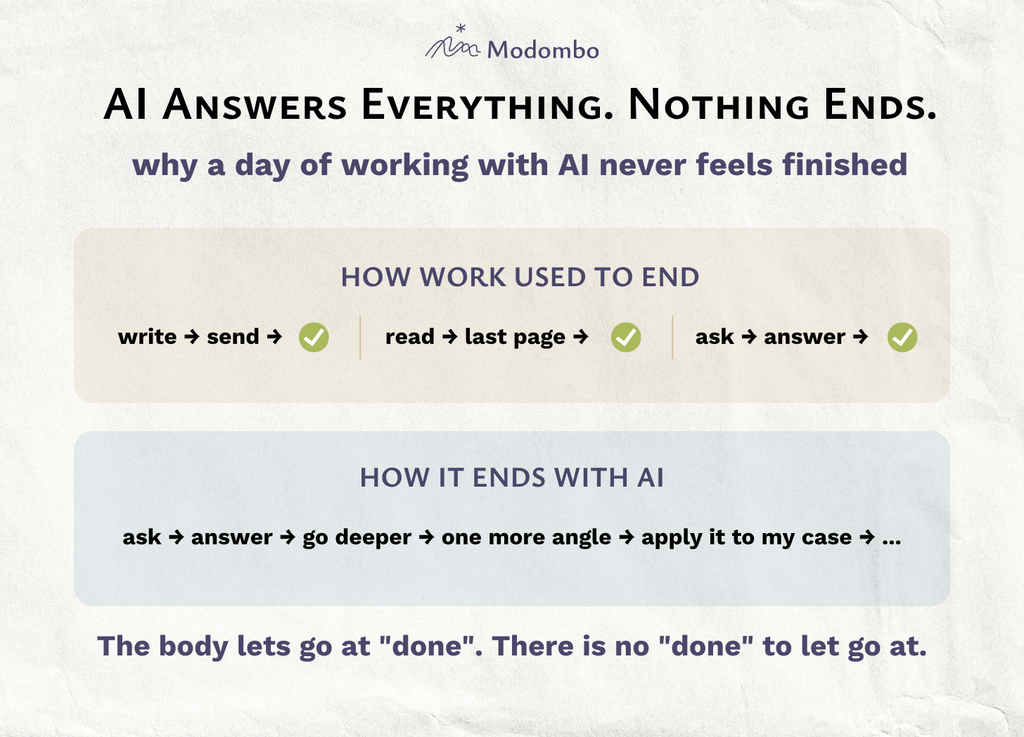
You think “done” is a decision you make. It is something your body does. A book ends, a meeting ends, a sent email ends. At each ending, the activation that carried the work drops. Fullness ends a meal the same way: not because you decided to stop, but because a signal arrived. The stopping points of a working day used to arrive by themselves. Nobody had to make them.
The ending was built out
The problem is not how much the AI gives you. The problem is that it never stops. Every answer arrives with a next step. Go deeper. Add one more angle. Apply it to my case. This is not malice and not a flaw. The product is built to continue, and it never says “that’s all I have.” Books end. Articles end. Teachers pause. AI doesn’t. A book has a last page. This has none.
This is not information overload with a new name. The volume is not the mechanism. The missing ending is. A slow day with three open threads does this too.
The eighteen minutes were not wasted
The twenty-minute email did not only cost you time. It gave you an ending. Twenty careful minutes became two: you tell the AI in a few words what you want to say, and it writes the email for you. The first letter of this series counted that as a saving, and the saving is real. Here is what left with the eighteen minutes. They were not rest. They were slow, and slow work carried three things the fast version skips. The thought moved at the body’s speed. Writing the email was how you found out what you really thought. And at the end you typed the last line, read it once, and pressed send. The body knew it was finished before you did. The dictated version comes back complete. You send it, and the next task is already open. Nothing ended, and nothing had time to: the eighteen minutes are gone, and the next thing arrived in their place. What that does to a whole day is the next letter. Nothing was wrong with the email.
Clear in the head, still switched on
Knowing more does not calm you down. She asked the AI one thing at four o’clock. Each answer closed with three doors. By seven she knew more about the problem than anyone in the building, and nothing had been decided. Her body was still holding the four o’clock question open.
Ten at night, he asks the question about his own life, and the answer is patient and good. At some point a person would have said “that is all I have”, or looked at the clock. That ending would have done something for him. This conversation is still open at midnight. So is he.
The state has no common name yet. Clear in the head, restless in the body. Informed, and not satisfied. Not stress, not excitement. Just never done. Some nervous systems feel this first and hardest; they get their own letter later in the series.
“I can’t tell when I’m done anymore.”

This week, just watch
Nobody will end the session for you. Not the product, and not a timer. An earlier letter used a timer as a test, and a test is what it is: a timer interrupts, it does not end. Endings are now something you make. Before you make anything, watch. This week, notice how each of your threads ends. With a decision. With exhaustion. Or with the next tab.
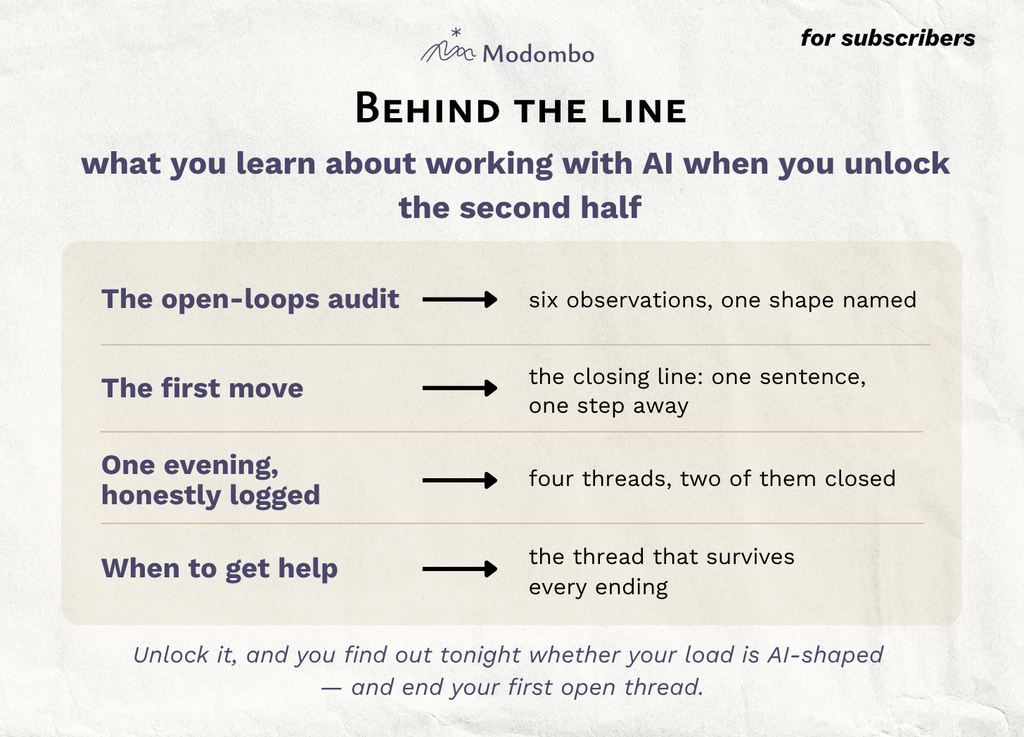
Below the line: the Open-Loops Audit. Six observations about last week’s threads, the first move that ends one, and the line where closing on your own stops being enough.
What is coming in the next episodes?
Next Thursday: why your most productive day leaves you the most tired. And, below the line, where in your day the debt is made.
Related episodes
- NL53 A0 – Overload in the AI Age — where the load went; the email as the column that shrank
- NL30 – AI vs Human Therapist – Endings and Containment — the conversation that never closes; the timer as a test
- NL47 R6 – The Texture Of Restoration — closure belongs to the day, completion to the project
- NL16 – Tips 3 – Transitional Rituals and Rhythm Design — the short act that ends one mode
- NL20 – How AI Rewrites Our Stress and Anxiety — “nothing ever really feels finished”, first said in passing
- NL40 B9 – Silent Overload Burnout — always something unfinished, before AI