
This post is an excerpt from my newsletter.
For full editions, extended reflections, and member-only tools, please visit the original publication on Substack.

For most of us, life is an endless cycle of stress and relief from it.
At first, it’s a challenge. Sometimes even a thrill.
But after a few years, something starts to fade.
You manage, but something feels different…
It begins subtly:
You function. You do your work. You handle things at home. You cope with everyday pressure. But somewhere, something’s off. Sometimes more, sometimes less. It’s a bit like driving with the handbrake on.
Or as if your body, mind, and relationships can’t keep up with the pace you’re setting. Even when you take time off, your energy doesn’t fully return. Or your interactions with close people feel distant, difficult, or just off. You rest, but rarely feel truly great afterward.
Chronic overload has two faces
People who come to therapy or coaching with this issue often fit into two patterns. Two faces of the same problem:
-
You keep up the pace despite resistance:
You have goals, vision, responsibility. You don’t want to slow down. But everything around you starts to protest:

Your body, moods, emotions — as if fate is throwing obstacles in your path through them. But you keep going. Because you’re used to managing. Because there’s no other option. Because people know you can handle it.

It’s like a pressure cooker without a valve — calm on the outside, but with pressure building inside.
2. You’re losing capacity:
You used to handle stress with energy. Maybe it even motivated you. Today, it’s different:

You’re present — but as if behind thick glass. This isn’t laziness. Not spoiled behavior. Not a “bad mindset.”
This is chronic overload — a condition where the body and mind carry more than they can recover from over a long time. Without drama, without collapse, but with erosion that eventually becomes impossible to ignore.
Work that once brought you joy now feels distant. Relationships that once fulfilled you now feel empty. Or they’re simply difficult.
What to compare it to?
For a clearer picture, imagine:
- Keeping up the pace despite resistance

- Losing capacity
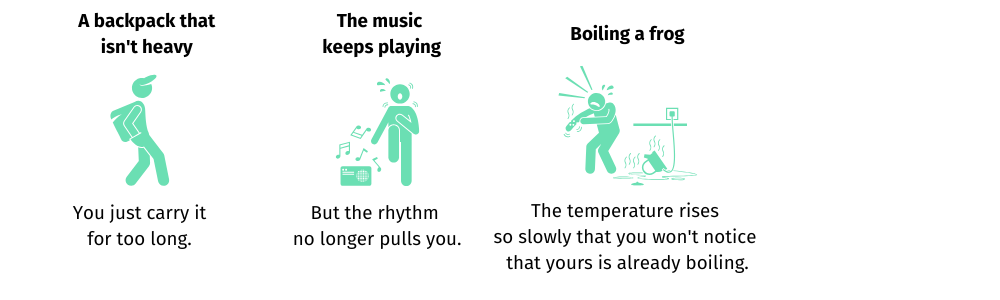
What it isn’t — and why you have it?
Chronic overload is a peculiar condition. It’s not an illness. But it’s unsustainable. And it’s often mistaken for something else:
- It’s not aging, even if you’re 30, 40, or 50+
- It’s not depression, even if joy and motivation are missing
- It’s not burnout, even if work feels meaningless
- It’s not ingratitude, even if everything frustrates you
It’s somewhere in between. A nameless state. You function. But inside, joy, rhythm, and desire quietly fade away. Or your connection with the world around you.
Not even the “good tools” work anymore?
Meditation. Breathing exercises. Yoga. Bouldering. Cold water. Marathon.
Maybe you’re thinking: “Yeah, yeah, I tried. Didn’t work. Next.”
Or: “Maybe what I really need is a quiet room and a bowl of semolina porridge.”
I’m joking, of course — there are countless techniques these days. You’ve probably tried them. Maybe they worked for a while. But after some time, they stopped.
The kind of advice like: “You’re not lazy, you just need a morning routine with cocoa, Wim Hof, and a split.”
“Sure, let me cut into my little sleep for half an hour so I can shake with cold and be unable to walk again.”
This is not your failure. It’s a sign that these tools aren’t made for what you’re going through now. They may be great. For a different phase, a different kind of overload, different depth of fatigue.
These tools are for managing stress, not chronic overload. When the system is out of rhythm long-term, these techniques often don’t restore what’s missing.
It’s like taking in vitamins when you’re seriously sleep-deprived.
Like eating bread when you’re thirsty.
Like trying to charge a phone with a broken battery.
It looks like charging, but the capacity doesn’t come back.
It’s not about another tool. It’s about restoring the rhythm.
Overload isn’t about purpose or time management. It’s about losing natural rhythm between:
- performance and rest
- focus and distraction
- giving and receiving
- responsibility and carefreeness
- others and yourself
When that rhythm disappears, the body starts conserving energy. The soul withdraws. Rest stops working because there’s nowhere to return to. It’s like a dancer still moving — but the music has stopped playing. Life continues, but only through habits. And it grinds you down.
What to do: How to regain your own capacity?
What I call the return of capacity involves guiding my clients and readers through several phases. It’s not a one-time instruction or a universal solution. It’s a framework that helps you rediscover rhythm, orientation, and breath – in work, relationships, and your own body.
First step?
- Stop the internal chase for performance.
- Look at where and how you’re losing capacity.
- Don’t fix it too quickly. Don’t speed up.
- Just make visible what costs you the most energy.
Next steps?
- Mapping your own overload.
- Returning to inner orientation.
- Restoring connection with your body and daily rhythm
For starters, just remember this:
You are not lazy. You are not weak. You’re just keeping a pace that can’t continue. And maybe it’s time to stop trying to improve – and start listening to yourself again.
We will also talk about how overload often doesn’t arise solely from work or external circumstances. It has deeper roots – patterns from childhood we inherit from childhood, such as: for example, excessive loyalty, pressure to perform passed down from parents or our environment, or the need to handle everything on our own…
And also about how overload is often the result of a combination of:
-
Deeply rooted patterns,
-
Life circumstances,
-
Psychological specifics – such as PTSD, ADHD, high sensitivity, or other traits that make us more vulnerable to stress.
What's next?
This article is the first part of a series of texts, podcasts, and videos about overload.
If you recognize yourself in it, stay with us. In the upcoming texts and podcasts, I will show you:
What the map of overload looks like – types, dynamics, symptoms.
Common mistakes we make when trying to manage overload on our own.
What returning to rhythm means – without rigid routines, but with purpose.
What to do when usual tools stop working.
How to regain your inner capacity – without having to “improve” yourself.
It’s not about performance. It’s about returning to a living system that knows what it needs – once we finally stop drowning it out.
Magnets
Want to receive new episodes automatically? Subscribe to our newsletter.
This is where the free version ends.
To read the full extended edition — including tools, deeper notes, and case studies — continue on Substack.
→ Continue reading on Substack
A final note
Reading about topics like stress, overload, or exhaustion can itself bring relief and progress. This is sometimes called bibliotherapy — a form of self-care where we help ourselves by recognizing our experiences in words, gaining self-understanding, and finding our own path.
However, even though this can be very helpful, it’s important to realize:
Beyond a certain level of difficulty, it’s not good to face these challenges alone.
If you have long-term or strong suspicions that your condition is not okay, or if you’ve been struggling with overload for a prolonged period, it is entirely appropriate to seek help from a therapist, psychologist, or doctor.
This article focuses on overload, but we know it is not the same as depression, anxiety, burnout, or a midlife crisis. That doesn’t mean these issues don’t affect you. On the contrary, in some cases, it’s important to explore these diagnoses and possibly address them with a professional.
If you have traits like:
-
ADHD,
-
High sensitivity (HSP),
-
PTSD,
-
Depression, anxiety, sleep disorders, or other conditions,
then overload can be much more challenging than for others. In such moments, it is vital not to go through it alone. Remember, no path to healing or restoring capacity is easy, but you don’t have to walk it alone. Professional help can be an important step toward rediscovering yourself and finding balance in your life.
For regular updates and the complete extended versions, join the Substack newsletter.
It’s free to sign up, and you can upgrade anytime.
→ Subscribe on Substack