Same advice, opposite effect
Take two people. Both exhausted, both handed advice, both failed by it.
The first has spent three years caring for her mother through dementia. A well-meaning friend tells her to set some boundaries, as if the dementia would honour them. She does not need a boundary. She needs a break, some support, and someone to say out loud that this is not a discipline problem.
The second is three years into a job he has quietly started to hate. His manager, trying to help, tells him to work on his work-life balance. So he does. He guards his evenings, takes up a hobby, protects his weekends, and arranges his whole life more neatly around the one thing that is poisoning it. Balance was exactly the wrong tool. He did not need the job spaced out more evenly. He needed to leave it.
Same tiredness, opposite fix. The advice that would have freed one of them would have done real harm to the other.
This is the part of recovery almost nobody gets right, professionals included. We reach for one tool, usually boundaries or slowing down, and hand it to everyone. It is the same mistake as giving everyone in the waiting room the same pill because they all walked in saying the word tired. People do not arrive empty for the same reason, and the move that helps depends entirely on which reason is yours.
The move that frees one person does real harm to another.
Three ways to end up empty
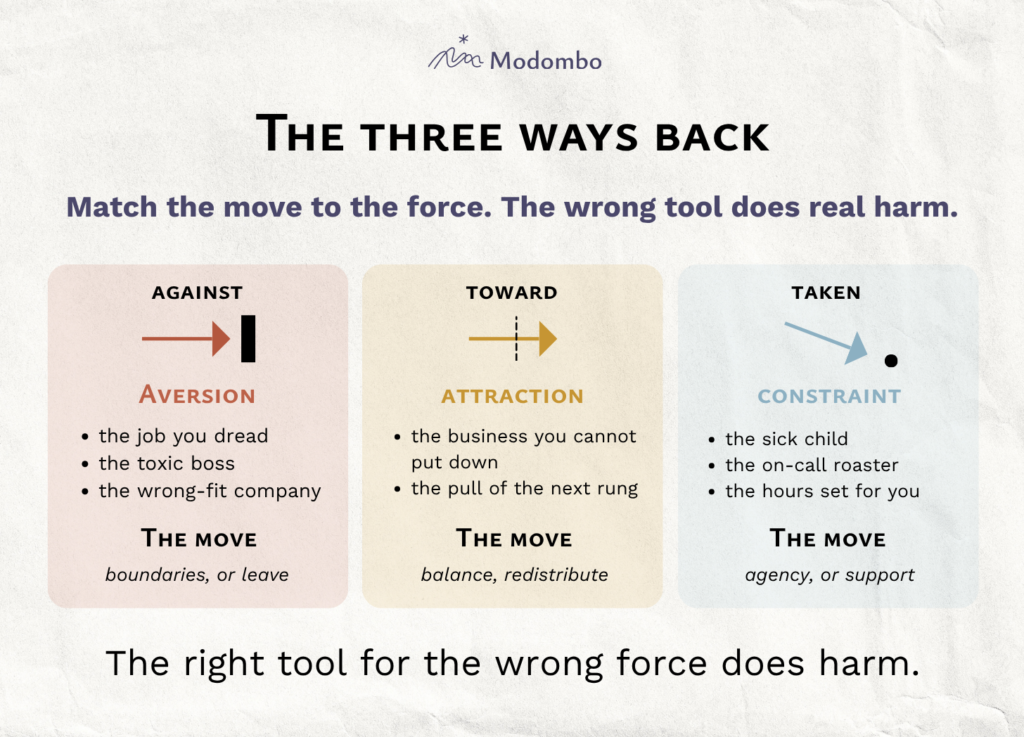
There are three, and they are easier to feel than to define.
The first is that you are spending yourself against something. A job you have quietly come to dread, a role you push through every day with your jaw set. The cost is not the hours. It is the friction of doing what part of you does not want to be doing. It wears many faces, and none of them look like laziness. Picture a lawyer who thinks slowly and carefully, in a firm that wants every answer in ten minutes and emails her at midnight to get one. She is good at the work. She simply never gets to do it the way her mind actually works. Or a designer who spends his days making beautiful advertisements for a company he finds hollow, shipping polished, clever work that sells something he does not believe in. From the outside the job looks enviable, which is part of why no one sees what it costs him. Or a manager who is warm and easy with clients he privately cannot stand, and drives home each evening a little emptier for the pretending. None of them is short of sleep. Each is spending themselves against the grain, day after day, and no weekend touches that.
The second is that you are spending yourself toward something, too hard. Something that pulls you so strongly it eats everything else without you noticing. You are not miserable. You are pouring so much into one place that the rest of your life is quietly running on empty. Picture a founder whose company grows a little more every month. He can hardly believe it is his. It is the most alive he has ever felt, and he means that almost literally. He forgets to eat. He wakes at four with an idea and cannot get back to sleep. His body has been quietly asking him to stop for months, and he cannot, because nothing in his life has ever glowed like this, and turning away from it feels unthinkable. The painter who forgets meals is the same shape. So is the quieter, harder version that looks identical from outside: the person chasing the next milestone, the next follower count, the next rung, who could not tell you why they cannot stop, only that stopping feels like disappearing. Some of that is love. Some of it is closer to obsession, and the difference changes the fix, so we will come back to it.
The third is that your capacity is being taken, without much say from you. You may not even mind the task. You simply do not control when and how it gets extracted. A mother of a small child, whose day is cut into pieces by someone who cannot yet tell the time. A nurse whose shifts are set by a manager she barely sees, nights one week and early mornings the next, her sleep rearranged for her without being asked. A one-person business whose customers decide when the phone rings, so a holiday is never quite a holiday. A daughter looking after her father, whose needs do not pause because she has a meeting. In each of these the person may not even mind the work itself. What they have lost is any say over when it lands on them.
Most people have more than one of these live at once. But usually one is doing the heavy pulling, and it is the one you have to name, because each one wants a completely different move.
Three different ways back
If you are spending against something, the move is boundaries, and sometimes the courage to leave. Not balance. You cannot balance your way into peace with a thing part of you refuses to keep doing. The work is to draw the line, change the terms, or go. For the lawyer that might be a slower firm. For the designer, a brand he can stand behind. Sometimes it is smaller than leaving, renegotiating the role, changing teams, letting the client go. Sometimes it is not.
It gets much harder when the thing you are spending against is one you cannot seem to leave. Some people are worn thin by a relationship, or a job, that they keep being pulled straight back to, drained by the very thing they will not walk away from. If that is you, the first move is not the boundary. It is seeing clearly that you are allowed one at all. That seeing is usually the slow work of therapy, not the quick work of a weekend, because a boundary you do not believe you deserve will not hold for a week.
If you are spending too hard toward something you love, the move is not boundaries. It is balance. Nobody needs to talk you out of the thing you love, and they should not try. The work is redistribution, giving the starved parts of your life some of the capacity the loved thing has been quietly taking, so it stops bankrupting the rest of you. For the founder, that is dinner at home three nights a week actually kept. For the painter, someone who notices when he has not eaten.
That is the answer when it is love. When it is obsession, balance alone will not hold, because the pull is not really coming from the work. It is coming from the compass, from a self that only feels real when it is producing, or winning, or climbing. You can redistribute the calendar all you like, but if your worth is wired to the next rung, the pull comes straight back the moment you stop. That is the identity work from last time, the performer who cannot let the tank sit full, and when it is load-bearing it belongs in therapy or coaching, not in a Sunday reshuffle of your diary.
If your capacity is being taken without your say, the move is agency, or support where agency is not possible. Reclaim what control there is and redesign the structure where you can. Where you truly cannot, a dependent who needs you on their own schedule, the work shifts to being held and supported rather than pretending you can set a boundary that does not exist.
That last one matters most, because it is the one the usual advice insults. Telling the parent of a sick child to set better boundaries is not help. It is a small cruelty dressed as wisdom.
Why the wrong tool hurts
You can see the trap now. Hand the boundaries tool to the person spending toward something they love, and you have told them to give up the best thing in their life. Hand the balance tool to the person spending against something, and you have helped them get comfortable somewhere they need to escape. Hand either to the person with no say, and you have blamed them for a cage they did not build.
The tool is not good or bad on its own. It is right or wrong for the force. Match them and it frees you. Cross them and it does damage, which is why this is worth getting right before you act.
Seeing which way you are bent
You do not need a test for this. You need the compass from last time, the part that reads your own signals. Sit with the thing that is draining you and feel the direction. Do you dread it? That is against. The teacher whose shoulders drop the hour term ends already knows. Do you love it too much to stop, or cannot stop and cannot say why? That is toward. The founder who feels restless and oddly flat on the one weekend he protects is feeling it. Is it simply not yours to schedule? That is taken. The mother who would trade almost anything for two uninterrupted hours, and cannot find them, does not need to be told which one is hers. The body usually knows the direction long before the mind will admit it.
Getting the direction right is most of the work this letter can do for you. The precise moves, the actual sequence for each force, is where the companion e-book goes, out in the end of September. This letter helps you feel which way you are bent. The book is the set of moves for each direction.
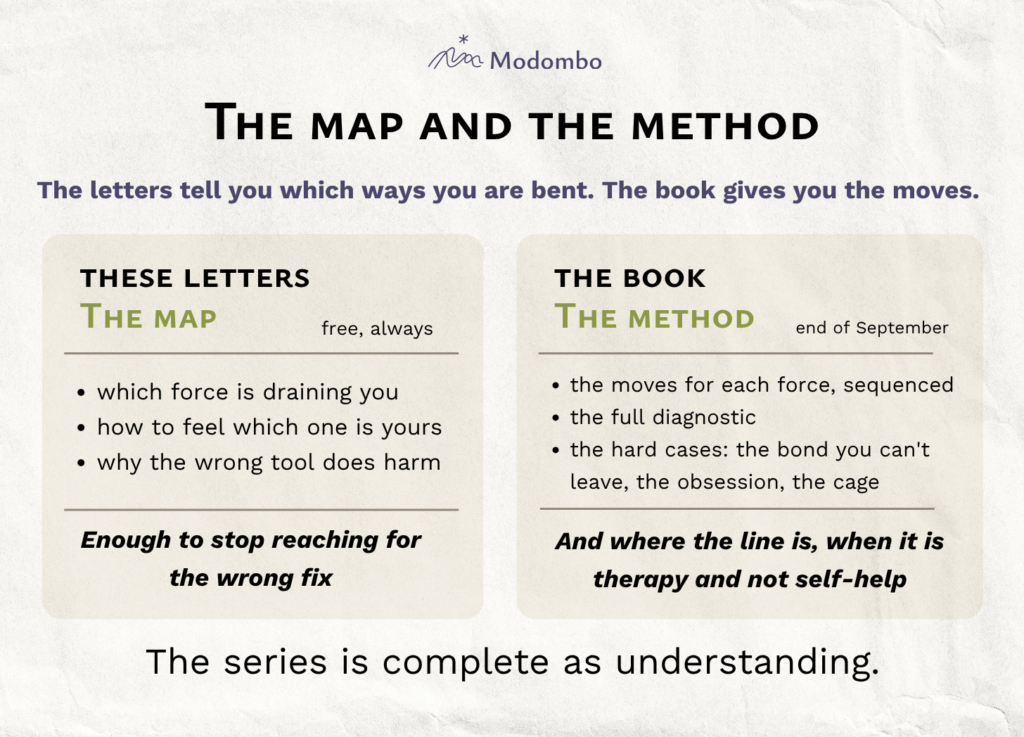
The letters are free and they stay free, and they are enough to feel which force is yours and to stop reaching for the wrong tool. The book is for the people who want the actual moves for their direction, sequenced, with the harder cases handled properly: the relationship you cannot leave, the obsession you cannot name, the cage you cannot yet change. It lands in the end of September.
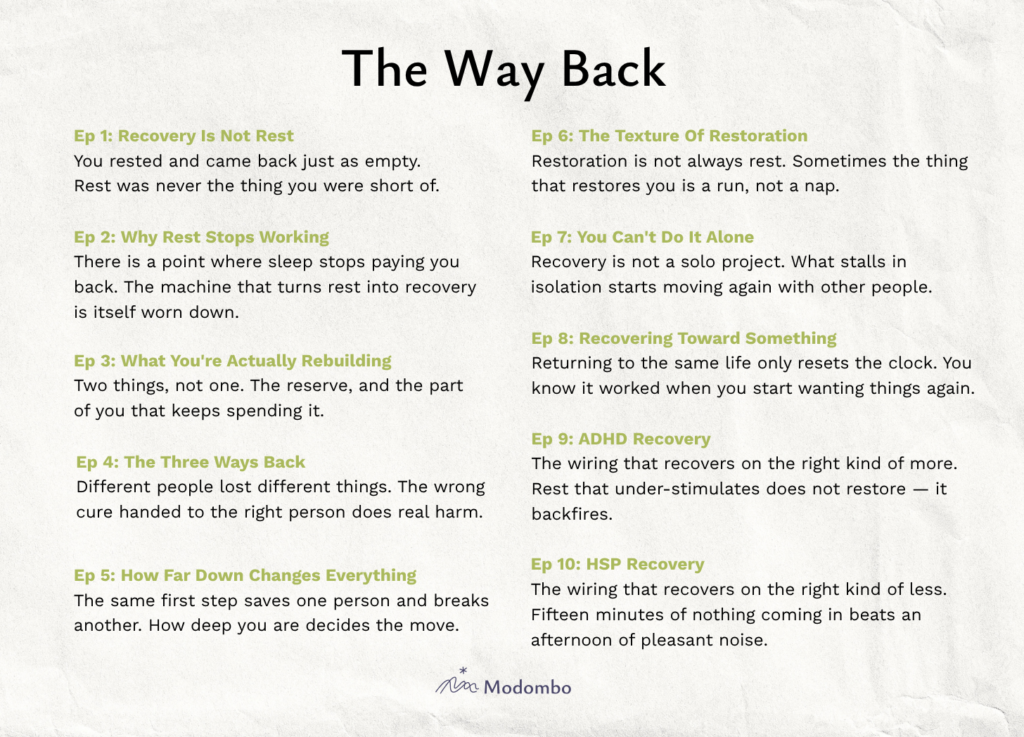
What is coming in the next episodes?
Next time: how far down changes everything. Naming your force tells you which direction to move. It does not tell you how much you can take on right now. The same correct move can heal one person and flatten another depending on how depleted they already are, and getting that order wrong is its own kind of setback.
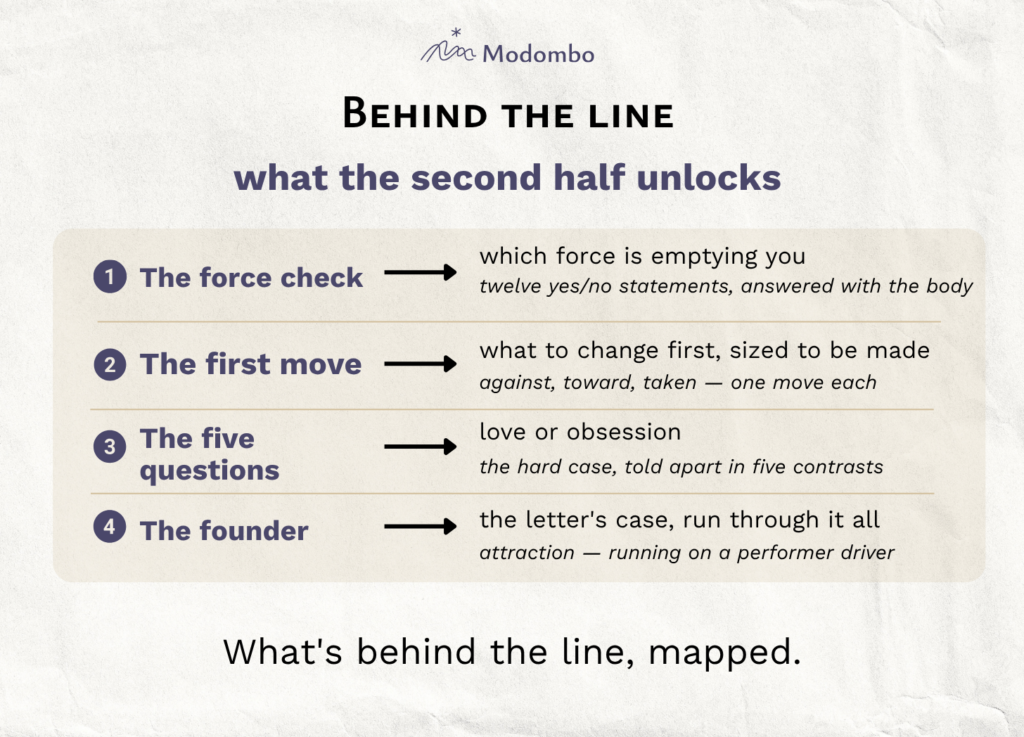
The rest of this letter is for subscribers, and it is the practical half: a self-check that locates which force is emptying you, the first move for each of the three, the five questions that separate love from obsession, and the founder from this letter walked through all of it.
Related episodes
- NL03 – Slow Down Is Wrong Medicine — the original wrong-tool argument. R4 generalises it: slowing down is one tool among three, and it is only right for one of the forces.
- NL17 – Tips 4 – Boundaries for Overloaded People — the boundaries tool up close, which is the aversion move here, and specifically not the move for attraction or constraint.
- NL14 – Why Most Advice for Chronic Overload Stopped Making Sense in 2025 — rhythm works where balance fails; the diagnostic-not-prescriptive stance that this episode runs on.
- NL35 B4 – Caregiver Burnout — the lived case behind the constraint force, and why “set a boundary” is the cruel answer there.