In therapy, the skill is not only what to say. It is also when to say it.
A powerful question can help someone see their situation clearly. But the same question, asked at the wrong moment, can create confusion, defensiveness, or emotional overload.
Understanding this difference requires something subtle. It requires a sensitivity that therapists, coaches — or even wise friends — often develop naturally: A sense of timing in the conversation.
AI chatbots, however, currently cannot sense this timing.
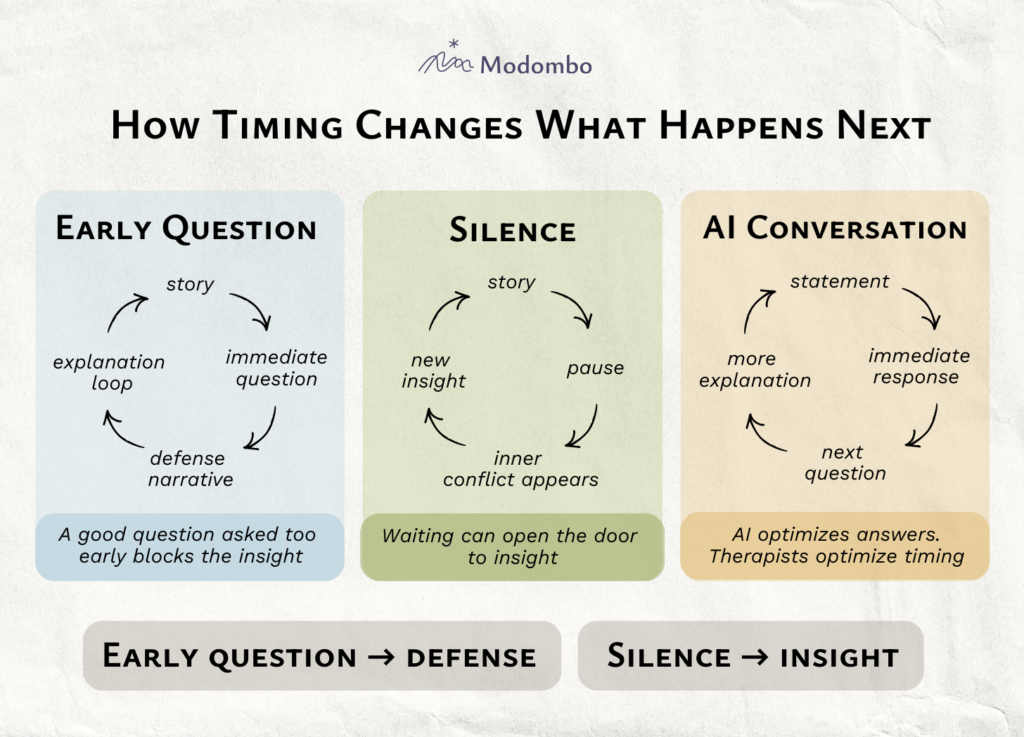
When a good question comes too early
Imagine a client describing tension in their relationship. They talk about frustration, exhaustion, and doubts about the future. At that moment, a therapist could ask a very logical question:
“Why do you stay in this relationship?”
It is a reasonable question. And sooner or later, it may be an important one. But if it appears too early, several things can happen:
- the client may feel pushed before they understand their own feelings
- the question can trigger defensiveness instead of reflection
- the conversation can shift into explanation instead of exploration
The problem is not the question itself. The problem is timing.
The role of silence
Experienced therapists often do something that can feel unusual in everyday conversation.
They wait.
And they don’t hesitate to keep the silence much longer than would feel comfortable in ordinary dialogue.
Silence has different meanings.
1. Awkward silence
Nothing is happening. Both people are simply unsure what to say next.
2. Processing silence
Something is happening internally. This is typical for a good therapy or coaching. The client is deeply inside their own experience — observing feelings and thoughts, and searching for words that cannot come immediately because they describe something new.
What changes in that silent moment is not only the conversation, but the state of the nervous system. When the space is not filled too quickly, the person has a chance to feel the internal conflict instead of defending against it. A calm presence and enough silence can let the nervous system settle just enough for the experience to be tolerated. In therapy this is often called containment: the emotional space becomes stable enough for something difficult to be noticed without overwhelming the person.
This second type of silence is often extremely valuable. During these moments, new insights can appear naturally. For example, after a pause a client might suddenly say:
“Actually… I think what hurts most is that I still care about them.”
This sentence often appears because the space was not filled too quickly. If another question came immediately, the client might simply continue the protective narrative: “I’m over it. I don’t care anymore.”
Silence makes room for the deeper conflict to emerge — the feeling that contradicts the story the person is trying to believe. This inner conflict is often exactly what keeps rumination and mental loops alive — and recognizing it clearly is the moment when the loop can finally begin to loosen.
Timing is relational, not logical
This is one of the subtle skills in therapy.
A therapist senses:
- when a question may open reflection
- when it would increase pressure and overwhelm the client
- when silence will allow something deeper to appear
AI systems can generate excellent questions.
But sensing whether a person is ready for that question — or whether they need silence instead — is something different. It depends on timing, rhythm, and presence. Sometimes the most helpful intervention in a conversation is simply this: waiting long enough for the person to find their own next step.
What this means for using AI
This series is not an argument against using AI for psychological questions. AI can be extremely useful.
It can:
- educate about psychological patterns
- offer new perspectives on situations
- help structure thoughts and reflections
- even help prepare for a conversation with a human expert and then evaluate it
But language-based systems work primarily with words and explanations.
If you notice yourself returning again and again to the same topic — explaining it, analyzing it, thinking about it, but still feeling stuck — this may be a signal that the issue cannot be resolved only through better explanations.
Sometimes what is needed is something different: a conversation where timing, silence, and human presence allow something new to emerge.
That is the difference explored in this series.
What is coming in the next epizodes?
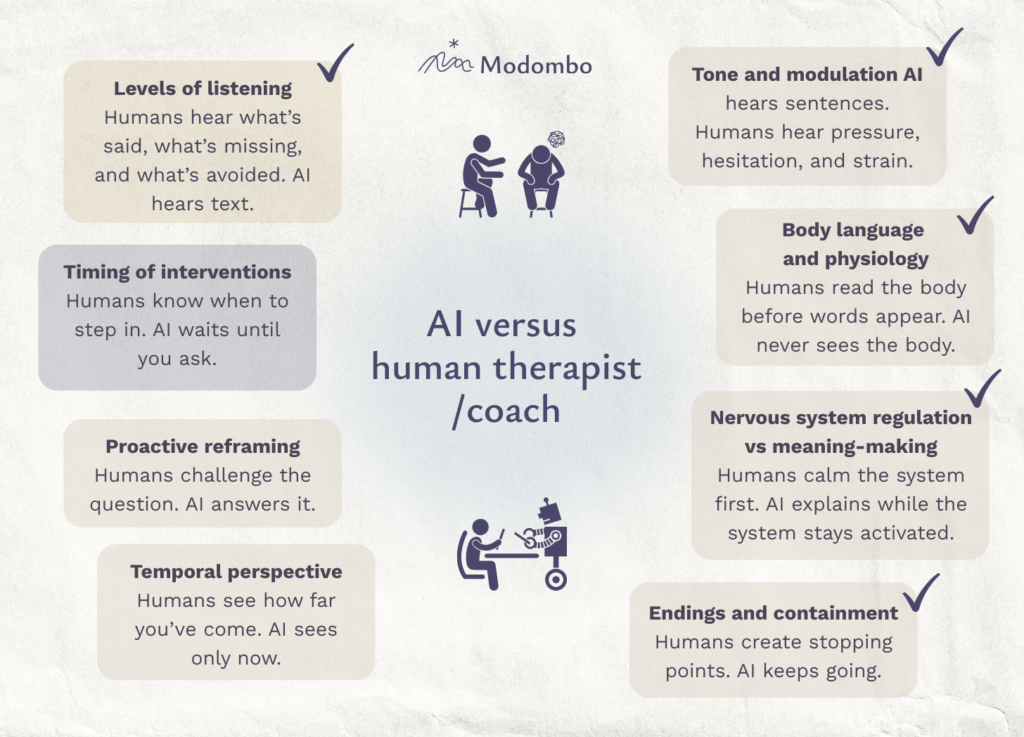
We’ll go step by step through several differences between AI as therapist and human care:
- Tone and modulation
- Body language and physiology
- Nervous system regulation vs meaning-making
- Levels of listening
- Timing of interventions ← today
- Proactive reframing
- Temporal perspective
- Endings and containment