This is an archive version. For all new articles, extended editions, and full resources, visit my newsletter on Substack.
—
Motto of the Week
Rhythm restores you. Routine can exhaust you.
—
When Rhythm Hardens into Draining Routine
It happens quietly. A morning walk that once grounded you becomes a task to tick off. Exercise turns from joy into obligation. The mind shifts from “I want” to “I must,” and the soul begins to resist.
—
Two Examples from Practice
David, a finance advisor, used to run his days with near-military precision — waking at 4:30 a.m., exercising, planning, deep work, then straight into meetings and output. On good days — after solid sleep, with engaging projects — that structure worked perfectly. But on other days, especially by mid-afternoon, his focus collapsed. Instead of forcing himself through it, he learned to respond to what his body and mind actually needed: a short walk in the park. Sometimes five minutes were enough to restore clarity; other times, twenty minutes brought calm and perspective.
Anna, a yoga-studio owner, built her mornings around demanding physical practice. When her energy was high, it gave her focus and strength. But on slower days she felt drained before the first class even began. She learned to listen instead of push — replacing intensity with gentler movement or breathwork. The result wasn’t loss of discipline, but a return of vitality and calm; her practice began serving her again, not the other way around.
Sometimes rhythm means ten minutes instead of twenty, or extra sleep instead of another task, or not picking up a call when calm is needed, or simply leaning back and breathing for two minutes. It’s not neglect — it’s intelligent care.
—
Routine or Rhythm?
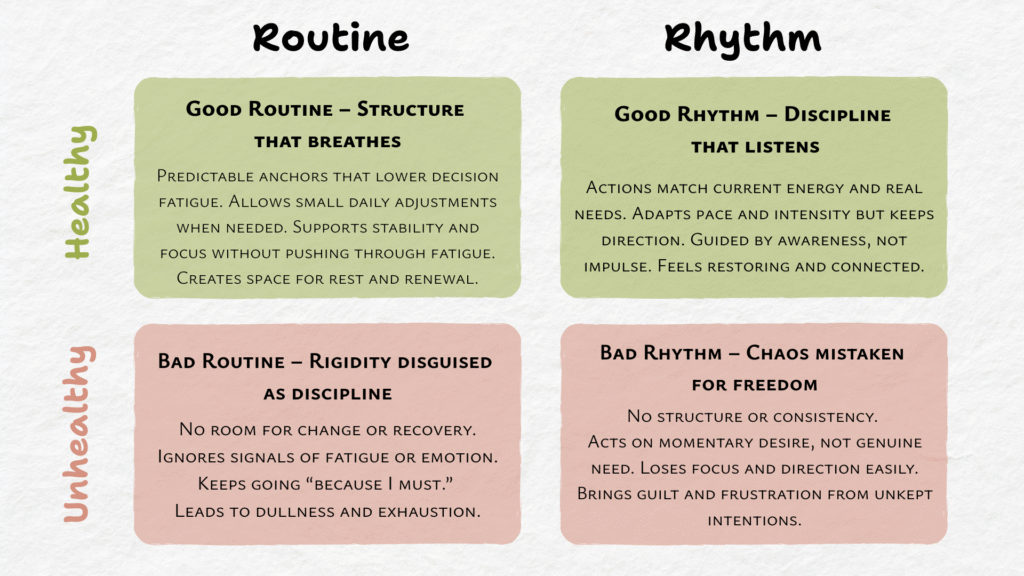
The problem isn’t routine itself — it’s rigidity. A good routine is the framework; rhythm is the movement within it.
Without routine, life scatters; without rhythm, it stiffens.
The art is knowing which parts need structure and which must stay alive. 1 Low-sensitivity tasks — emails, planning, logistics — thrive on steady routine. They don’t need deep emotional feedback. 2 Energy- or meaning-sensitive areas— creative work, relationships, self-care — depend on rhythm.
Here, rhythm means permission to adjust pace, to explore, to listen before acting — not pushing for results when they’re not ready to come.
—
Personal Note
Rhythm is harder. It asks you to notice, evaluate, and adapt — without losing your grip. Many people, when they relax their routine, swing to the other extreme and drop discipline altogether.
Rhythm is freedom with structure, not freedom from it.
Routine spares you from constant decision-making — it offers relief through predictability. Yet when predictability overtakes awareness, it slowly drains your energy.
The art lies between: discipline that listens. The hardest translation is from “what I want” to “what I need.” Routine lowers decision fatigue — it matters. But living in rhythm means bending the rule when life changes, without losing your compass.
—
Closing Thought
A good life isn’t built on strict routine; it’s built on rhythm that evolves with you. When you fall out of it, don’t blame your discipline. Rebuild your listening.