This is an archive version. For all new articles, extended editions, and full resources, visit my newsletter on Substack.
—
If you never feel stress, fatigue, or doubt — you’re probably not alive.
—
What it’s about
- Short-term stress is a healthy reaction that helps you adapt.
- When it becomes your default mode, the same mechanism starts to break you down.
- The goal is not to eliminate these states, but to stop turning a temporary reaction into a lifestyle you quietly accept as normal.
—
What’s happening
Stress, fatigue, and doubt are unavoidable. The real question is how you respond.
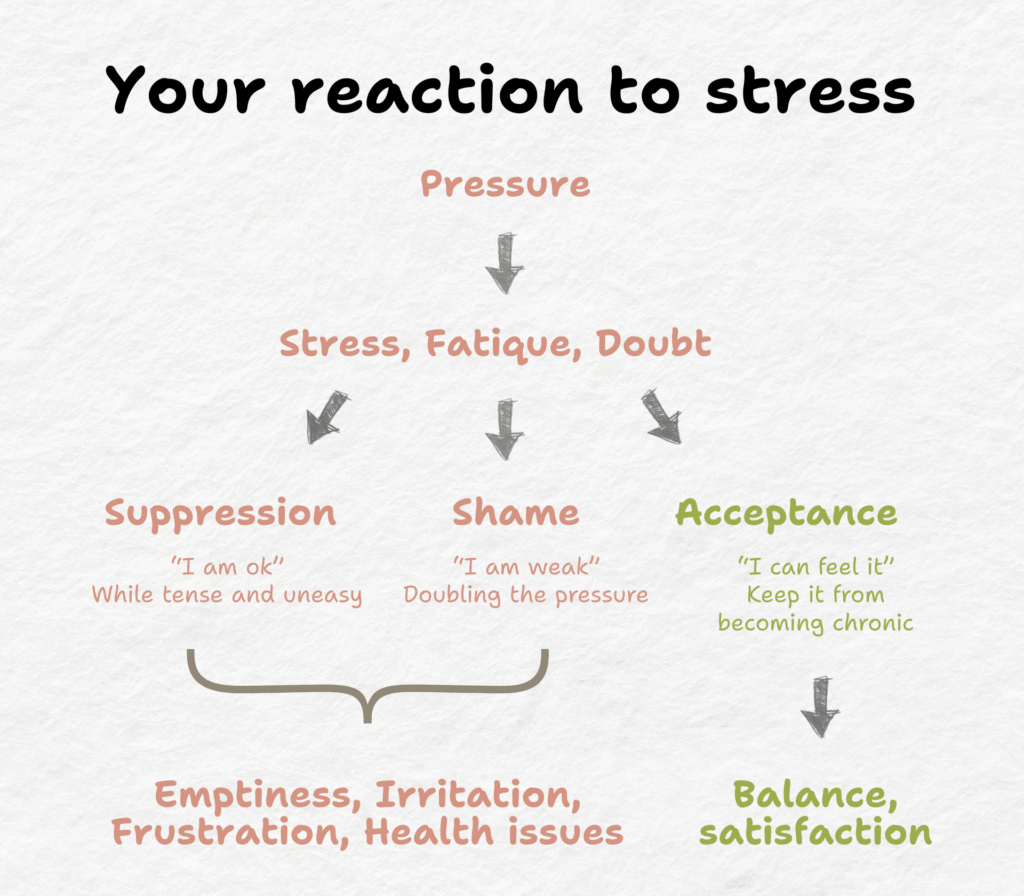
- Some feel them and instantly add shame: “I shouldn’t feel this way.”
- Others suppress them completely: “I’m fine, nothing’s wrong.”
- A few notice them — neither proud nor ashamed — simply aware.
Only the third path works long-term. Shame doubles the load. Suppression blocks action. Acceptance allows adjustment.
—
The result
Without awareness — or with shame attached — stress doesn’t resolve. It lingers, piles up, and turns into chronic overload. The body keeps paying the price: elevated tension, shallow rest, emotional flatness. But when you can register stress without judgment, it stays what it was meant to be — temporary, informative, and manageable. You can take action before it turns into allostatic load — the invisible wear and tear that transforms effort into exhaustion.
I remember that well from my startup and management years. I was either lying to myself — pretending I was fine while losing sleep and snapping over small things — or I admitted I was stressed and immediately felt weak. Only when I learned to accept these feelings as normal, and focused on preventing them from becoming chronic, did I start to function in a calmer, happier way.
—
What now?
Healthy self-management doesn’t start with optimization tricks. It starts with:
- Honesty: “Yes, I’m stressed.” That sentence alone changes physiology.
- Acceptance: “It’s normal in my situation.” This lowers inner resistance, frees attention, and makes recovery possible.
Stress and fatigue are not enemies — they’re messages. They signal that your system is mobilizing extra energy to meet higher demands and will soon need recovery to restore balance. When you process this cycle consciously — activate, respond, then recover — stress remains useful. When you ignore or judge it, activation never turns into restoration, and that’s when overload begins.
—
Tip #4
Normalize what is normal.
Short bursts of tension, tiredness, uncertainty — they’re signals of a living system that adapts. Take measures when it becomes chronic: when you feel persistently empty, numb, or irritated, or trapped in toxic routines. That’s not “just how life is.” And it’s not strength to endure it. That’s overload — the path toward burnout, depression, and other problems if left unchecked.
—
About me
I started out as a startup entrepreneur. After successfully selling my company, I became a corporate director. In the end, I left that career and turned my long-time passion into a profession: I became a full-time therapist and coach. I help high performers overcome overload and rediscover satisfaction in their lives.
—