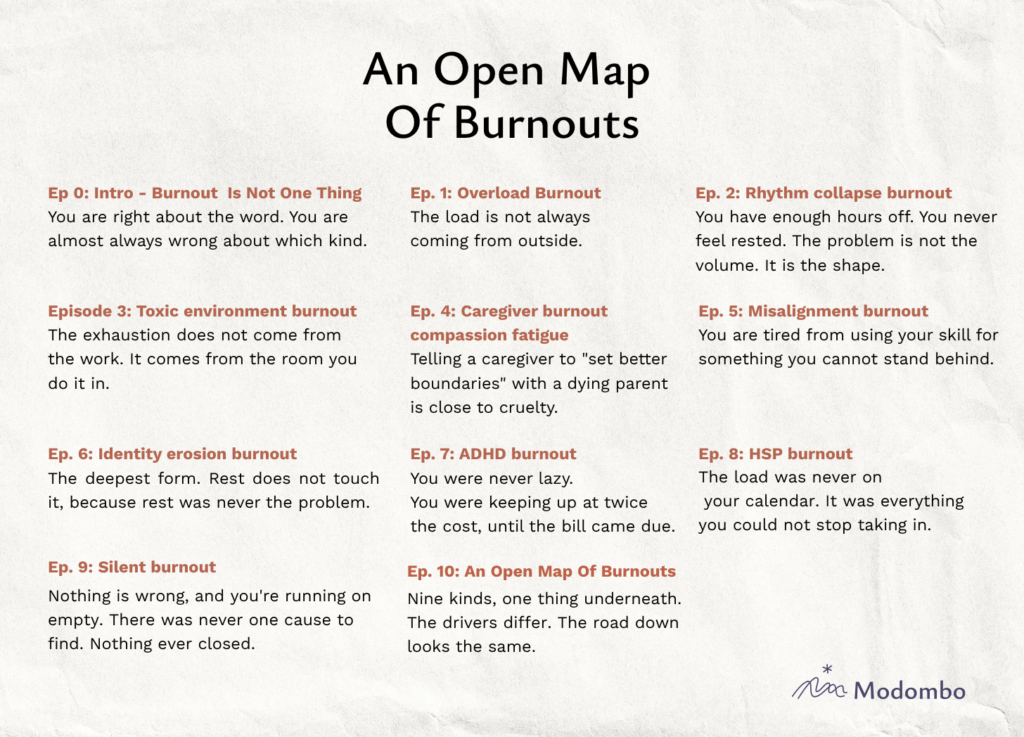
Rhythm Collapse Burnout
The closest relative
This one gets mistaken for overload more than any other type. The person is tired, the tiredness does not go away, and the obvious conclusion is: too much work.
But when you look closer, the total load is often not extreme. The hours are manageable. There may even be weekends, evenings, vacations. On paper, enough rest.
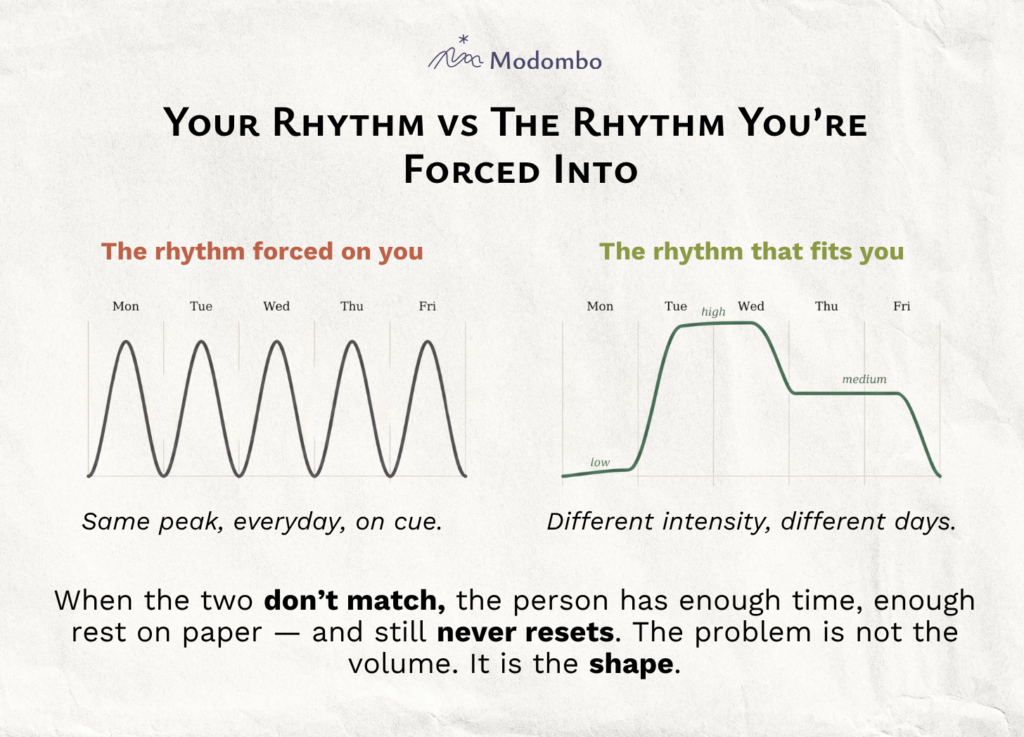
The problem is not the volume. It is the shape.
How it sounds in the room
“I have time off, I just never feel rested.” “My days are full of meetings and context-switching. By 3 PM I’m done, but the afternoon is just starting.” “I work best in bursts, but my job wants steady output five days a week.”
The person often struggles to explain what is wrong. They know they are exhausted but they cannot point to a specific overload. They feel guilty about it. Other people seem to handle the same schedule without breaking down.
What is actually happening
Every person has a natural rhythm. Some need a slowdown after lunch. Some function best in intense waves — three deep days, then one day off. Some need long uninterrupted blocks for focused work. Some need solitude after social exposure.
When the environment forces a rhythm that does not fit (meetings scattered across every day, constant availability on phone and messengers, no protected time for deep work, a steady daily cadence when you function in waves), the total amount of rest may be adequate, but it is in the wrong shape. The body gets rest. It just never gets the right rest at the right time.
The restoration cycle runs, but it never completes. The person recovers enough to keep going, never enough to actually reset.
Family life does the same, and people often miss it. Small children need near-constant, regular attention. That kind of demand rarely matches anyone’s natural rhythm. For neurodivergent parents, or for anyone who functions in bursts, the always-on cadence at home can deplete them faster than any job ever did. Many people describe hitting the deeper stages of burnout at home long before they ever reached them at work. Not because the load is heavier. Because there is no room left inside it for their own shape.
You can have enough hours off and still never recover, because the recovery was always in the wrong place.
Why “rest more” misses the target
This is the real difference from overload burnout. In overload, the volume is too high. Reduce it and the system recovers. In rhythm collapse, the volume may be fine. Reducing it helps at the margins, but the underlying shape problem stays.
A person with rhythm collapse who takes a week off often feels better. And then returns to the same daily structure and is depleted again within days. The vacation did not fail. The return to the wrong rhythm undid it.
A good holiday often produces five days of recovery and a Sunday evening so heavy it undoes three of them.
What actually helps
The fix is structural, not volumetric. It is about redesigning how the day and week are organized:
- Protected blocks for deep work, free of interruptions
- Pushback on meetings that could be messages
- Pushback on constant availability on phone or messengers
- Permission to work in a rhythm that looks irregular to others but is natural for you: bursts and recovery, not steady output
- A slowdown after lunch if that is what your body needs, instead of scheduling the hardest meeting at 1 PM
- Boundaries that protect the shape of the day, not just the number of hours
For some people, especially those with ADHD or high sensitivity, this is not a preference. It is a baseline requirement. The rhythm that fits a neurotypical colleague is the rhythm that depletes them. Recognizing this is often the first real step toward recovery.
Where this is, and where it isn’t
A few questions:
- Do I have enough time off on paper, but still never feel rested?
- Would rearranging my day help more than reducing my workload?
- Do I function in bursts or waves, but my job demands steady output?
- Is there a time of day when I reliably crash — and is my schedule ignoring it?
- When I had a week or two off, did I feel better quickly — and then lose it within days of returning?
If the shape of the day is the problem, not the total load, you are likely in rhythm collapse. The intervention is not less work. It is a different structure.
What is coming in the next episodes?
Next — NL B3: Toxic environment burnout. When the exhaustion comes not from the workload but from the atmosphere. Why hypervigilance drains your capacity before the work itself even starts, and why individual recovery strategies help you cope but never solve the source.