She did the recovery properly, and it worked. A client of mine: years of chronic stress and overload that had finally tipped into severe burnout — and then a recovery done right. The overdue leave, sleep first, then the walks, then — carefully — the parts of the work she could stand. The energy came back the way this series said it would: slowly, invisibly, then suddenly obvious. Eighteen months later she is tired in the same specific way, in the same chair, and she has drawn the only conclusion the evidence seems to allow: recovery doesn’t last.
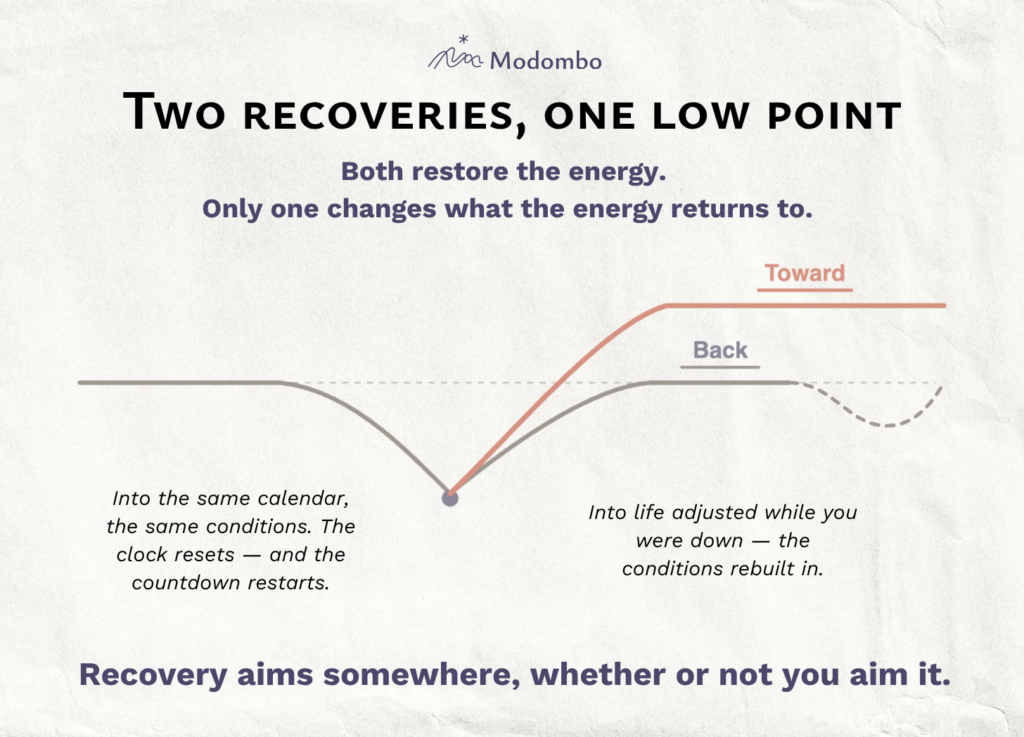
Nothing failed. The recovery worked exactly as designed. It was just aimed backwards — into the same calendar, the same role, the same conditions that produced the overload the first time. The same life produces the same overload. That is not a character flaw and not bad luck; it is what structures do.
The last letter ended on the question this one exists to answer: what are you recovering toward? Because recovery has a direction whether or not you choose one. And the default direction is back.
A recovery that ends in the same life is a longer runway to the same crash.
The default direction
Nobody chooses to recover backwards. It is simply where the road already points. The job held open, the calendar politely waiting, the role everyone assumes you will resume — the whole environment is built to restore you to factory settings. The lay model of recovery agrees: get back to normal, it says, as if normal were not the thing that produced this. So capacity gets rebuilt with real discipline and then handed straight back to the structure that spent it the first time, and the structure spends it the same way, because that is what it is for.
This is the trap the second letter pointed at from a distance — the difference between feeling better for a month and actually getting out. Feeling better is a state; getting out is a change of structure. The whole reason recovery comes in phases is so that you do not bolt new energy onto an unexamined life. Do it anyway and everything works, briefly: the eighteen-month case from the opening is not a story about weak recovery. It is a story about perfect recovery with the default aim.
How you know it worked
The energy coming back is not the finish line. An earlier letter called it the Monday reboot: you come back from a genuinely restful weekend with a full tank, hand it to an unchanged week, and by Tuesday it is empty again. The rest worked. The life just spent it — same demands, same pace, same places. If rest can fill the tank on Sunday and the life can drain it by Tuesday, then energy cannot be the measure of recovery: it says nothing about what the energy returns to. Neither can the absence of symptoms; absence is just quiet. The real marker is stranger and better: the return of wanting.
You know the recovery worked when you can want your life back.
Start with the sharpest version of the test. You rested — the night, the weekend, the whole holiday. The measure is not how rested you feel on the last day. It is whether anything in you wants to return to what you rested from. If the wanting comes back, you were depleted, and the rest reached it. If it never comes back — not after the weekend, not after the holiday, not after months of doing everything right — then rest was never the problem. The life is what needs to change.
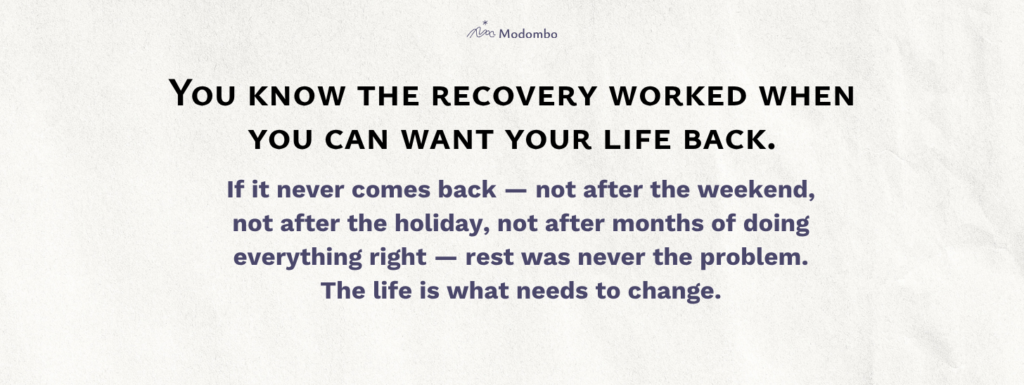
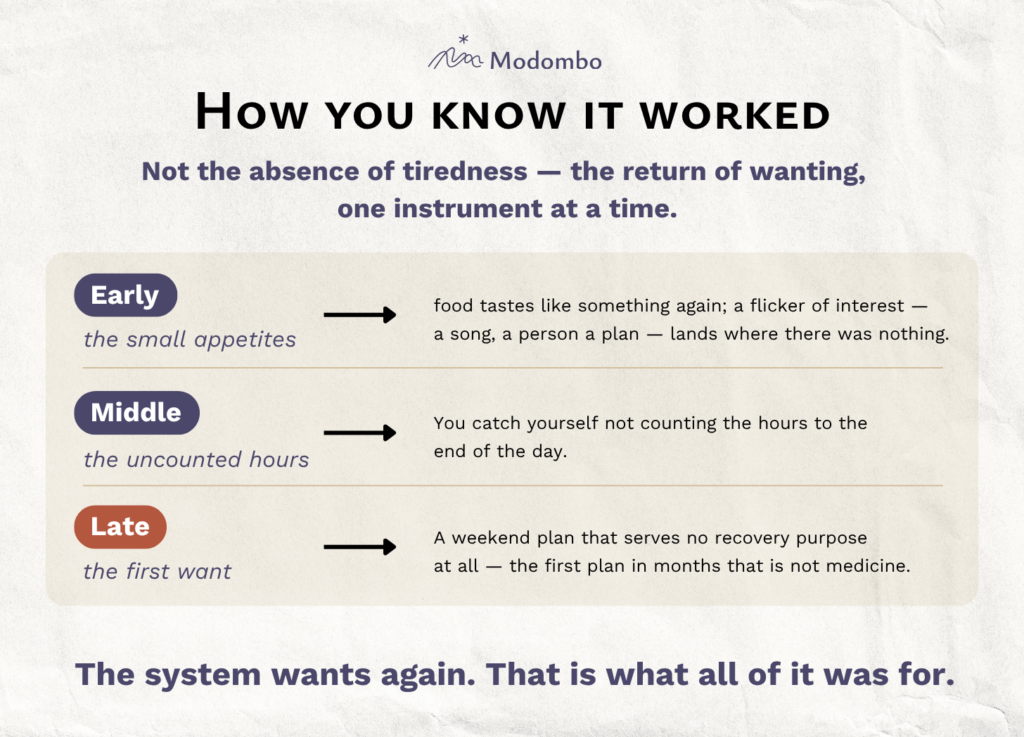
The wanting has an order, and the early entries are humble. First the small appetites — food tasting like something again, a song you put on twice, the first pull toward company instead of relief when plans get cancelled — a flicker of interest landing where there was nothing. Then, further in, the day stops being something you count your way through: you notice, one afternoon, that you have not checked the time in hours, and not because of a deadline. And then, late, the unmistakable one: an ordinary Tuesday, and you catch yourself planning something for the weekend that serves no recovery purpose at all. Not rest, not repair, not maintenance. The first plan in months that is not medicine.
None of this is mood. Each instrument reads a repair the earlier letters built. The good can land again because the machinery that converts rest into recovery — the first thing this series rebuilt — is working. You can feel what you want because the signal of what matters is readable again once exhaustion stops shouting over it. And there is room for a want to exist at all because your capacity is no longer spent before the want arrives. Wanting returns because the machinery works; it is the machinery’s receipt, and it is the one signal that cannot be faked by rest alone. The want itself is not graded. If the first thing that comes back is, embarrassingly, a spreadsheet — the system works; the taste is your own business.
And “wanting” here is not a category of approved objects — it is one mechanism, reporting on everything at once. An evening of pure entertainment counts. A person you reach for counts. A film, a trip, a hobby that serves nothing counts. And — usually last — parts of the work itself: the corner of it that used to be interesting before everything went heavy. Wanting your life back is not a separate, nobler appetite. It is the same appetite aimed at the largest object, which is why it is the last one to return.
And if none of this has arrived — if you are reading about wanting the way a person in February reads about spring — this letter is not telling you that you failed. The late instruments stay silent long after the early ones start moving; recovery has a long flat middle — a stretch where nothing reads on any instrument because everything is being rebuilt underneath — and that is where most people reading this are standing. The small appetites come first: taste, music, company, the corner of the work that used to be interesting. They are the same road, earlier. Only if even those have stayed flat for months — static, nothing returning at all — does this stop being a recovery question; that boundary points to a professional, not to more patience.
The shape you have been walking
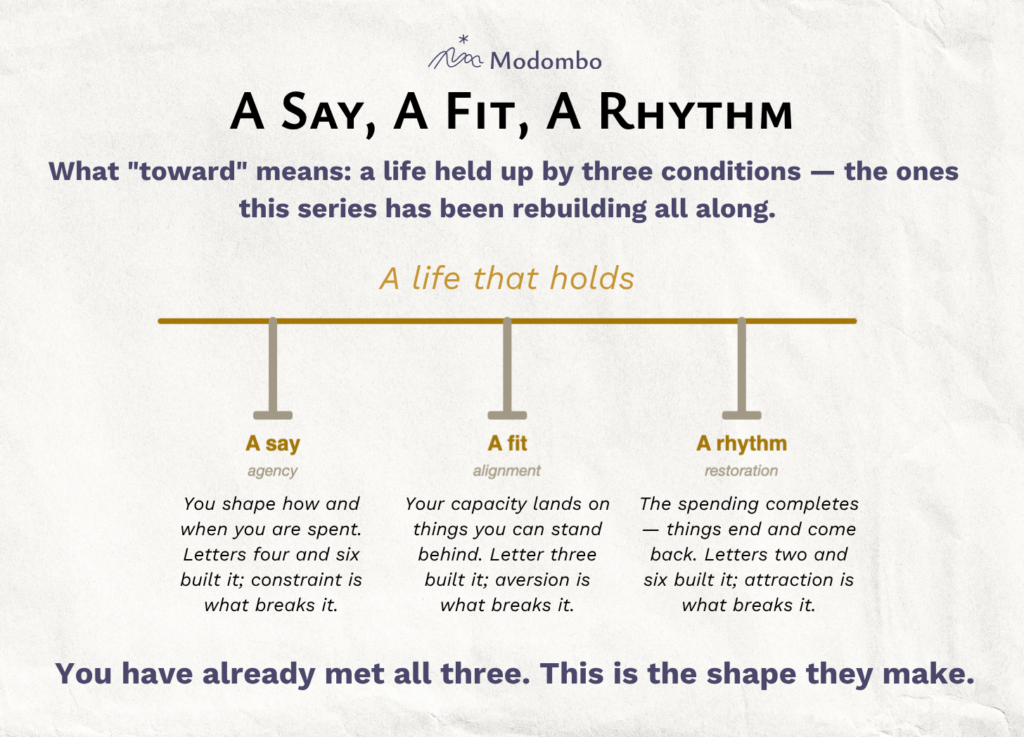
Here is the thing this series never told you: it had a skeleton. Eight letters have felt like a sequence. Underneath, they were circling one claim: a load, even a heavy one, is sustainable while three conditions hold. A say — you shape how and when your capacity is spent; work arrives on terms you had a hand in setting. A fit — the spending lands on things you can stand behind; what fills your week and what matters to you point the same way. A rhythm — the spending completes; things end, quiet actually happens, and things come back. The formal names are agency, alignment, and restoration.
If you have read along, you have already met all three — just never by name. The rhythm is what the letters on rest kept building: recovery lives in completed cycles — days that actually end, weeks with real quiet beats in them — not in the amount of sleep. The fit is what the compass was really for: never a motivation tool, but an instrument that checks whether what you spend yourself on matches what you deeply want. And the say has been deferred the whole series — mentioned once, as the condition that makes rest work at all — because it belonged here, in the letter about aiming. If this is your first letter: there is nothing to catch up on. The three conditions are the whole idea; the letters behind this one rebuilt them one at a time.
One more click, and the map closes: overload has three drivers, and each one breaks exactly one leg. Working against what matters, so that every hour costs double — aversion — breaks the fit. Being pulled by something so absorbing it floods everything else, so that no cycle ever completes — attraction — breaks the rhythm. Having your capacity extracted on someone else’s timing — constraint — breaks the say. An earlier letter named those three forces and built a way back from each; it just never said out loud that each way back is one leg of this triad, rebuilt.
So “recovering toward something” is not a poster about purpose. The something has a describable shape: a life where the three conditions are built in and checkable. Not a calling, not a passion — a passion is one more thing to spend capacity on. Conditions are about how the spending itself is held. That is the difference between this letter and every “find what sets your soul on fire” essay you have scrolled past: fire is load. What you are recovering toward is the structure that can carry it.
A say, most of all
Of the three, the say has had the least airtime, and that was deliberate: it is the forward-looking one. One line earlier in the series carried it and promised the rest later: restoration only works when you have a say in it — a rest someone else schedules is just a pause. Here is the rest of that thought. Recovering toward something is an act of agency by definition: you cannot aim a life you have no say in. Two recovered lives can look identical from the outside — same energy, same functioning, same Monday. One was chosen; the other merely resumed. The difference does not show up in week one. It shows up at eighteen months, in which of the two lives has quietly begun producing the same overload again.
And some cages are real. The dependent whose schedule will never be negotiable. The diagnosis. The money. If your capacity is genuinely extracted by a structure you cannot exit, “design your life” reads like satire, and this series has already drawn the honest line: where the structure truly cannot change, agency does not vanish — it relocates. It becomes the choice of stance and the choice of supports inside conditions you did not choose. The carer cannot fire the constraint; she can decide what the constraint costs her — one hour a week whose timing is hers and stays hers, one activity her own evidence says actually restores her, one person who sees her often enough to notice when she starts disappearing. That is not pretending the cage away. It is furnishing it deliberately, and it is design in the fullest sense available.
Prevention is architecture
Prevention, as usually taught, is vigilance: watch yourself for the early symptoms. The triad retires that model. Symptoms are late — tiredness is a lagging indicator, arriving months after the conditions have already begun to fail. So the watchable thing is not you; it is the conditions. And better than watching them is building them in. A say designed into how work arrives — recurring time that is structurally yours, not defended weekly by willpower. A fit checked on a calendar date — a yearly appointment where you ask whether what you spend yourself on still matches what you want, before misery asks it for you. A rhythm with real quiet beats in this week’s actual calendar, not theoretical ones in August. Prevention stops being a mood you maintain and becomes architecture that holds whether or not you are paying attention.
Because rebuilt lives drift — that is not pessimism, it is maintenance reality. And the drift is quiet and condition-level. The say narrows first: the calendar fills with other people’s timing again, one reasonable request at a time. The fit slips: a little more of the week lands on things you cannot quite stand behind. The rhythm flattens: the quiet beats postpone themselves to the next holiday. None of it feels like anything — that is the point. Watch the conditions, not the tiredness. The tiredness always arrives late.
The way back was never back
The first series of these letters, the one about burnout, ended by pointing at the exits: the way back is written into the kind of overload that took you down. This one ends by correcting its own preposition. Eight letters — the machinery rebuilt, the compass restored, the force named, the depth respected, the texture found, someone beside you — and the destination was never the life you left. It was the life adjusted while you were down: the say designed in, the fit checked, the rhythm real. The way back was never back at all.
And you will know you have arrived without needing an instrument panel. One ordinary Tuesday you will catch yourself planning something that serves no purpose whatsoever — and want it. Caring will have come back online without an announcement. The good will land again, one small thing at a time, in order. That is not the reward for recovering. That is what recovering was.
Alive again. That is what all of it was for.
Three questions to locate yourself:
- When did you last make a plan that served no recovery purpose at all?
- If your recovery completes perfectly, what exactly resumes — and is that a relief or a sentence?
- Which of the three — the say, the fit, the rhythm — went missing first, last time?
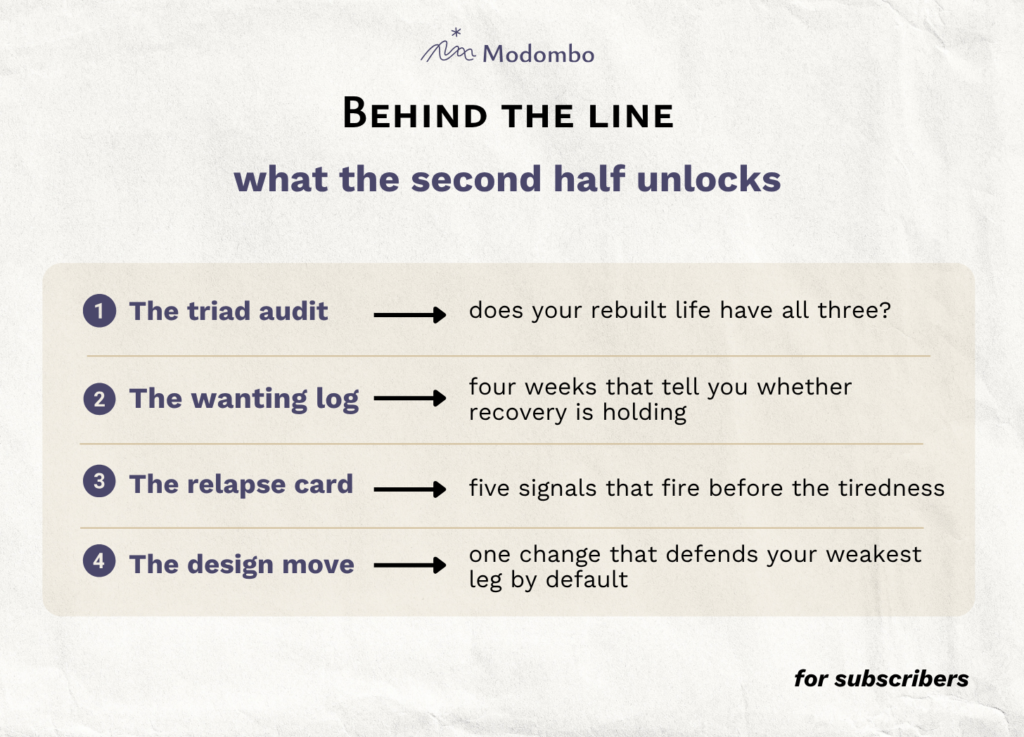
The rest of this letter is for subscribers, and it is the practical half: the triad audit of your rebuilt life, a four-week wanting log that tells you whether recovery is actually holding, the five early-warning signals that fire before the tiredness does, and the one design move that defends your weakest condition by default.
What is coming in the next episodes?
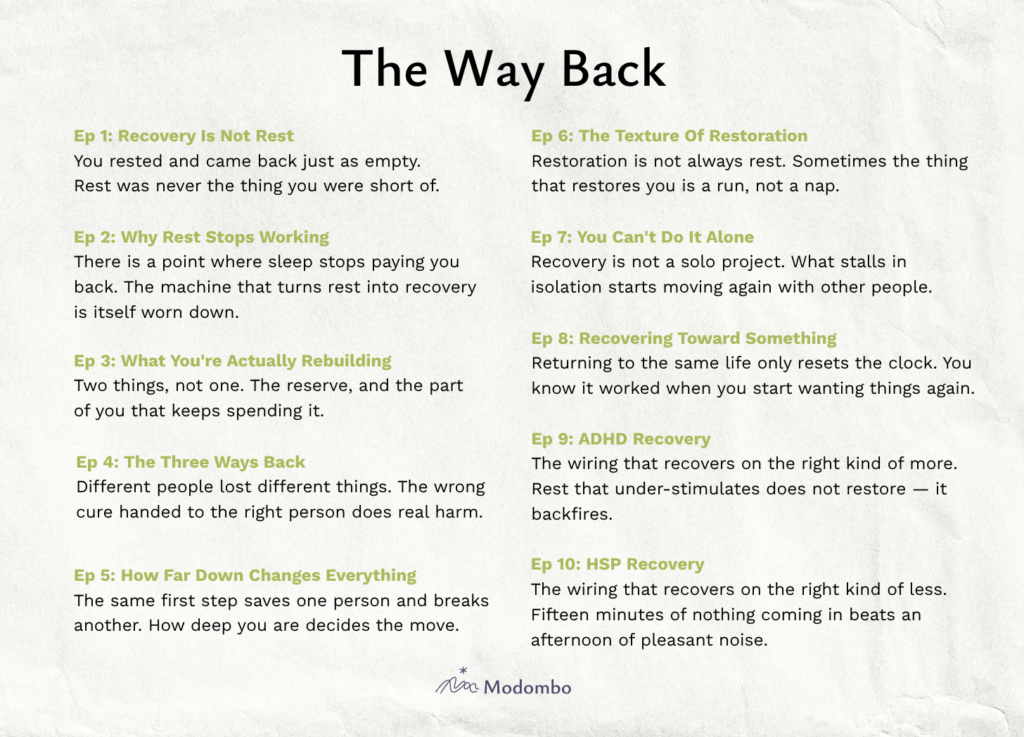
The core series closes here — eight letters, one map, and a direction. Two more letters follow for particular wirings, because the map bends with the nervous system reading it: recovery with ADHD, where the restoring thing is the right kind of more, and recovery with high sensitivity, where it is the right kind of less. Same mechanics, recalibrated. And in October, the book — Recovery Is Not Rest: everything the eight letters built, assembled in order, free to download for paid subscribers.
Related episodes
- NL48 R7 – You Can’t Do It Alone — the hand-off this letter answers; the steady presence on the relapse card
- NL47 R6 – The Texture Of Restoration — the held thought: restoration only works when you have a say in it
- NL45 R4 – The Three Ways Back — the three forces that each break one leg
- NL44 R3 – What You’re Actually Rebuilding — the Monday reboot; the compass that was a fit instrument all along
- NL43 R2 – Why Rest Stops Working — the small appetites; the flat middle; feeling better vs getting out
- NL42 R1 – Recovery Is Not Rest — the reframe this letter completes
- NL41 B10 – Burnout Synthesis — the first series’ capstone; the way back written into the kind