The one everyone knows
This is the one most people mean when they say the word. Too much for too long. You have handled intensity for years, and this year, something in the machinery gave out. You sleep the whole weekend and wake up still carrying it.
It is also the only type where the standard advice (slow down, rest more, reduce the load) is the right intervention. Which may be why people keep applying it to every other type as well.
How it sounds in the room
“I’ve handled much worse. I don’t understand why I’m so tired now.”
“I’m working at 70 percent and it’s exhausting me more than 100 percent used to.”
The fatigue has a flat, grey quality. Decisions cost more than they should. Things that used to be automatic now take deliberate effort. The person usually senses that this is not a bad week. It is a shift in the baseline.
Why this type is actually mechanical
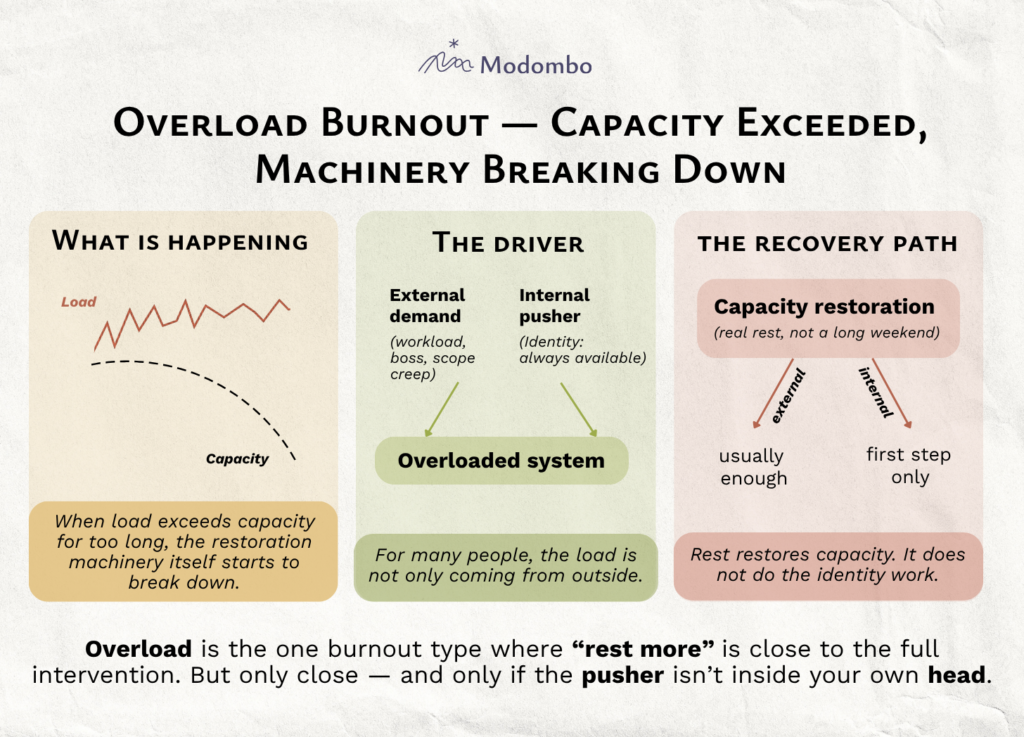
Capacity is a real physiological quantity. You spend it, you restore it, and if you spend more than you restore for long enough, the restoration machinery itself starts to break down. At that point the system does not just need a weekend. It needs a proper reset — weeks, sometimes months of a schedule that lets it rebuild.
When people with overload burnout get that reset, much of what looked “psychological” softens on its own. The irritability was the fatigue. The flatness was the fatigue. Even some of the career doubts were, in part, the fatigue talking.
This is the one type where “do less, rest more” is close to the full intervention. Real rest, not on-call in a quieter room — but the direction is right.
The catch inside this type
If overload burnout is this mechanical, why not just prescribe six weeks off and close the case?
Because in many people I see, the load is not only external. It is being amplified, sometimes generated, by an internal pusher. And the pusher is not a habit you could drop next week. It is closer to an identity. It is how the person wants to be seen — by their boss, by colleagues, and most of all by themselves: as the always-available one, the one who never says no, the one for whom “good enough” quietly feels like sloppy. A character trait that was an asset for twenty years, still running at full strength regardless of what the boss actually asks.
If you want something done, ask a busy person.
For that kind of person, six weeks off can go one of two ways, and both lead to the same place. Some spend the break anxious about being unreachable — checking mail, half-present, unable to actually land. Others genuinely put it down: sleep, read, forget the office exists. Then, on the first Monday back, the identity reboots. Within a week they are again the always-available one, the one who cannot say no, and the capacity starts draining at the same rate as before.
Rest restores capacity. It does not teach you to stop spending it faster than you can refill.
What actually helps
First, the restoration itself — real rest, not a change of scenery with the same phone habits. Then the part people usually skip: an honest look at whether the load is coming from outside, from inside, or from both.
If it is primarily external — a boss who keeps adding, a team that leans on you, a role whose scope quietly doubled — the work after recovery is about boundaries. Saying no more often. Protecting hours that used to be yours. Pushing back on a pace that was never actually reasonable in the first place. Not comfortable, but the intervention is structural and it is in the world, not inside you.
A harder subcase inside the external one: sometimes the role itself exceeds what the person can carry. Not a moral failing — a capacity mismatch that no amount of rest or boundary work will close. It is one of the hardest things to name honestly, in therapy or anywhere, because it sounds like a judgement. It isn’t. It is a fit question. People in that situation also need support: to see it, to stop punishing themselves for it, and to step into a role or a level that actually matches them.
If it is primarily internal, recovery is only the first step. Boundaries help, but they will not hold if the person setting them still believes, underneath, that being unreachable means being worthless. The work there is slower and more personal — where the pusher came from, what it protects against, what it costs. That is closer to psychotherapy than to time management, and it is rarely a matter of weeks.
Where this is, and where it isn’t
Two questions, in order.
First — is this overload burnout at all? Picture three unbroken months off and then returning to the same job with half the workload. If the exhaustion would clearly lift, you are in overload territory and this episode applies. If the tiredness would still feel like it would be there — because the rhythm is wrong, the environment is hostile, or the role itself does not fit — you are looking at one of the other types in this series.
Second — if you are in overload, where is the load coming from? Imagine your boss calling tomorrow and saying: “Do less. We will cover the rest.” A few days in, do you settle? Or do you quietly fill the space back up on your own — a new project here, a higher standard there, one more thing only you can handle? If you would settle, the problem is mostly external and the work after recovery is about boundaries, and sometimes about an honest look at fit. If you would find a way to keep yourself at the same pressure, the pusher lives inside, and the work is further in.
What is coming in the next episodes?
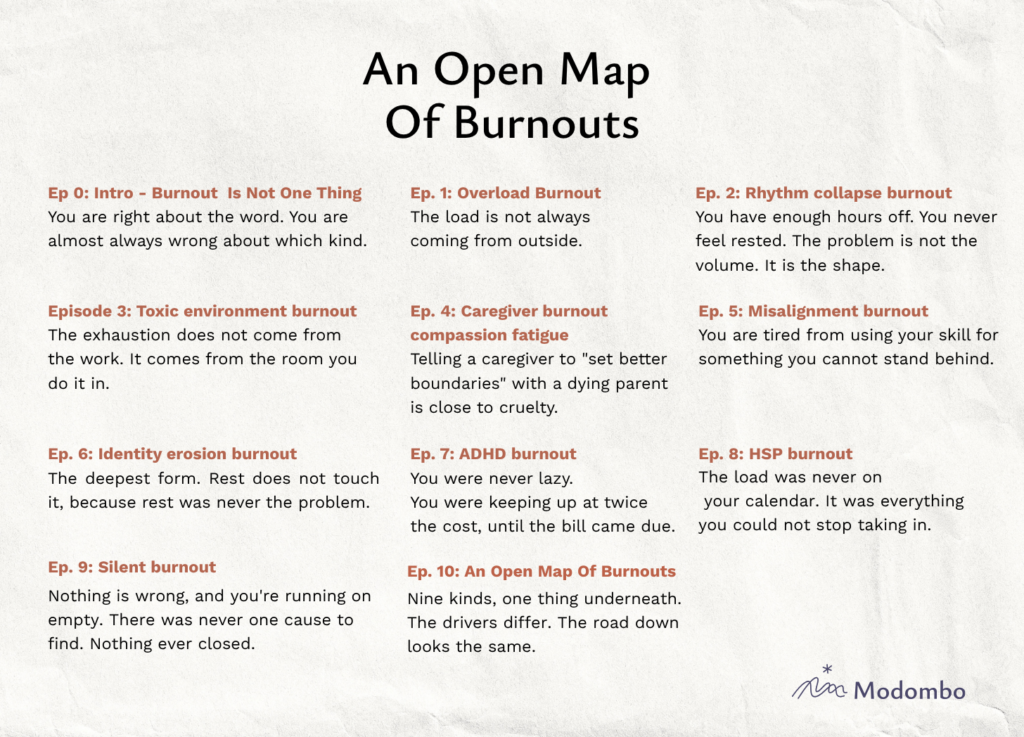
Next — NL B2: Rhythm collapse burnout. The closest relative of overload burnout, and the one most commonly mistaken for it. Why the problem is not the volume but the shape of the day, and what recovery looks like when the missing ingredient is a rhythm that actually fits you.