You Can’t Do It Alone
He is recovering the way he did everything else: competently, and alone. The sleep data has its own spreadsheet. The books are annotated. This newsletter is read carefully, twice, and forwarded to no one. Nobody at work knows; nobody at home knows how far it goes. It is a serious, well-run project — and it keeps stalling at the same place.
The last letter ended on a deliberate gap. Rhythm, closure, fit — and one ingredient left out, because it is not a thing you do at all. Some of the cycle only completes next to another nervous system.
Recovery is the one thing overload convinced you to attempt entirely by yourself.
The trap
Overload isolates you first, then makes the isolation feel like the solution. When capacity runs low, people are the most expensive thing on the calendar. So you withdraw to cope — calls postponed, plans cancelled with relief, the story that you’ll get back to everyone once you’re through this. And the withdrawal is genuinely protective at first. Fewer people really does mean less spent.
Then it quietly becomes its own problem. The friendships lapse without a single argument. The people who would have offered something slowly stop offering, because you slowly stopped answering. And by the time recovery starts, the isolation has hardened into method: you attempt the climb the same way you fell. Alone, privately, as a project you manage.
Not more social
Here is what this letter is not saying: be more social. For an overloaded person that advice is not just useless, it is threatening — crowds drain a depleted system further, and the problem was never relationships anyway, it was unbroken access to you. If people exhaust you, you are reading the right letter.
What recovery needs is smaller and stranger than a social life. One steady presence next to yours. A therapist. A coach. A partner who can stay calm when you cannot. One friend. Not a network. A nervous system.
Borrowed regulation
One steady presence works where willpower doesn’t, and the reason is physiology, not company. I wrote about this in the AI series: sit with someone genuinely grounded and your body does not stay untouched — breathing slows, tension softens, pace shifts, not through advice but through physiology. What that mechanism means for recovery is the part nobody tells the competent: a dysregulated nervous system cannot talk itself down. It can synchronise with a calmer one beside it. You do not think your way back. You borrow someone else’s regulation until your own returns.
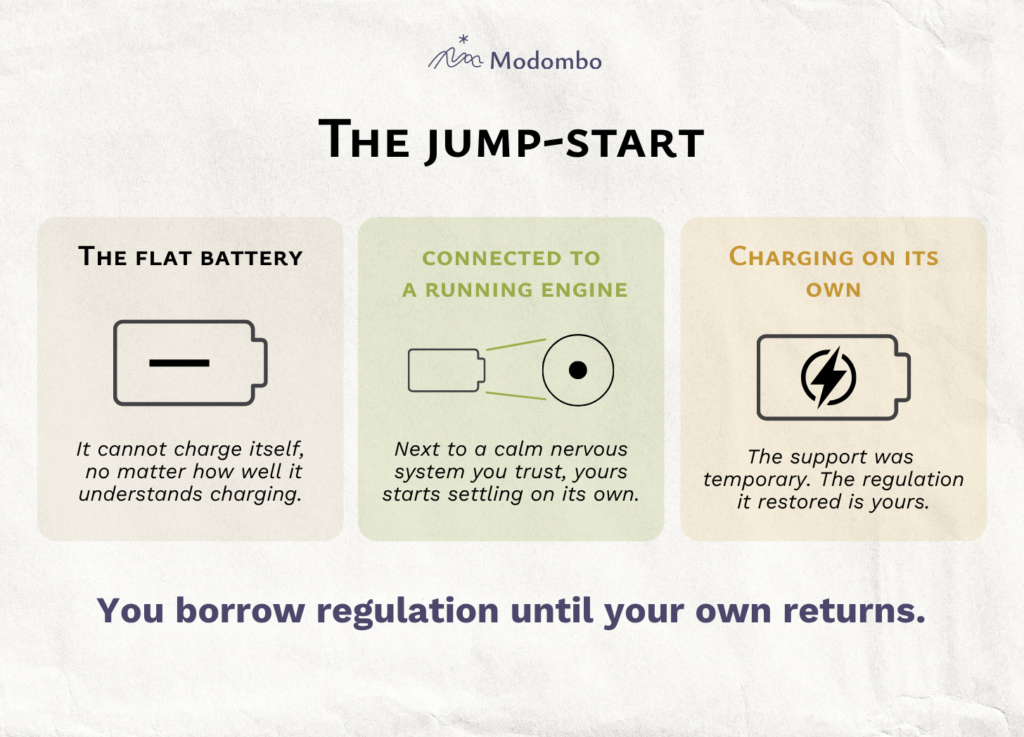
A flat battery is the honest picture. It cannot charge itself, however precisely it understands charging. It needs cables to a running engine — and then, this is the point, it runs on its own again. Borrowed regulation is a bridge, not a residence. The belay is the other honest picture: someone holds the rope, and you still do the climbing.
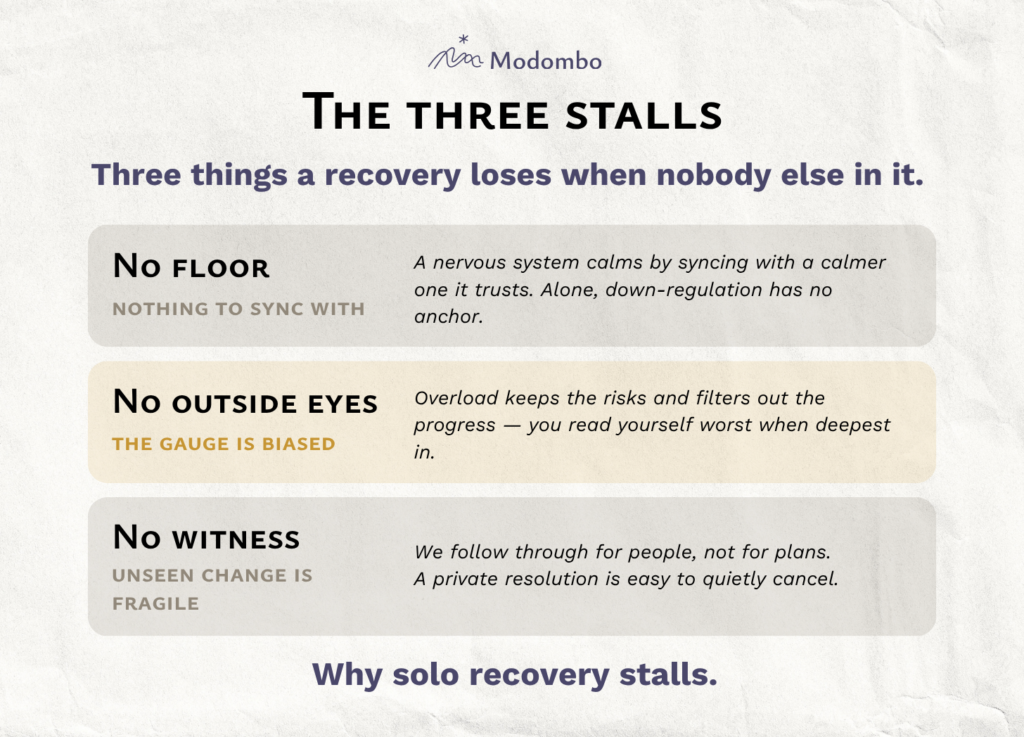
Solo recovery stalls in three specific ways. First, no floor: with no calmer system to sync with, down-regulation has nothing to settle against — the depth the last letters kept pointing at stays out of reach. Second, no outside eyes: depletion damages the very gauge that measures depletion, so the person deepest in it is the least able to self-assess — which is exactly why episode five’s checks kept partially outsourcing the reading. Third, no witness: the identities that overloaded you — the performer, the pleaser — grew in relationships, and they retrain in relationships. Change nobody sees is fragile. A private resolution is the easiest thing in the world to quietly cancel.
This is also why the flat middle of recovery is so much more survivable accompanied. When progress can’t be felt and the instruments say keep going, someone else can believe the instruments while you can’t.
Three ways of being alone in it
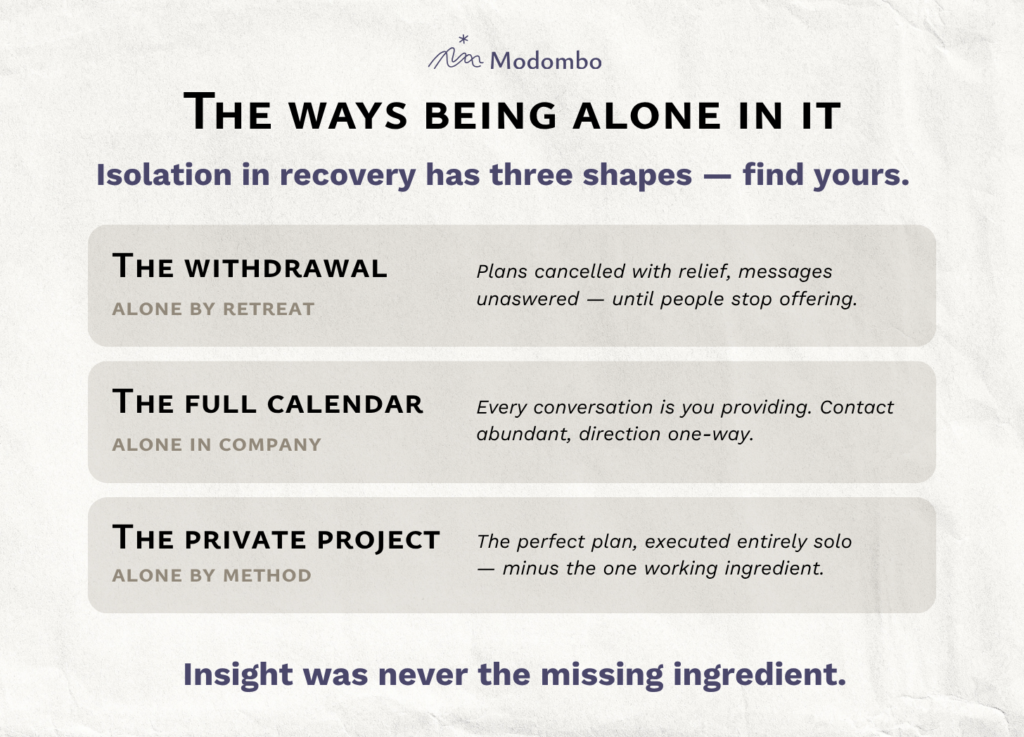
The withdrawal. Messages answered later and later, then not. Plans cancelled with relief. From inside it feels like efficiency — and it can pass for focus for a remarkably long time. From outside it looks like disappearing, and the people who might have been the steady presence slowly stop offering.
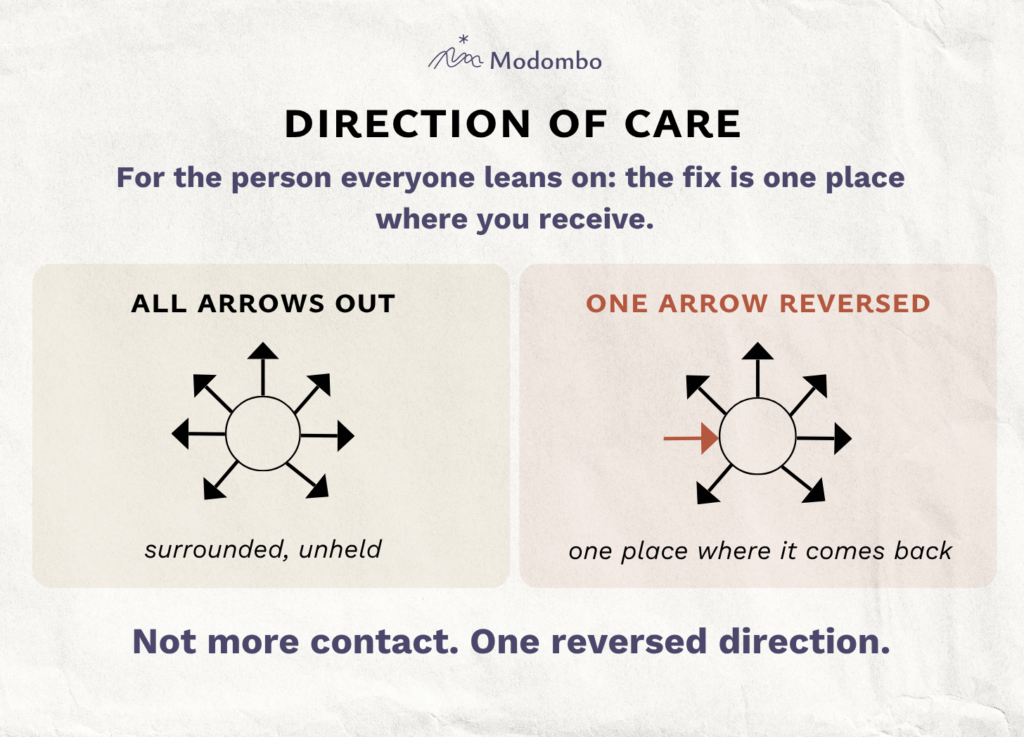
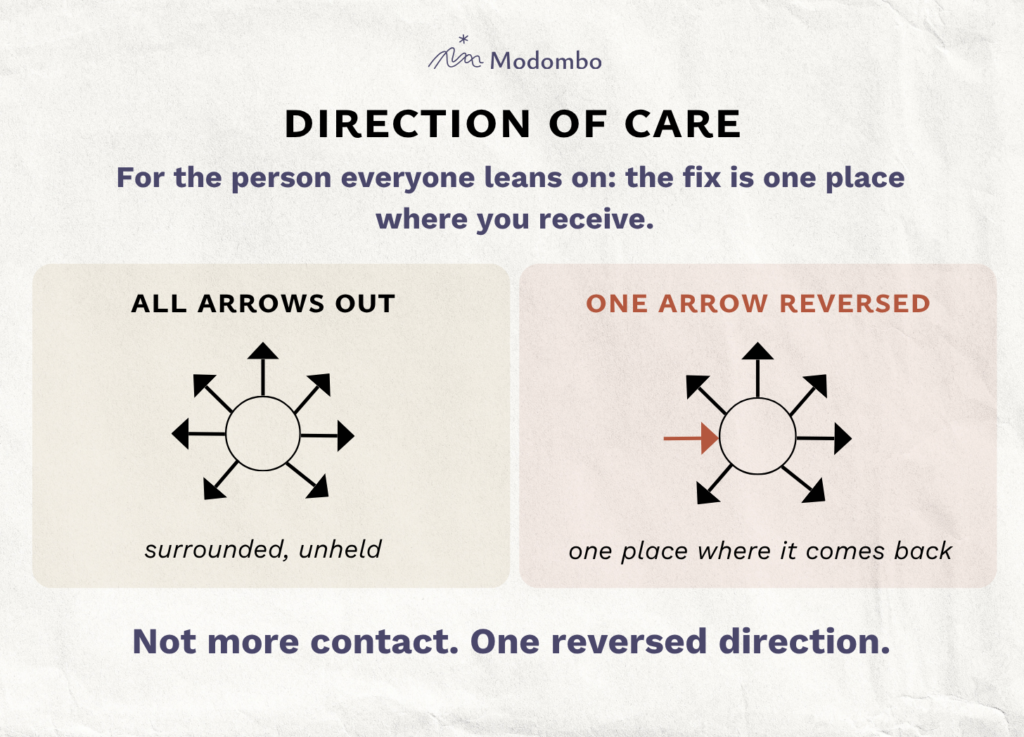
The full calendar. A family, colleagues, meetings, dinners — and not one conversation in months where you weren’t managing, performing, or providing. This is the caregiver’s shape, and the manager’s: emotional steadiness given all day, none received. Contact is abundant; direction is one-way. The loneliness of the person everyone leans on is not solved by more contact. It is solved by one place where the direction reverses.
The private project. The spreadsheet from the opening. Genuine effort, real knowledge, and a recovery that stalls at the same place every time, because insight was never the missing ingredient. Regulation was — and regulation, at depth, is the one thing a depleted system cannot generate alone. A system that cannot start itself cannot be willed into starting; recovery has to be arranged to arrive. The plan was comprehensive, minus the one working ingredient.
What the steady presence looks like
It has more shapes than the therapy chair. The professional shape: a therapist, a coach, supervision — a steady presence with a container around it. The personal shape: the partner or friend who can sit with you without fixing you. The structural shape: working alongside someone in silence, the standing walk with the same person every week. The ADHD world got there first under the name body-doubling — the productivity vocabulary discovered what the therapy vocabulary took longer to say, that another present nervous system changes what yours can do.
And a sentence for the other reader — the one this letter gets forwarded to, the partner or friend of someone deep in it: what you provide is not solutions. It is regulation. You do not have to fix anything to be the reason someone’s system finally settles. You are allowed to stop fixing.
One honest paragraph about partners: sometimes the partner is enough — and sometimes the partner is the one person who cannot do it. Not from a lack of love. They live inside your overload. They have been absorbing its symptoms for months — the short answers, the flat evenings, the cancelled weekends — and a person can be worn allergic to exactly the signals you now need to hand over. A therapist, a coach, even a friend comes with a boundary built in: you do not live with them, and the hour ends. A partner has no such edge. Offload onto a partner who has no capacity left themselves and the load does not transfer — it doubles, and it drains both of you. If your partner is inside the overload with you, or on the receiving end of it, they may need a steady presence as much as you do. Two flat batteries do not jump-start each other.
Why asking is the hard part
The difficulty of asking is not evidence against the ask. It is the driver defending itself. You met all three of these in episode three — the identities that drained the tank are the same ones now arguing against the refill. For the people-pleaser, asking reverses a lifelong role — you are the one who helps. For the performer, needing help reads as the failure the whole performance was built to prevent. For the self-sacrificer, support is a resource that belongs to other people. Whatever got you overloaded will argue, fluently, that you don’t need anyone — and it will sound like modesty, or consideration, or strength. Overload hides longest in the people who don’t feel bad enough yet to ask; the not-asking is part of the condition, not a neutral preference.
The quieter objection calls this dependence. The belay already answered it. Someone holds the rope. You still climb. The whole purpose of borrowed regulation is to make itself unnecessary.
Three questions to locate yourself:
- When did you last talk to someone without managing, performing, or providing?
- Who in your life can you be visibly tired in front of?
- If recovery needed one phone call, do you know who — and have you made it?
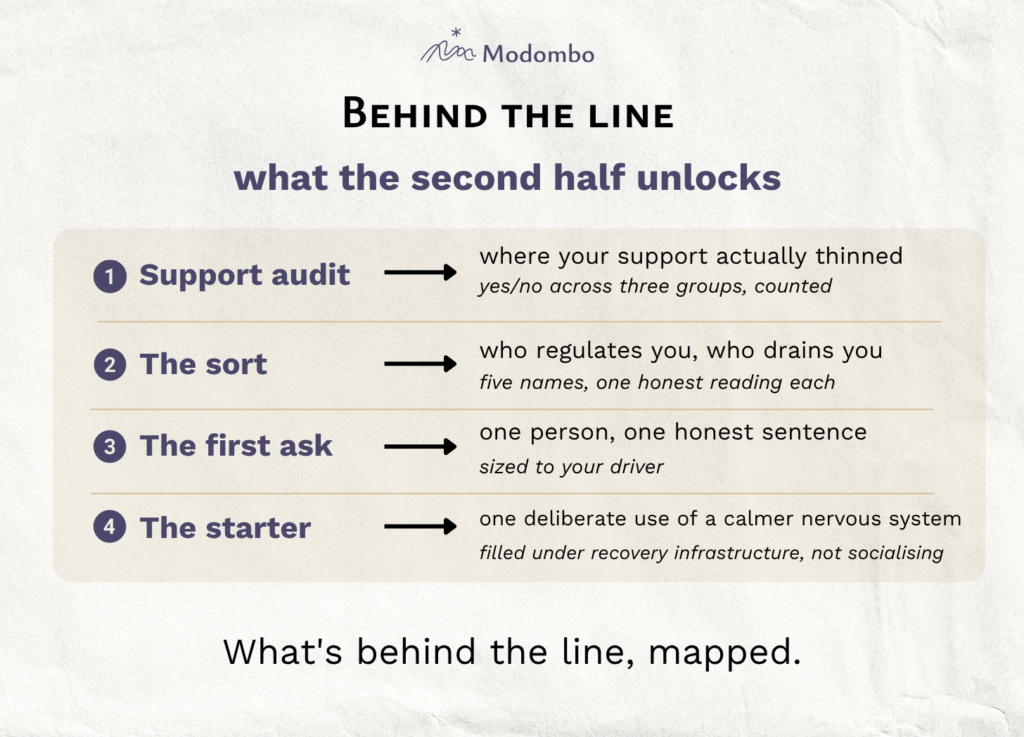
The rest of this letter is for subscribers, and it is the practical half: an audit of who regulates you and who drains you, the evidence sort that finds whether your week contains even one net-regulating presence, the smallest real ask and how to size it against your driver, and what to do if the honest answer is that there is no one.
What is coming in the next episode?
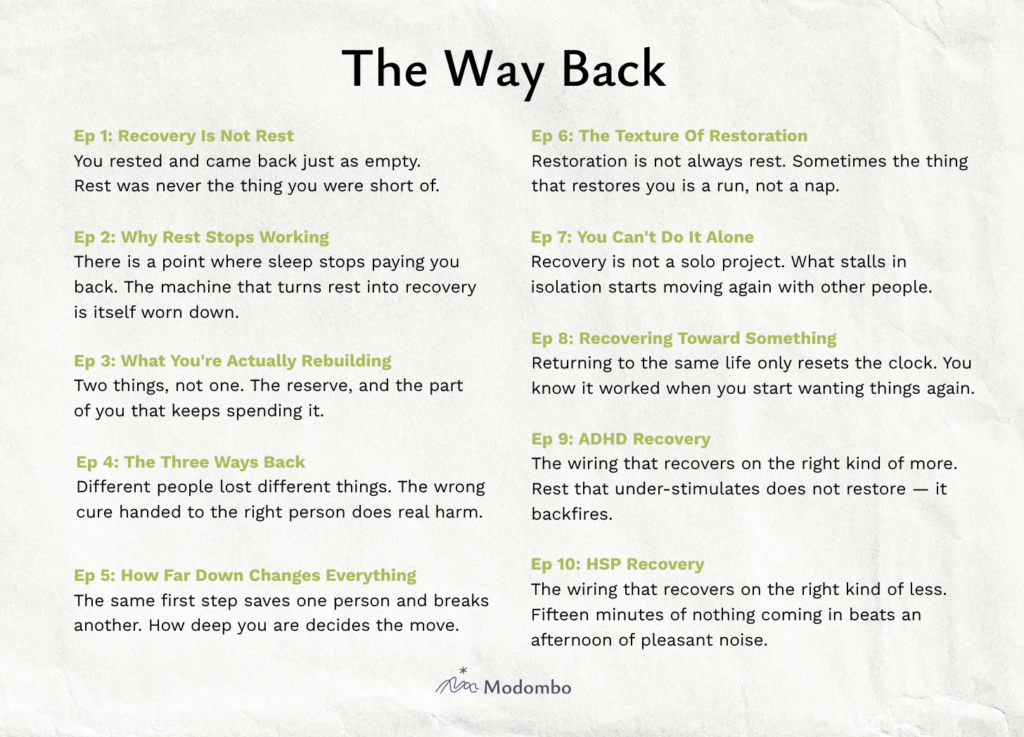
Ep 8: Recovering Toward Something: Returning to the same life only resets the clock. You know it worked when you start wanting things again.