The wrong role, not the wrong amount of work
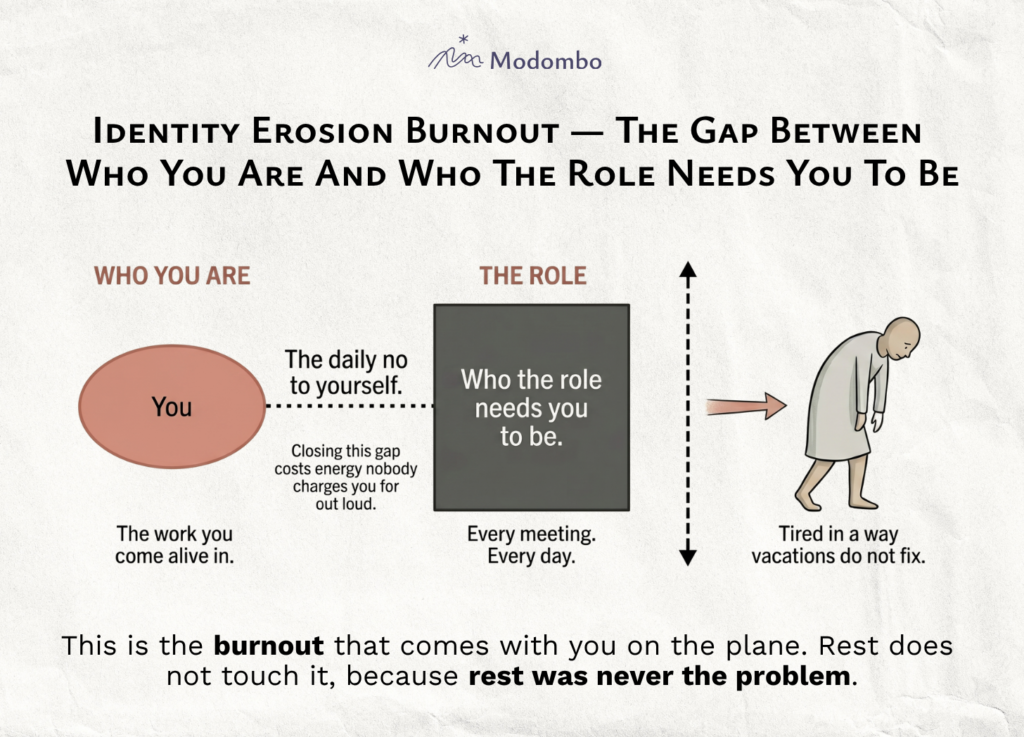
The previous episode was about misalignment: the role fits, but what the role is being used for does not. This is the next layer in. Here the role itself does not fit. Not the mission, not the employer, not the hours. The shape of the job is wrong for the shape of the person, and every working day is a small no to who you actually are.
The clearest example in my practice is the expert engineer who was promoted into management because that was the only path to a raise. The work they came alive in was being deep on one problem, holding the whole of it in their head, and slowly solving it. The new role is about supervising many such people without ever being allowed to go deep on any of it. On paper it is a promotion. In their identity it is a slow subtraction of the thing that made them feel like themselves at work.
Identity erosion also shows up in people who stayed on the expert track and still ended up in the wrong shape. A principal engineer overseeing eight projects without really being in any of them. A senior lawyer who no longer writes briefs, only coordinates associates. A senior therapist whose day is all triage and intake. A founder who used to build the thing, now running the people who build the thing. A clinician who became a director, and now sees committees instead of patients. The craft they love is still in the office. It is just being done by someone else.
How it sounds in the room
- “I get my energy back on vacation, and I lose it the moment I walk into the office.”
- “Technically this is the role I worked for. I did not realise how much it would cost to be this person all day.”
- “I watch my old team solve problems I used to love. I am in a meeting about resourcing.”
- “I don’t know when I stopped being someone I recognise. The paycheck is higher.”
Why rest does not touch this one
The other types at least respond to rest at the edges. Overload resolves with it. Rhythm collapse improves briefly. Toxic environment down-regulates on vacation. Misalignment at least lightens when the friction pauses.
Identity erosion does not. The exhaustion is not from doing too much. It is the running cost of being someone you are not, every meeting, every day, for years. The role does not ask for your effort. It asks for your identity, and every day is a small “no” to the self that does not fit it.
Time off simply pauses the daily “no”. The moment the role resumes, the cost resumes at the same rate. Many people in this pattern report that holidays actually make it clearer: they feel entirely themselves for a week, and then on the Sunday evening before return the old heaviness arrives, specific and physical. The body knows the difference, even when the calendar hasn’t changed yet.
This is the burnout that comes with you on the plane to your sabbatical, orders a drink, and waits.
The cost of staying
The other thing this type does, left to run, is erode the person’s competence in two directions at once. They lose ground in the role they are in, because it drains them faster than they can refill. And they lose ground in the work they came from, because the qualities that made them good at it are exactly the qualities they are spending every day suppressing. The role they are trying to do well asks them to override the self that could do something else well.
The slow ending I have seen most often: the person becomes frustrated that they are not performing well in the role. They double down. They go further into the persona the role demands, further from the craft they came alive in. By the time it ends, they are no longer fully able to do either — not the role that was wrong for them, and not the work they loved. This is the part that makes identity erosion the hardest type to unwind: it does not just exhaust the person, it slowly disassembles the version of them that could have done something else.
What actually helps
The fix is rarely in the world. It is closer to the work.
First: naming it. Many people sit in identity erosion for years because the role is prestigious, well-compensated, or the one their past self was explicitly aiming for. The honest recognition is often the first movement: the role I worked for is the role that is taking me apart. It usually takes support to arrive at, because the person has invested years of identity in the upward move that produced the problem.
Naming it also means naming whose voice is keeping you in it. The career narrative is rarely only your own. It is also the parent who wanted you to be the director, the partner whose pride is built on the title, the school or the family arc the role completes. Some of these voices have to be heard before the role can be put down — not argued with, just named, so that the person can see what they have been carrying as if it were theirs.
Second: the move that helps is usually sideways or down, not further up. Going back to the work that made them feel like themselves — the work whose shape matched theirs. Letting go of status, sometimes letting go of pay, often letting go of the title that looked like the reward for twenty years of effort. This is the part that makes identity erosion the hardest type to unwind in the world — not because the fix is unclear, but because the fix contradicts the career narrative that produced the problem.
Third: this is usually psychotherapy territory, not coaching. The question is not “what role should I take next” but “who am I when I am not trying to be the person this role requires.” That work is slow, and it is structurally different from boundary-setting or time management.
The choice is rarely clean
In practice, what helps and what is possible are often different questions. Most people in identity erosion are not choosing between a good option and a bad one. They are comparing two costs, and the work is to compare them honestly.
The first question is whether the original work is still available to you. Some people can go back. A senior lawyer who still writes can return to writing. A therapist who stopped seeing clients can start again. But a principal engineer who spent eight years in management often cannot — the field moved on, the stack changed, and the person who used to do the work no longer exists. The cost of staying is real, but so is the cost of trying to go back to a role you can no longer do.
The second question is whether a different employer would let you do the role differently. Sometimes yes — the same title carries a different shape in a smaller company, a different industry, an organisation that values the craft you are good at. Sometimes the title carries the shape with it, and changing employer is just changing the logo on the same draining job. This is worth investigating before you assume the only fix is going down.
The third question is whether you can stay deliberately. Not as denial, and not as endurance — as strategy. Two more years until the children are through university. Five more years until the mortgage is paid. A defined end date, with the cost of staying named honestly, is structurally different from drifting on in the hope it will get better. The body still pays the price. But carrying a known cost toward a known endpoint is survivable in a way that carrying an open-ended cost is not.
The stop-condition only works if it is real — a date that arrives, not a date that keeps moving.
What does not work is pretending the role fits, hoping you will grow into it, or taking another sabbatical and expecting a different result on Monday. The role is not going to become a better fit. The question is whether you go, when you go, and what you are willing to pay either way.
Where this is, and where it isn’t
One question is usually enough.
If the role were stripped back to the work you used to do — same employer, same mission, same colleagues, same salary, same status, same recognition from the people whose opinion you carry — just the shape of the day you had before — would the heaviness lift?
If yes, this is identity erosion. The role itself is wrong for the shape of you. Going further up will not fix it, because further up is what produced it. Changing employer will produce the same exhaustion under a new logo.
If no, the heaviness is doing different work. Look back at B5 — the role may be right, but what it is being used for is not.
What is coming in the next episodes?
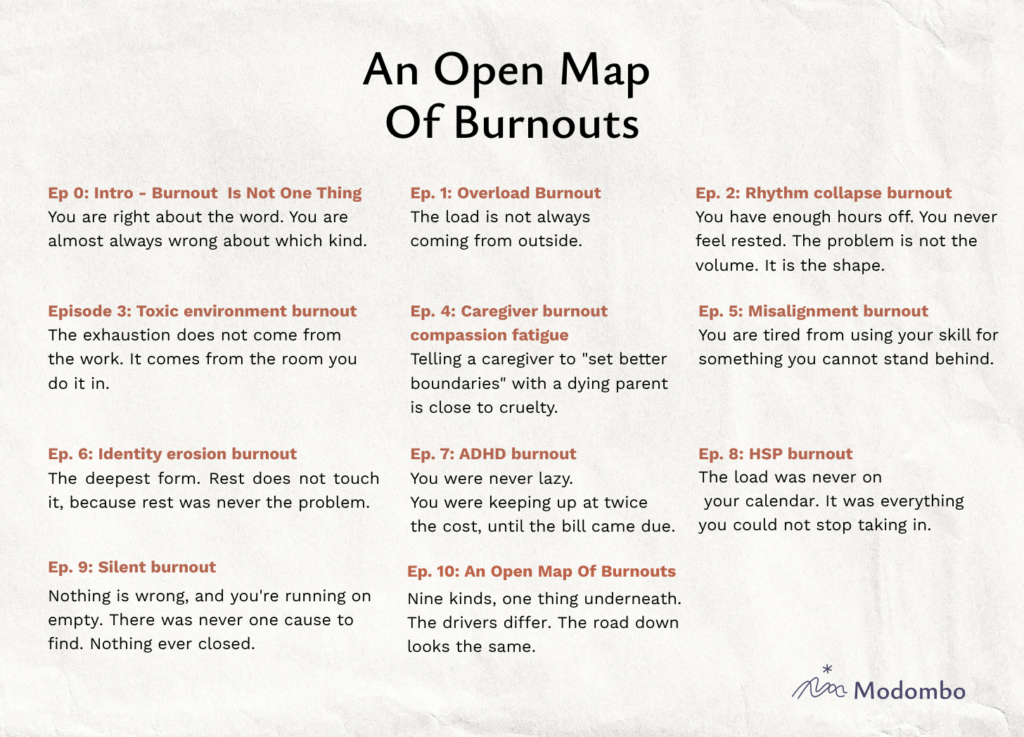
Next — NL B7: Neurodivergent burnout (ADHD and HSP). The final type in the series. When the load that fits others is the load that broke you, and the regulatory machinery that held through your thirties gives out on a schedule nobody warned you about.