This is an archive version. For all new articles, extended editions, and full resources, visit my newsletter on Substack.
—
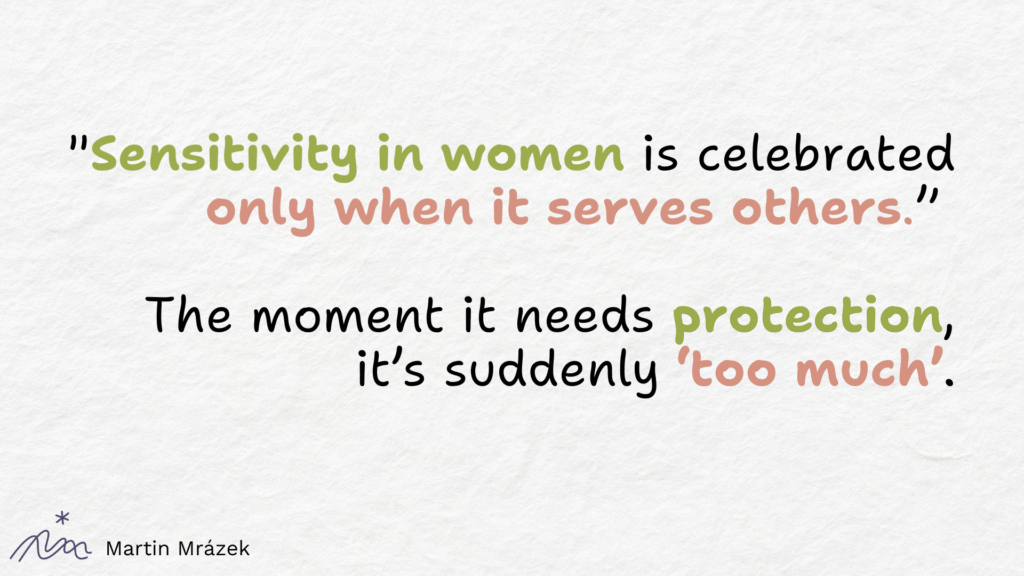
”Sensitivity in women is celebrated only when it serves others.” The moment it needs protection, it’s suddenly ‘too much’.
—
HSP Women Are Not Accepted
There’s a cliché that high sensitivity is easier for women — that they’re somehow allowed to be more emotional.
In reality, sensitivity in women is accepted only when it’s convenient.
—
What it’s about
About 20% of people have a naturally higher sensitivity — they process emotions and sensory input more deeply than others.
Ordinary situations can overwhelm them faster. It happens in men and women alike — and today I’d like to focus on women, because recently I had an interesting coaching session with a manager.
She was chronically overloaded: hours in a noisy open-space office, then a stressful commute, then family life with two adolescent kids. With her permission, I decided to share some moments from our session anonymously.
—
What’s happening
A highly sensitive woman is appreciated for her empathy, intuition, and warmth — as long as it serves others. Yet the moment she needs quiet, rest, or withdrawal, the same qualities stop being welcome.
That was exactly the case with my client. When she did all that emotional labor — supporting colleagues, smoothing conflicts, listening endlessly at home — everyone was satisfied. They expected her empathy to be available on demand.
But the moment she said, “I’m overwhelmed now, I need some quiet time,” people around her started to react — politely or not — that something was wrong with her.
During our session, I asked her to imagine this:
She comes home after a demanding day — full of meetings, requests, noise, people. On her commute home, the subway was a chaos of sounds and bodies. She walks through the door, exhausted, and says to her husband and kids:
“You, go shopping. You, make me tea. You, tidy up. And all of you — be quiet for twenty minutes. I just need silence — I’m overwhelmed and need rest.”
It was interesting to watch her reaction. First, she laughed, assuming it was a joke. When she realized I meant it seriously — at least as a thought experiment — she became slightly irritated, even offended by the idea. That moment said everything about how deeply this cultural pattern runs: It sounds absurd, almost offensive to many HSP women, because culturally, they’ve been trained to serve, not to be served.
—
The result
This constant emotional labor drains sensitive women long before they realize what’s happening. Sensitivity is praised as long as it’s productive — listening, caring, supporting. But the moment it needs protection, it’s labeled selfish.
So many sensitive women learn to override their limits. They keep absorbing, helping, adapting — until the system breaks down. Irritability, anxiety, burnout, chronic fatigue, loss of joy — the nervous system collapses under the constant input it was never designed to process without pauses.
—
What now
With my client, we started to work on her trust that this kind of request for support can be expressed in ways that are both authentic and acceptable, at home or at work.
We also began exploring what needs to be in place — internally and in her environment — for her to have the strength to express such requests without guilt or apology.
This is what chronic overload often looks like in disguise. It’s not about weakness. It’s about the absence of boundaries that would let the body and psyche regenerate. Real acceptance means allowing sensitivity to give — and to rest.
—
Personal note
I’m a man, but I score very high on HSP scales. It took me years to accept that I need short periods of total disconnection during the day — fifteen or twenty minutes with closed eyes, no input, just breathing. During my years in management and entrepreneurship, this was almost impossible — yet without it, I slowly lost clarity and presence. It’s not indulgence. It’s maintenance.
—
Tip
If you’re HSP, stop measuring your worth by how much you can handle. Start protecting what keeps you human — your rhythm. Set boundaries that give you space to recover during the day, at home and at work.
It’s not always easy, especially in a new workplace. But long-term, it’s essential. Protecting your rhythm isn’t selfish. It’s stability. This article continues on my Substack, where I’ll also be releasing a deeper, extended e-book with practical tools for applying these principles in everyday life.