The life that looks fine on paper
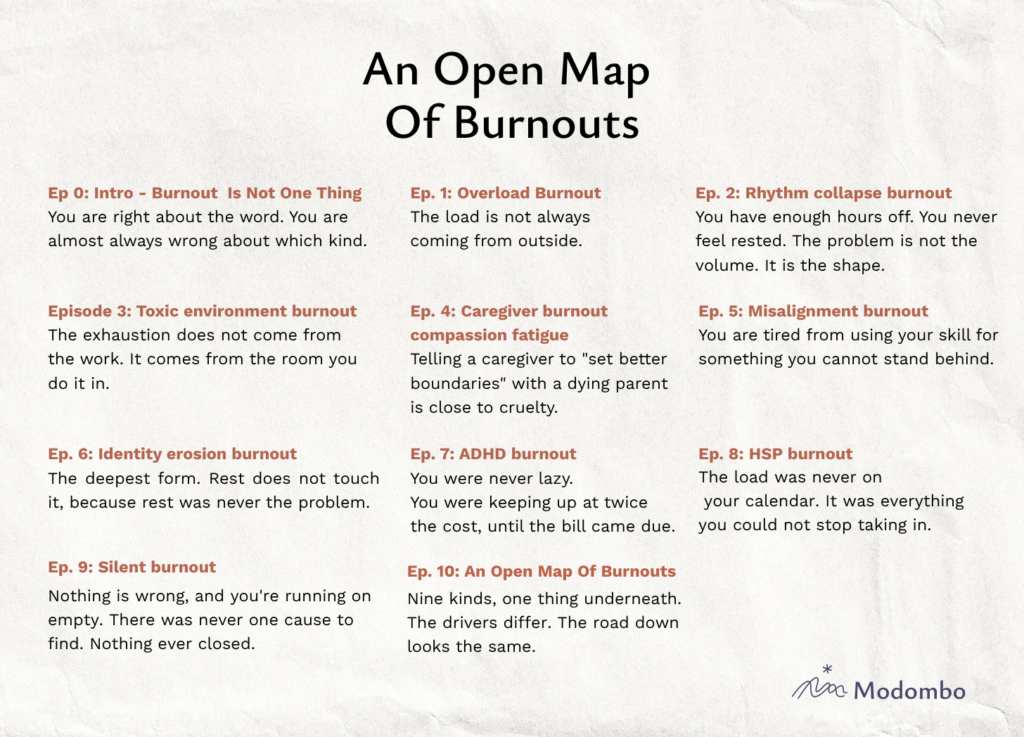
Fine on paper, hollow by Wednesday. This is the burnout where, by every measure anyone could check, you should be all right. The hours are reasonable. The workload is one a colleague carries without much trouble. And you are wrung out in a way that matches none of it, and you cannot point to the cause. The first thing to know is that the gap is real. The cause exists. It is just not on the calendar.
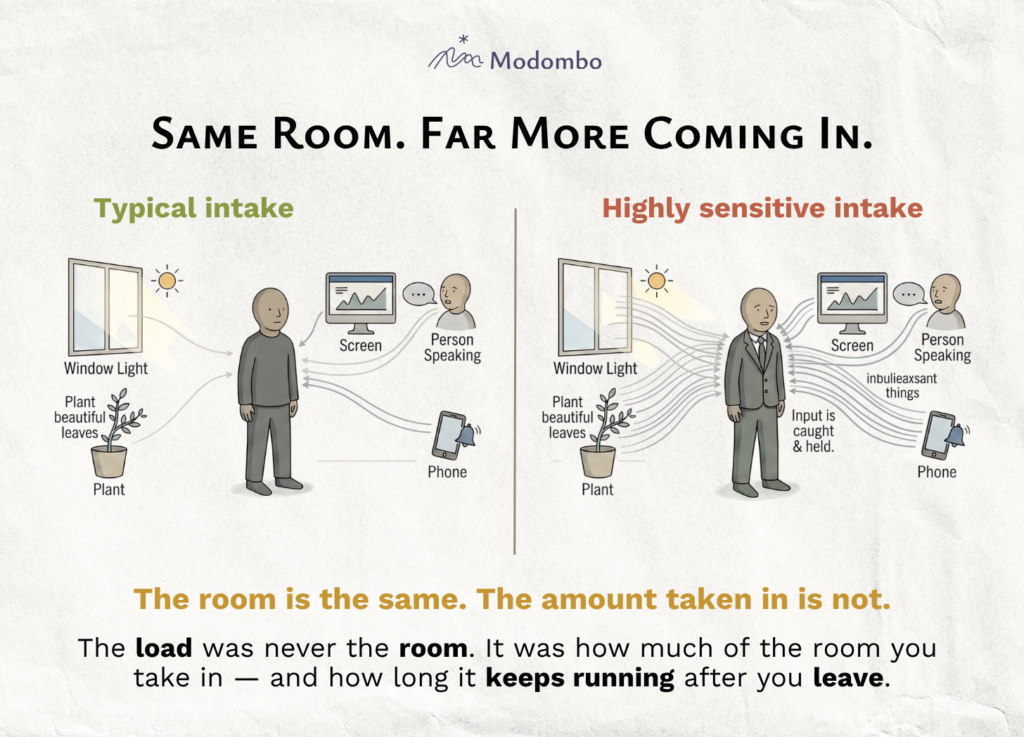
The load you can’t see. Most burnout is about what you do — the tasks, the hours, the demands you could in principle count. This one is about what comes in. A sensitive nervous system registers more of every room: the half-second of tension in someone’s voice, the flicker of a light, the three subtexts under a short email, the mood of everyone at the table. It takes all of that in, and processes it deeper than the people around you do. None of it shows up on a to-do list. So you can run a sane, balanced life and still sit at full saturation, because the expensive part was never the schedule. You weren’t overspending. You were over-receiving.
Even the good costs. Here is the part that confuses everyone, including the person living it. Depth of processing does not sort its input into good and bad. The beautiful concert, the long warm dinner, the film that moved you, a friend’s good news told with real feeling — all of it is processed deeply, and all of it draws down the same capacity a hard day does. This is why a wonderful weekend can leave you needing to recover from the weekend. Not because anything went wrong. Because all of it went in.
The day doesn’t end when the day ends. And it keeps costing after the input stops. The conversation from this morning is still running at midnight. The room you left two hours ago is still being metabolised. For most people the day closes when they walk out of it. For you the processing has a long tail, so the recovery your evenings and weekends are supposed to give you never quite completes.
Why you keep adding to it. Some of the load is self-generated, and it is worth naming without shame. You feel other people’s states whether you want to or not, so you respond to distress nobody asked you to carry. You perceive every variable, so you run every scenario in advance. And because the world has told you since childhood that you are “too sensitive,” you spend energy hiding the overwhelm — performing unbothered, proving you are not too much. That performance is its own quiet, full-time job, running underneath everything else.
How it sounds in the room
- “Nothing happened today. I just feel like I’ve been hit by a truck.”
- “I had a lovely time at the party. Then I needed two days alone to get over it.”
- “My job isn’t even hard. I don’t understand why I’m this wiped.”
- “The argument was at nine this morning. It’s midnight and it’s still going in my head.”
- “People kept telling me I was too sensitive, so I stopped saying when it was too much.“
The person usually cannot name a cause, and that absence is itself the clue. There is no single overload to point at. There is a whole environment being taken in at a higher resolution than anyone around them, and then carried home and replayed.
A good party costs a sensitive person two days. Nobody prints that on the invitation.
Why standard advice misses
“Rest more, do less” lands closer to right here than it does for most types — and it still misses, for two reasons.
The first: it cuts the wrong load. Told to reduce, the person trims the visible commitments — a meeting, a project, a plan. The intake and the masking, which were the real cost, are not on that list, so they stay exactly where they were. The largest load goes untouched.
The second: rest taken without understanding the mechanism is often more input, not less. A holiday packed with new places and people, a weekend of seeing everyone, a busy day out as a “treat” — these read as rest and arrive as more to process. The person comes back from the break needing a break.
What actually helps
Name the intake as the load. The shift that changes everything is recognising that the expensive part was never the schedule. You were not failing to cope with an ordinary day. You were quietly clearing a much larger one, all day, with nobody charging you for it.
Recovery is low input, not just time off. This is where the sensitive system is the mirror image of the ADHD one. An ADHD nervous system recovers on the right kind of more — a channel, something engaging enough to organise the restlessness. A sensitive system recovers on the right kind of less: genuine low input. Quiet. Solitude. A dim room with nothing asked of you for a while. Fifteen or twenty minutes of nothing coming in can do more than a whole afternoon of pleasant distraction. The instinct to fill the recovery with something nice is the instinct to resist.
Protect the boundary at the receiving end. Most boundary advice is about saying no to tasks. Yours is about what you let in. The sensory environment is not a secondary comfort, it is a primary intervention: the open-plan desk, the constant notifications, the always-on group chat are not preferences to tolerate, they are load. The empathic boundary matters as much. You are allowed to not absorb every state in the room. Feeling something is not the same as having to carry it.
Drop the mask where it’s safe to. Performing unbothered is one of the heaviest costs, and you cannot drop it everywhere. But you can find the contexts — a person, a room, a part of the week — where the sensitivity does not have to be hidden, and guard them. Every place you can stop performing is capacity handed back.
If the good has gone quiet, this is not only sensitivity. One honest check. Clean sensitivity keeps the whole range: the beautiful still moves you, the harsh still stings. If you notice the good has gone flat — music, nature, a real conversation no longer reaching you — while the hard things still land at full force, that is not sensitivity wearing out. It is a sign something else is riding along, and it is asking for more than rest. That is the moment to get a second pair of eyes, not to manage your sensitivity harder.
If you’re also ADHD. The two recoveries look like they cancel out — less input for the sensitivity, more stimulation for the restlessness. They don’t, because the answer isn’t on the volume dial. What serves both at once is a single absorbing channel with the people, noise, and emotion stripped out: deep solo work, a long run, a focused craft. Engaging, but light.
Where this is, and where it isn’t
A few questions, in order.
- Is your life actually heavy, or does it look manageable on paper and flatten you anyway?
- Do you need to recover from things other people find restful — a party, a busy city, a full but pleasant day?
- Does the day keep running after it ends, the morning’s small conflict still going at midnight?
- Does the good cost too — do beautiful, warm, exciting things also leave you needing to retreat and go quiet?
If the load was never really on your calendar, you are not looking at a volume problem, and “do less” will only ever half-work. You are looking at an intake problem, and the work is about what you let in, and how completely you let it back out.
One last filter. If the good has gone quiet — the positives flattened while the hard things still cut — look past sensitivity for something sitting on top of it, and treat that first.
You were never too sensitive for the world. You were taking in more of it than anyone around you, all the time, and paying for it on an account nobody else could see.
What is coming in the next episodes?
Next — the burnout with no name on it at all. Not too much work, not the wrong rhythm, not a hostile room, not a nervous system tuned differently. Just a life that is reasonable on every single line and unsurvivable in total. The one that looks completely fine, right up until it isn’t.