The house on fire
Nobody renovates a burning house. If the kitchen is in flames, you do not stand in the driveway comparing floor plans. You put the fire out, and only then, weeks later, with the smoke aired out, do you start deciding which walls to move. With houses this is so obvious it sounds silly written down.
With lives, we get it wrong constantly. Someone finally understands what has been draining them, the wrong job, the unbalanced love, the schedule they never chose, and they reach immediately for the renovation: quit, restructure, renegotiate the marriage, redesign the week. Big moves, brave moves, often exactly the right moves. And whether those moves heal them or hurt them depends on something the advice never mentions.
Last week gave you the direction. This week is about your position. You named your force: against, toward, or taken. That is half the address. The other half is how far down you already are, and it changes everything, including whether the right move is safe to make at all.
Two readers, same force
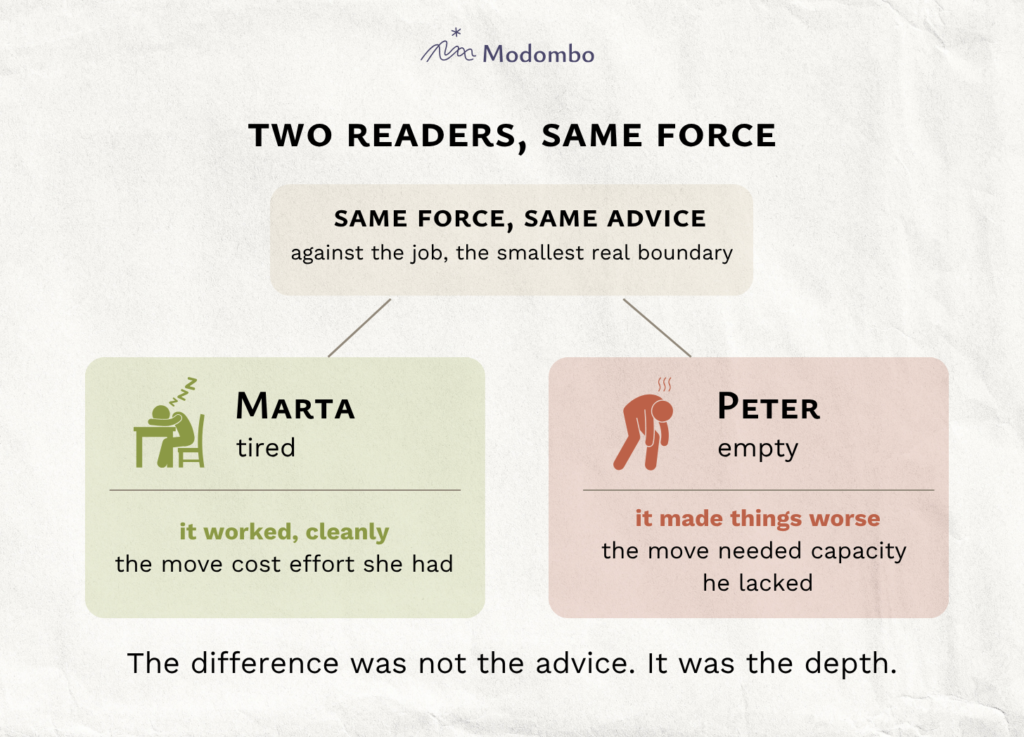
Picture two people who read last week’s letter. Call them Marta and Peter. Both recognised themselves in the same force. Both, say, are spending against a job they have come to dread. Same diagnosis, same direction, same advice: the smallest real boundary, and if the boundary proves impossible, the courage to leave.
Marta does it. She renegotiates one recurring meeting, holds the line for two weeks, feels the difference, and three months later she has changed teams. It worked, cleanly.
Peter does the same thing and it goes wrong. The renegotiation takes more out of him than it gives back. The two weeks of holding the line feel like two more projects on a desk already sliding. A month in, he is worse than when he started, and he draws the obvious, wrong conclusion: even the correct fix does not work on me.
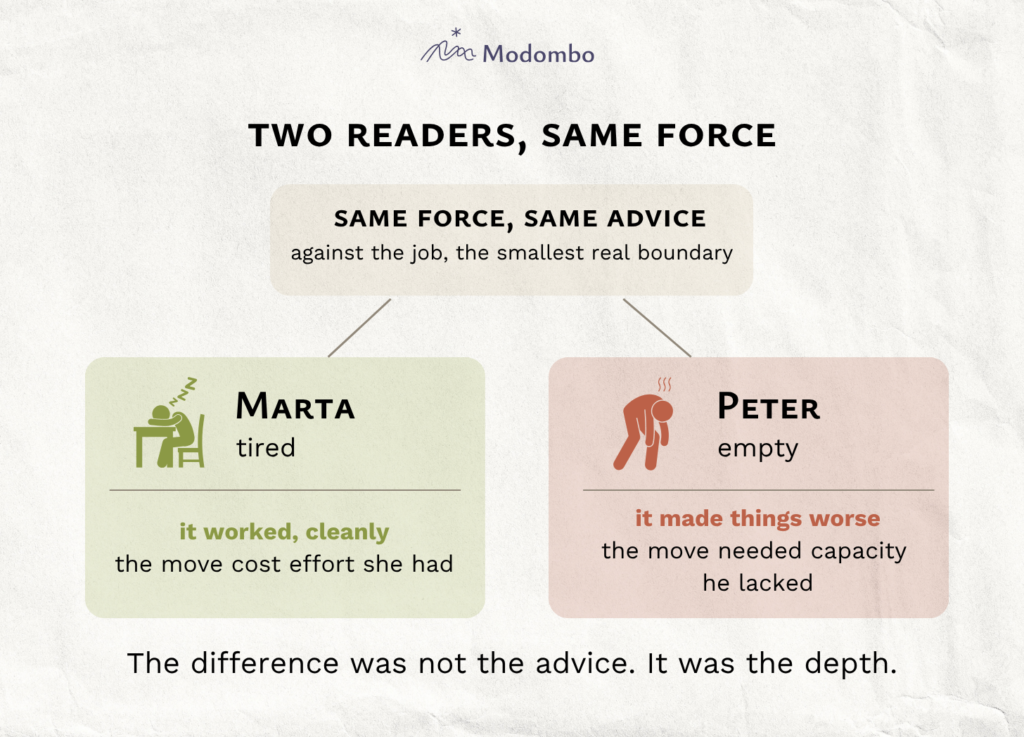
Nothing was wrong with Peter, and nothing was wrong with the advice. The difference was position. Marta was tired. Peter was empty. The same move that cost her a manageable effort demanded capacity he no longer had, and a move you cannot afford does not heal you. It drains you further.
A move is only right at the depth that can afford it.
The three bands
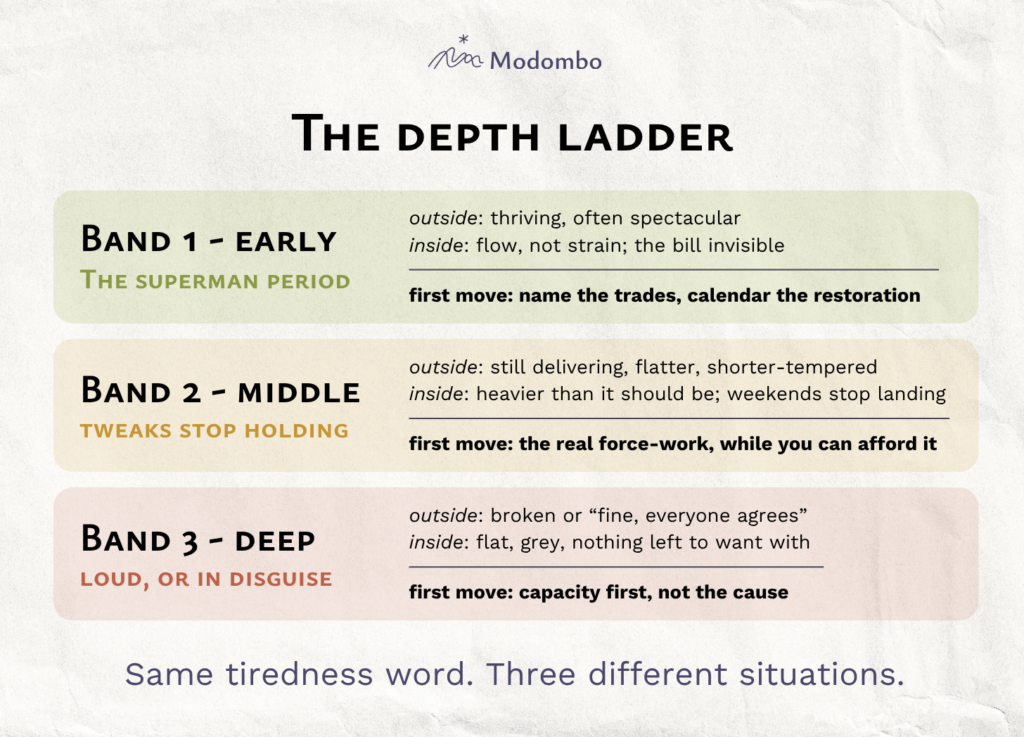
Depth is not a smooth slide. In practice it comes in three rough bands, and each one looks different from outside, feels different from inside, and wants a different first move. Finding your band matters more than any other single thing in this series, and it is harder than it sounds, because from inside, the borders are blurry.
Band one is the early band, and its nickname in my practice is the Superman period. From outside, this person is thriving, often spectacularly. From inside, it feels like flow, not strain. The work is fascinating, the pace is intoxicating, the results keep coming. Meanwhile the body and the closest relationships are already thinning, and the person cannot feel it, because at this stage the bill is invisible. The tiredness, when it comes at all, still answers to a weekend.
Here is what I tell the band-one clients who sit across from me radiating capability: the enthusiasm is not free. It is being financed by something. Usually by the body, the partner, or the hobbies that used to make life feel like yours, and you never chose those trades. They just happened while you were busy being excellent. So the first move at this band is almost embarrassingly small: put recurring restoration in the calendar, and make one honest inventory. Name the two or three precious things currently paying for your pace, and decide on purpose which of those trades you actually accept. Not to slow down. To make the financing visible while it is still cheap to change.
The tragedy of band one is that nobody in it believes they are in it. And the few who admit it believe something almost as costly: that there is no real bill. That the body will forgive, the marriage will wait, and the friendships will be there when the sprint ends. The bill is real. It is just quiet.
Band two is the middle band, where the thrill has cooled and the tweaks stop holding. From outside, this person is still delivering, just flatter, more irritable, and the people close to them have started saying something. From inside, everything is heavier than it should be. A good weekend no longer resets the week. The tricks that used to work, the early night, the protected Saturday, hold for a few days and then dissolve. This is the territory where the converter I wrote about in episode two starts to wear.
The first move at band two is the real one: the work matched to your force, the one you named in last week’s letter. Redistribution, boundaries, reclaimed agency, whichever your force calls for. It will meet resistance, and the resistance will come from inside, because part of you still loves, or fears, or cannot imagine losing the thing that is draining you. Band two is where the structural change belongs, and where you can still afford it.
Band three is the deep band, and it wears two faces. One face is visible collapse, the person who openly cannot continue. The other face is far more common and far better dressed. Still performing. Still delivering. Still showing up to every meeting with nothing at all behind the eyes. Fine, everyone agrees, especially the people who need him to be. From inside, band three is flat and grey, nothing left to want with, or it is one small failure away from not being able to start anything. This is the territory where the converter itself is down (see episode 2 of this mini-series).
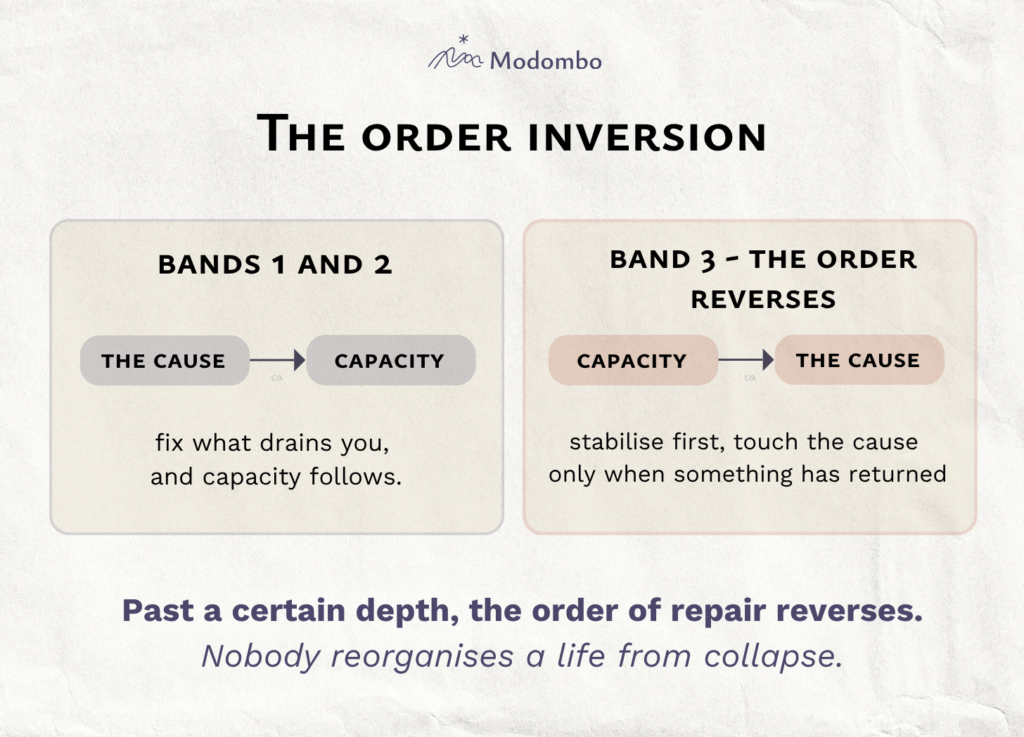
I want to be precise here, because this is the most important sentence in the letter for anyone reading it from the bottom: at band three, the first move is not the brave structural change. At band three, the order of repair reverses.
The order inverts
At bands one and two, the logic runs cause first. You fix what is draining you, and capacity follows. Cheap at band one, harder but affordable at band two. This is the logic all normal advice assumes, and within its territory it is correct.
Past a certain depth, it flips. At band three you stabilise first, and you touch the cause only after some capacity has returned. Sleep, the body, one steady support, tiny repeatable acts that give a little back, what I call micro-restorations, small enough to succeed on a bad day, and valuable twice over, because each one returns a little capacity and each one is proof that anything still works. The company redesign, the marriage conversation, the resignation letter: all of it waits. Not forever. Until there is something to make the move with.
Telling a wiped-out person to make big changes is like telling someone with no money to invest. The advice is not wrong about investing. It is wrong about the account balance. You need income before strategy, and at band three, micro-restorations are the income.
I know the objection, because band-three people are usually the most responsible people in the room: stabilising first sounds like procrastinating the real fix. It is not. It is what makes the real fix possible. The fix needs capacity, and band three has none to give. A person at one percent battery does not reorganise their apps. They find a charger.
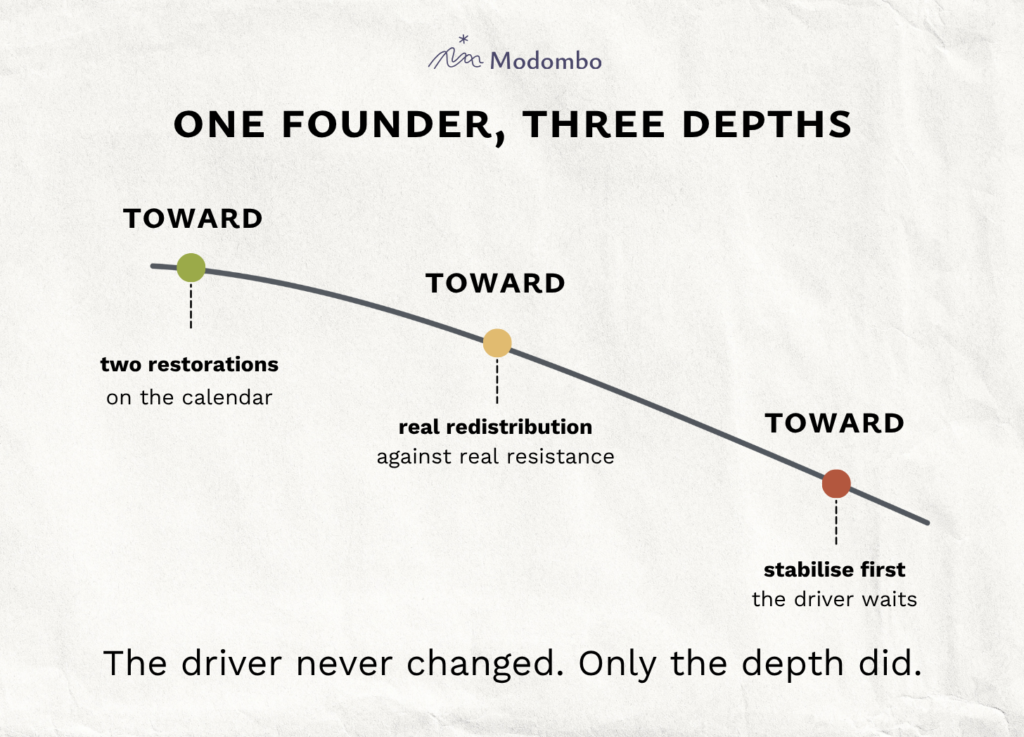
The same founder, three depths
To see how much position changes, take one person and move him down the slope. A founder, the kind I meet often. His force never changes: he is spending toward the company he loves, too hard.
Catch him early, in the Superman period, and the fix is almost nothing. Two recurring restorations in the calendar, the trade-off inventory, done. He will roll his eyes and do it, and it will quietly save him years.
Catch him in the middle band, and tweaks no longer hold. Now he needs real redistribution, actual protected evenings that outrank the roadmap, and he will resist it, because he still loves the work and hears “protect your marriage” as “betray your business.” Hard, affordable, and exactly the right move at this depth.
Catch him at band three, still shipping, on fumes, feeling nothing, and then one small setback, a deal that falls through, and he cannot start anything for weeks. Here you do not redesign his company. You stabilise: sleep, the body, one steady presence, clinical help if the flatness has tipped further than tiredness. Only when something returns do you go anywhere near the driver. The redistribution that would have saved him at band two is useless to him now. He has no capacity to redistribute.
Same person. Same force. Three different first moves, and the only thing that changed was the depth.
Where the line is
One more honesty, stated once and plainly. At the deepest end, this stops being newsletter territory. If the flatness is total and has been static for months, if nothing has tasted like anything for a long time, the honest possibility is that it has tipped into depression, and that is a medical situation, not a discipline project. The rough difference: the flat stretch of recovery slowly lifts, and the good things come back one by one. Depression is static, and the good things are simply gone. If your months look like the second, take it to a doctor or a therapist. That is not stepping off this path. It is the path, at that depth.
Before you act on last week
Somewhere out there is a person who once got exactly the right advice at exactly the wrong depth. They made the brave change, collapsed anyway, and carried away the quiet conclusion that they were beyond help. They were not. The sequencing was wrong, not them. If that person is you, this letter is the missing piece of the one that hurt you.
So before you act on last week’s letter, place yourself. That is what the rest of this one is for.
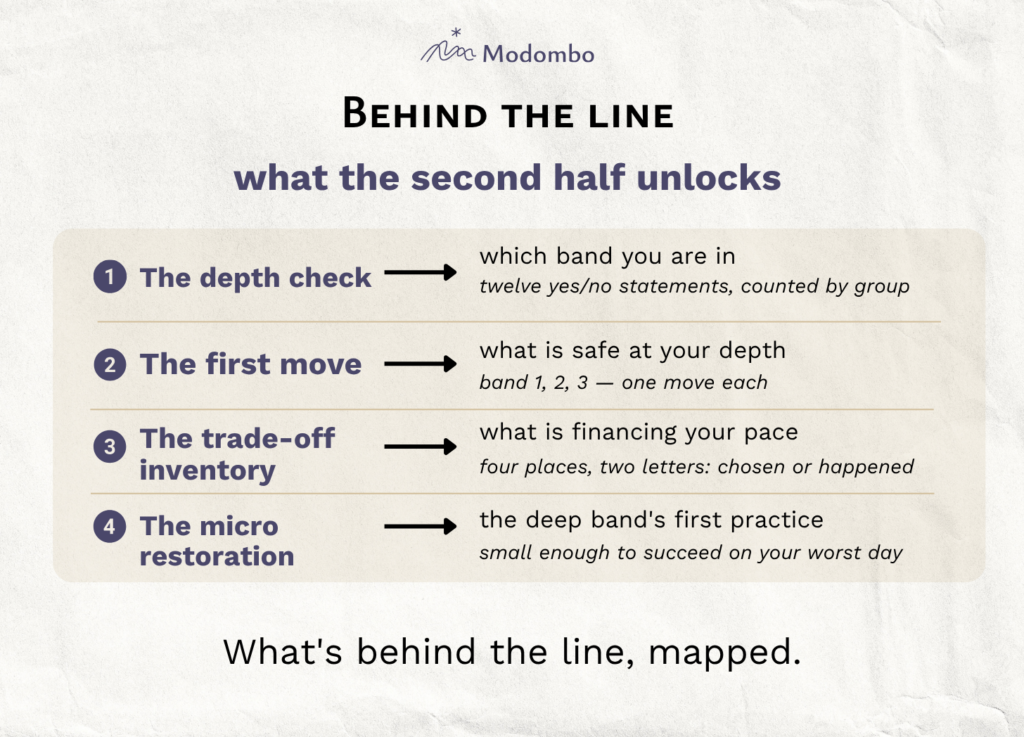
The practical half is for subscribers: a short self-check that locates your band, the first move for each band, the trade-off inventory for the Superman readers, the founder’s case walked through the check, one starter practice for the deep band, and the plain signs that it is time for professional help. The full episode, with all the tools, lives on Substack; if you are reading this anywhere else, that is where it continues.
What is coming in the next episodes?
Next time: The Texture Of Restoration. Restoration is not always rest. Sometimes the thing that restores you is a run, not a nap.

Related episodes
- NL R4 – The Three Ways Back — the direction half of the address. R5 is the position half; read them as a pair before acting.
- NL43 R2 – Why Rest Stops Working — the converter and the flat middle; band three is the territory where that machinery is down.
- NL35 B4 – Caregiver Burnout — the constraint force at depth, where “make big changes” insults hardest.
- NL31 B0 – Burnout Is Not One Thing — the series-one opener; depth here is the “how deep” axis of that map.