
If you have a difficult issue and you feel really bad, there are several options. You can stay alone with it. You can talk to friends. You can talk to a therapist. Or you can talk to AI.
Each option works. Each option does something different to your nervous system.
- Friends help you not be alone.
- Therapists help you not carry it alone.
- AI helps you think about it — alone.⠀
A simple comparison
Think of this as a comparison of psychological support plans. Same problem. Different operating principles. Different side effects.
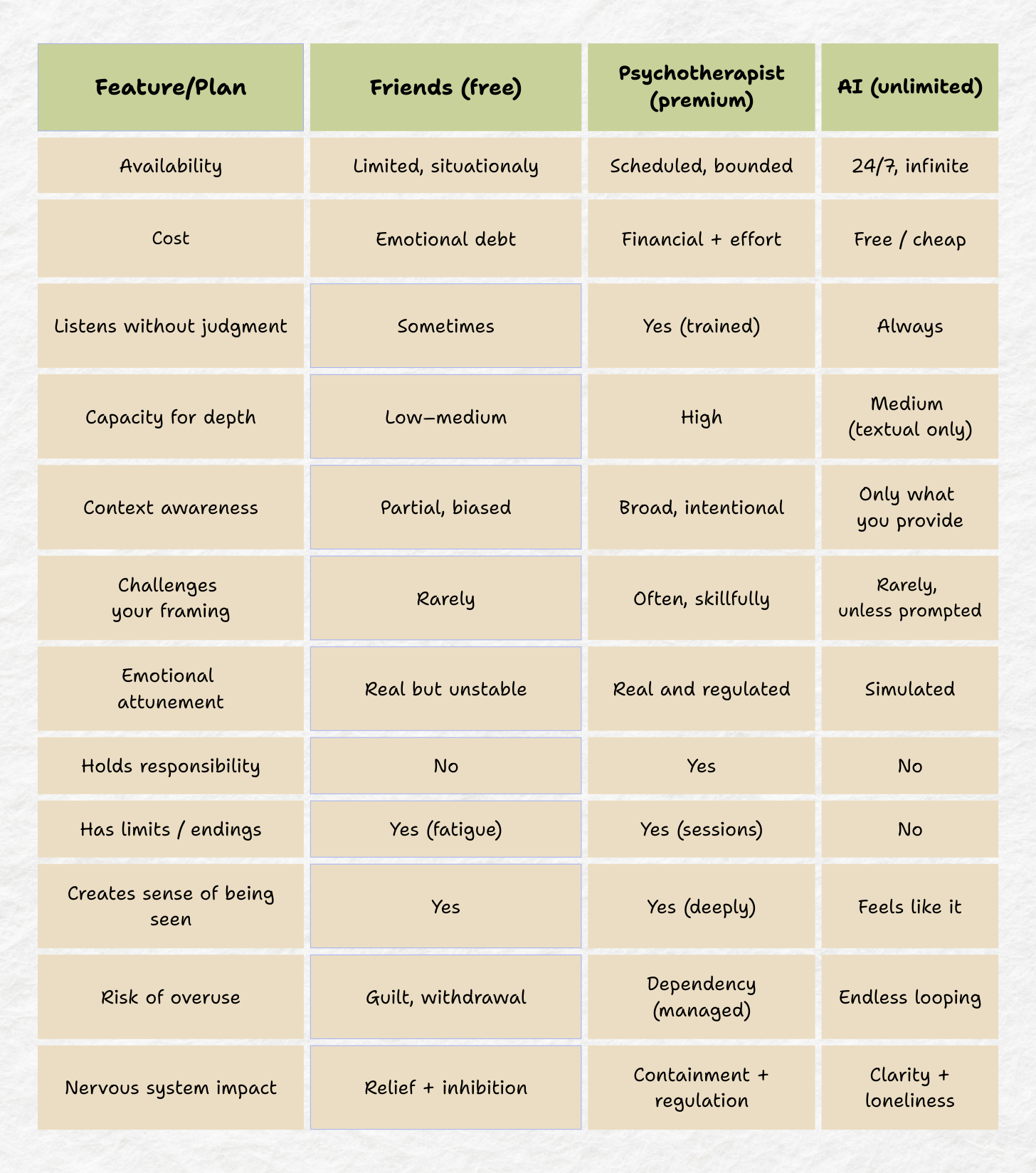
Side effects of AI as psychological support
This is not dramatic. It is predictable (usually):
- Not addiction
- Not delusion
- Not “AI replacing friends or therapists”
⠀But rather:
- delayed contact
- delayed containment
- delayed being seen
⠀Because:
- “AI helped enough for now.”
Why AI feels helpful — and still doesn’t settle things
AI does a few things very well:
- it organizes thinking
- it names patterns
- it produces reasonable perspectives
⠀What it does not do:
- hold concern
- notice subtle shifts
- carry consequences
⠀There is no external nervous system involved. So activation decreases — but does not resolve.
The typical inner state is not distress, but suspension:
- “This makes sense.”
- “I’m still not sure.”
Talking to AI / chatbots
What you get:
- immediate clarity
- usable language
- no shame
- no social cost
⠀ What is missing:
- no one notices when it’s too much — a therapist would sense overload, emotional flooding, or risk of re-traumatization
- no one reframes the question by default — friends or therapists often shift perspective or challenge the frame itself
- no one marks an endpoint — there is no equivalent of “We’ll stop here for today”
⠀Nervous system result:
- cognitive relief – confusion reduces, structure increases
- emotional suspension – feelings are named but not metabolized
- ongoing vigilance – part of the system stays alert, checking for certainty
⠀AI helps you understand. It does not help you settle.
Human context versus AI context
A psychotherapist — and sometimes wise friends — work with a wider context by default. They ask about your history and recurring patterns. They notice or deliberately explore your soft spots. They use intuition, training, and experience to sense what might be relevant but unsaid. They take into account the specific environment you live in and the pressures around you.
They may question the question itself. They may shift the frame entirely.
AI generally does not do this unless explicitly instructed. By default, it answers within the frame you provide. When the frame is incomplete, the clarity can still look convincing.
Final note — a clear position
My stance on AI in psychological topics
- I am not against using AI as a confidant, advisor, or counselor for psychological or relationship issues.
- On the contrary, I think it is genuinely valuable that people now have immediate access to a system that can:
- bring clarity,
- name inner experiences,
- organize confused thoughts,
- reduce acute distress.
⠀Why this matters in practice
- Getting access to a good psychotherapist often takes time.
- Waiting lists are long.
- The threshold to reach out is high.
- In many moments, immediate relief matters more than ideal conditions.
⠀In that sense, AI fills a real gap. And often, it fills it well.
What this text is (and is not) doing
- This is not a warning against AI.
- It is not a call to avoid it.
- It is not a moral judgment.
⠀What I am doing here is:
- naming the limits of this kind of interaction,
- and describing the qualities it has — and does not have.
⠀The core distinction
- AI can help you make sense of what is happening inside you.
- It cannot help you carry it.
- It cannot replace containment, relational presence, or shared responsibility.
⠀Both things can coexist. Knowing the difference helps people use AI more wisely, not less.
That is the point of this episode.