When one word stops being useful
I believe people when they sit down and say “I’m burnt out.” The word is almost always accurate. It is also almost always the wrong size for what they are describing.
“Burnout” collapses many different patterns into one label. Then the same generic advice gets applied to all of them. That generic advice is the right answer for one type. For the others, it misses, and occasionally it makes things worse.
What it actually feels like
You probably know the shape. Exhaustion sleep does not touch. A flatness where enthusiasm used to be. Work you used to care about now feeling like moving furniture you don’t remember buying. Something always slightly off in the body — shoulders, stomach, the quality of your sleep.
Not dramatic. Not yet. Which is the trap.
A scale, not a binary
The dramatic version is real. The person who finally crashes, takes six months off, has to relearn how to function from the bottom up — I meet them too. But they are the minority.
Most people live for years in the earlier stages. Quality of life degrades slowly, and you tell yourself this is just adult life. The middle region is where most of the damage happens, precisely because it is bearable.
The misdiagnosis trap
When people feel burnt out, they reach for the default response: do less, rest more, take more pauses. For one type of burnout, that is exactly right.
For the others, it is at best incomplete. Telling a caregiver to “set better boundaries” with a dying parent is close to cruelty. Telling rhythm-collapse burnout to reduce the load does not help, because the problem was never the total load. Telling identity-erosion burnout to rest leaves the person equally unhappy and now also bored.
If you don’t know which kind of burnout is actually happening to you, you will probably try to fix it with the wrong tool.
The patterns I see most often
In the room, these are the ones that keep coming back:
- Overload — too much for too long. The nervous system runs past its capacity until the restoration machinery itself breaks down. Rest restores function.
- Rhythm collapse — not necessarily too much work, but the wrong rhythm for you. Recovery cycles missing, or in a shape that doesn’t fit: no room for deep work, no siesta when your body needs one, no space to work in waves when that is how you function best. The environment or the role forces a daily or weekly rhythm that is not yours, and the body never fully resets.
- Toxic environment — the overload comes not from the volume of work but from the state of mind the environment produces. You feel unsafe, hypervigilant, constantly scanning for threat. That vigilance drains your mental capacity before the actual work even starts.
- Caregiver burnout / compassion fatigue — the load is someone else’s need, and you cannot put them on pause. You deplete yourself caring for someone whose situation does not improve on your schedule.
- Misalignment — the role fits, but the environment of the role clashes with your values. The friction between what you do and what you believe in drains what the work itself does not.
- Identity erosion — the role itself is wrong for who you are. Suppressing who you are to fit the role costs more energy than any workload.
- Neurodivergent burnout — your regulation capacity is different, and the load that fits others is the load that broke you.
These are the patterns I encounter most often. There may well be others — burnout is not a clean taxonomy, and human lives do not always sort neatly into categories.
Each one has a different mechanism and a different recovery path. A type-specific remedy beats a generic one every time.
Where to start, before reaching for a remedy
Three orienting questions are enough to slow the reflex:
- Is the load too much, or is there no pulse in it?
- Is the environment wrong, or is the role wrong?
- Is this load mine, or am I carrying it for someone else?
These are not diagnostic. They are just enough friction to keep you from applying overload remedies to a problem that is not overload.
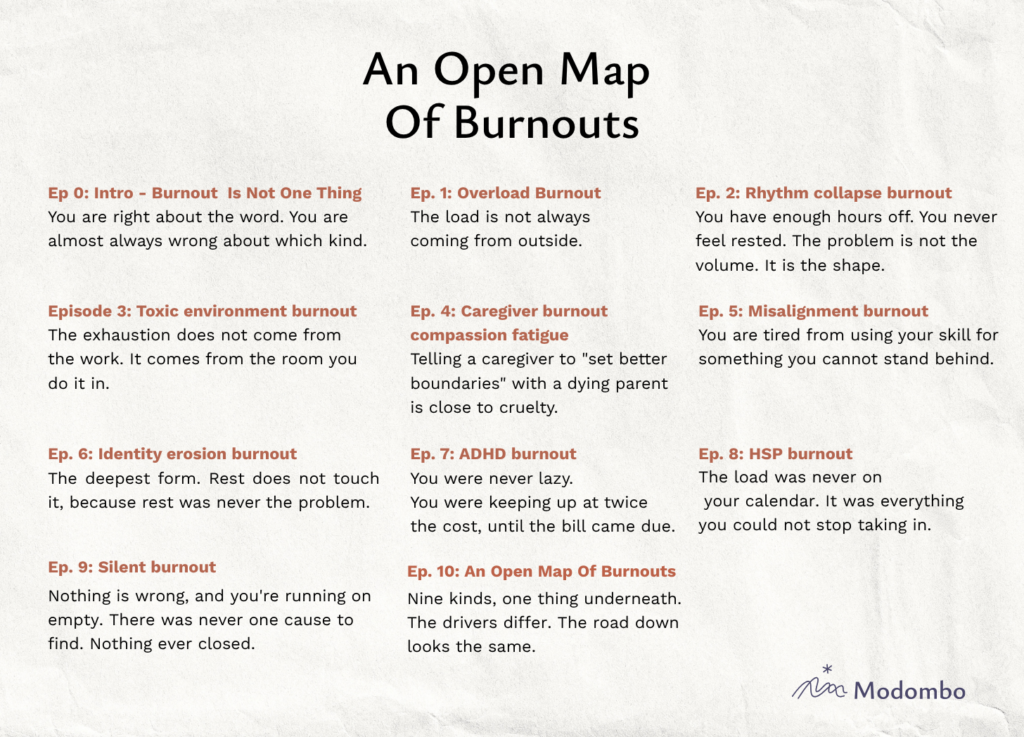
The episodes in this mini-series take one type each — how it sounds, why the standard advice fails, what actually helps. Starting with overload burnout, the one everyone thinks they have.
What is coming in the next episodes?
Next: Overload burnout. The one everyone thinks they have, often correctly. Why this is the single type where “rest more” is the full intervention, and why that is still not enough if the pusher is inside your head.