
Episode 1 — Tone and modulation
Why humans hear things AI doesn’t
Rough estimates suggest that somewhere between 25–50 % of questions people ask chatbots today are about personal psychological topics.
Relationships. Anxiety. Identity. Meaning. “What’s wrong with me?”
That makes sense.
- Chatbots are immediately available.
- They are calm, articulate, non-judgmental.
- Often, the answer is actually good enough.
And yet many people notice something subtle afterward:
- “I understand it better… but I don’t really feel settled.”
This mini-series is about that gap. Not to warn you away from AI as psychological support — but to map where it works well and where human care still operates differently.
We start with the most basic difference: voice.
Core distinction (simple and crucial)
- AI works with transcribed text.
- Humans work with sound, rhythm, and pressure.
Even when AI “listens”, current chatbots mostly:
- convert voice → text
- then process text only
What disappears immediately:
- how something is said
What this looks like in practice
A therapist, coach, or attentive friend may point out observations like:
- “You made a long pause before answering that you want to stay with her.”
- “Your breathing became heavier while you were explaining why this doesn’t bother you.”
- “You started talking much faster right after I asked about your father.”
- “When you mentioned your job, your voice got quieter and you started clearing your throat.”
These are observations, not interpretations. They describe what is happening, not what it means to you.
This matters, because in emotionally charged situations people usually don’t notice these signals themselves. Not because they are unskilled — but because stress narrows attention.
In theory, you could tell AI:
- “I’m speaking faster now.”
- “I’ve started breathing heavily.”
In practice, most people don’t notice these changes while they are happening. This is where psychotherapy and coaching can be so eye-opening: someone else notices what you cannot, and gently brings it into awareness.
That alone can invite:
- honesty
- clarity
- a first drop in tension
Before any explanation is needed.
What humans hear automatically
Humans do not need to analyze voice consciously. The nervous system registers it automatically.
A human listener notices:
- hesitation or sudden silence
- acceleration or abrupt slowing
- flattening or loss of melody
- trembling
- changes in volume
- dramatic or exaggerated intonation
- moments where words disappear or derail
- mismatch between calm words and tense sound
These signals are present even when the content sounds reasonable. They often appear before the person is aware that something is difficult.
Why this matters in difficult or intense situations
Voice changes are not just “communication details”.
They are often early warning signals.
They can indicate:
- emotional overwhelm before collapse
- rising anxiety before a panic attack
- destabilization before re-traumatization
- loss of safety before dissociation
- anger before acting out
A human listener can respond at this early stage:
- slow the pace
- ground attention
- reduce stimulation
- interrupt escalation
This often prevents things from going further.
Where AI support structurally differs
AI works after experience is translated into words.
Unless you explicitly write:
- “I’m getting overwhelmed”
- “My anxiety is rising”
- “This feels like too much”
AI has no reliable access to:
- rising activation
- loss of regulation
- approaching panic
- subtle destabilization
So support tends to arrive later, when symptoms are already explicit. That shifts the role of help from: early regulation → to post-hoc explanation.
When human support becomes essential
In moments of acute distress — panic, collapse, suicidal thoughts, or re-traumatization — human support matters in a fundamentally different way.
Not because humans give better advice, but because crisis is not primarily a cognitive problem.
It is a state of the nervous system.
In these states, people often cannot reliably assess or report how bad things really are.
A trained human listener can hear risk before it is named and respond immediately — slowing the interaction, grounding attention, and actively supporting safety.
This is why, in crisis, even a phone call with a trained human can be far more protective than a well-written response from an AI system.
What this tells us about AI versus human care
AI can be:
- clarifying
- verbally supportive
- educational
- helpful for naming inner experience
- sometimes exactly enough
But it mostly operates after meaning is verbalized. Human care often begins before meaning,
at the level of:
- voice
- rhythm
- pressure
That difference becomes critical when things are intense.
One-sentence takeaway
AI hears what you say. Humans hear how you are.
Next episode: what the body communicates long before words do.
What’s coming next in the future episodes?
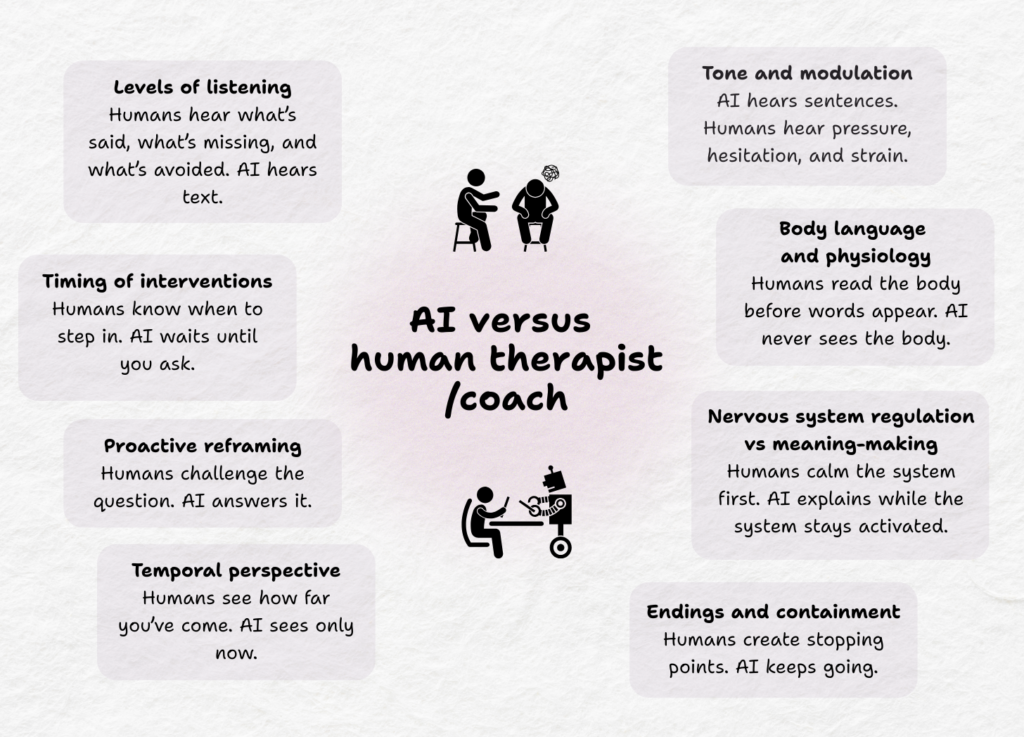
We’ll go step by step through several differences between AI as therapist and human care:
- Tone and modulation ← today
- Body language and physiology
- Nervous system regulation vs meaning-making
- Levels of listening
- Timing of interventions
- Proactive reframing
- Temporal perspective
- Endings and containment
Each episode focuses on one concrete difference. No theory overload. No moral panic.