Why Meaning Fails Without Regulation
Have you ever understood your problem perfectly — and still felt terrible? You could describe the pattern. You knew where it came from. You had a reasonable explanation. And nothing changed. You still felt emotional.
So far in this mini-series, we explored voice and body language — what humans register and AI currently cannot detect. Now we move one layer deeper. This is no longer about observation. It is about co-regulation.
The illusion of insight
Insight feels powerful. When something makes sense, we assume progress has happened. But understanding and regulation are not the same process. Explanation happens in the cortex — that part of the brain where words, meaning, and analysis dwell (yes, I simplify).
Regulation happens in the body. Stress, anxiety, tension, agitation, fear, anger — these are not abstract ideas. They are physiological states: breath changes, muscle tone shifts, heart rate accelerates, perception of threat increases.
You can explain your grief perfectly. It will not remove the pain. You can analyze your burnout precisely. It will not calm your nervous system. Insight does not automatically modulate your emotional or physiological state.
What happens when you speak to a regulated human
Something different occurs when you sit with a steady person. If someone feels grounded, present, and accepting, your nervous system does not remain untouched. Breathing slows. Muscle tension softens. Eye contact stabilizes. Pace shifts. This is not abstract empathy. It is physiology. Co-regulation means your nervous system borrowing stability from another regulated nervous system.
Think about grief again. When someone sits with you quietly, the pain does not disappear — but it becomes more bearable. Not because of explanation. Because of shared regulation.
AI explains. Humans regulate.
AI operates primarily at the level of meaning:
- Narrative — putting experience into story
- Pattern recognition — identifying recurring dynamics
- Clarification — organizing confusion into structure
Human therapeutic presence operates at the level of state:
- Co-regulation — stabilizing activation
- Modulation of arousal — slowing escalation or supporting mobilization
- Safety signaling — subtle nonverbal cues that reduce perceived threat
This distinction matters more than it first appears. This is no longer about who you talk to. It is about whether your nervous system can metabolize what is said.
Why state determines whether insight works
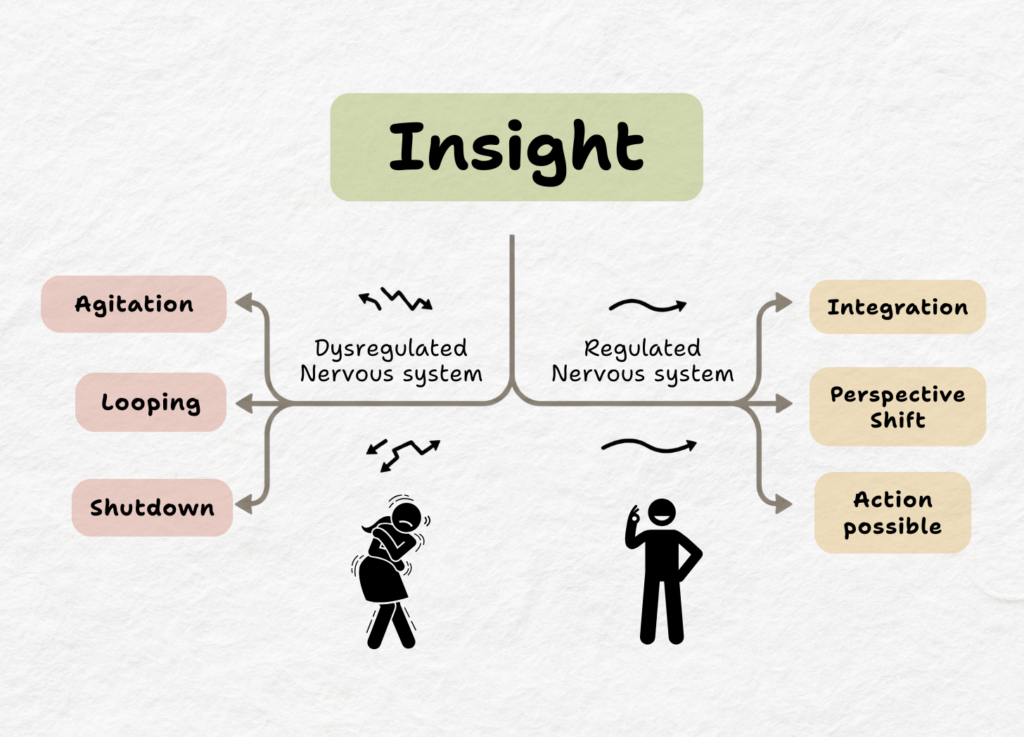
When you are highly activated (sympathetic arousal), thinking narrows, threat scanning increases, interpretation becomes defensive, and cognitive flexibility drops. In this state, insight can actually fuel rumination. More perspectives to be anxious about. More angles. More loops to agitate you. Depth of insight becomes another variable to manage.
When you are collapsed, energy drops, motivation fades, and action feels distant. You may agree with the insight. You simply cannot mobilize it: “Oh, I see … whatever …”
In both states, insight may be accurate. But it does not translate into change. You can apply insight only when your nervous system is within its window of tolerance. A dysregulated brain cannot integrate insight.
How AI can unintentionally amplify dysregulation
AI excels at expanding interpretation, offering alternative framings, and generating conceptual clarity. But in dysregulation, more framing can mean more cognitive load, more angles can mean more mental loops, and more insight can mean more internal pressure.
If you are activated, explanation can intensify analysis. If you are collapsed, explanation can remain intellectually interesting but emotionally irrelevant. Sometimes this becomes subtle dissociation — moving upward into thinking to avoid uncomfortable bodily activation. The mind becomes articulate. The body remains dysregulated. You can stay in an infinite thinking loop.
Why this is important for people in chronic overload
High-performing professionals often live in cognitive overdrive. They analyze brilliantly, explain flawlessly, and solve everything through thinking — and remain activated.
Without regulation, insight becomes another layer of mental work. Thinking itself becomes the overload mechanism. With regulation, insight becomes usable.
The shift in this series is no longer: “AI misses non-verbal signals.” It is: “Even perfect explanation fails in a dysregulated nervous system.” That distinction changes how we use both AI and therapy.
Final note
I am not against AI as psychological support. Sometimes explanation is enough. Sometimes clarification truly helps. But when the nervous system is activated or collapsed, regulation must come first.
Knowing the difference is what allows us to use AI wisely — and to know when human presence becomes essential.
I explore these themes further in the Modombo Brief newsletter — published here on LinkedIn and in extended form on Substack, where you’ll also find slides and simple schemas.
What’s coming next in the future episodes?
We’ll go step by step through several differences between AI as therapist and human care:
- Tone and modulation
- Body language and physiology
- Nervous system regulation vs meaning-making ← today
- Levels of listening
- Timing of interventions
- Proactive reframing
- Temporal perspective
- Endings and containment
