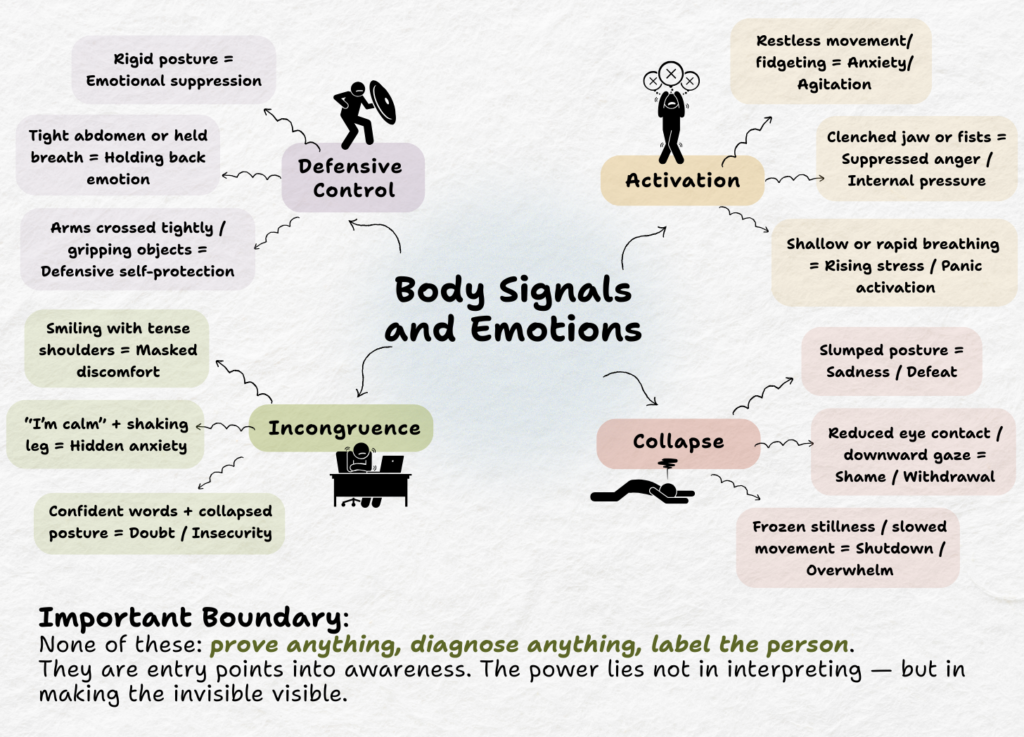
Episode 2 — Body language and physiology
What the body reveals before words do
You can say all the right words. You can explain your situation clearly. You can sound rational, coherent, even insightful.
And still — your body may be telling a completely different story. Most people are not aware of what their body is communicating while they speak. And that matters more than we like to admit.
The core distinction
AI works with language. Humans work with the whole organism.
A therapist, coach, or attentive listener doesn’t only hear your words. They see:
- posture
- muscle tension
- breathing patterns
- restlessness
- collapse
- freezing
- subtle gestures
- eye movement
- facial micro-expressions
AI doesn’t.
What this looks like in practice
A therapist may notice things like:
- You say you’re “fine,” but your shoulders are lifted and rigid.
- You describe a conflict calmly while your hands clench.
- You talk about your partner while your body subtly leans backward.
- You mention your father and your breathing becomes shallow.
- You speak about success while your posture collapses.
These are not interpretations. They are physiological observations. Often the person speaking has no conscious awareness of these signals.
Why people don’t notice their own body signals
Under stress:
- attention narrows
- internal awareness decreases
- survival systems activate
- cognitive processing dominates
Most people are trained to explain themselves — not to sense themselves. Without training, very few people reliably detect:
- when they freeze
- when they dissociate
- when their breathing shortens
- when their body braces
- when they subtly withdraw
This is where human presence becomes powerful.
How body awareness changes therapy
When a therapist says:
- “Your hands tightened when you said that.”
- “You stopped breathing for a moment.”
- “You leaned back just now.”
Something shifts. The person is invited to:
- slow down
- feel what is happening
- reconnect with bodily experience
- regulate before explaining
This often opens material that would stay hidden if the conversation remained purely verbal. Body awareness can reveal:
- suppressed anger
- fear masked as rationality
- grief hidden under analysis
- trauma responses before narrative memory
Words may defend. The body rarely lies.
What AI cannot access
AI cannot see:
- collapse
- agitation
- shutdown
- tears held back
- trembling
- dissociation
- subtle withdrawal
⠀Unless the person explicitly types:
- “My hands are shaking.”
- “I feel frozen.”
- “I stopped breathing.”
And most people don’t. So AI works with what is declared, not what is embodied.
Why this matters for overload and chronic stress
Chronic overload often lives in the body before it becomes a story.
- tension becomes normal
- shallow breathing becomes baseline
- collapse becomes personality
- agitation becomes identity
If only language is processed, the deeper regulation work may never begin. You can understand your burnout perfectly — while your body remains in chronic activation.
When body signals are critical
In intense states:
- panic
- trauma activation
- dissociation
- emotional flooding
Body signals often escalate before cognition does. A human therapist can intervene by:
- grounding
- shifting posture
- regulating breath
- slowing tempo
- re-establishing safety
AI cannot do this in real time.
What this tells us about AI and human care
AI can:
- clarify
- structure
- reframe
- suggest techniques
But it does not see your organism. Human care begins where language ends.
One-sentence takeaway
AI works with your story. Humans work with your body.
What’s coming next in the future episodes?
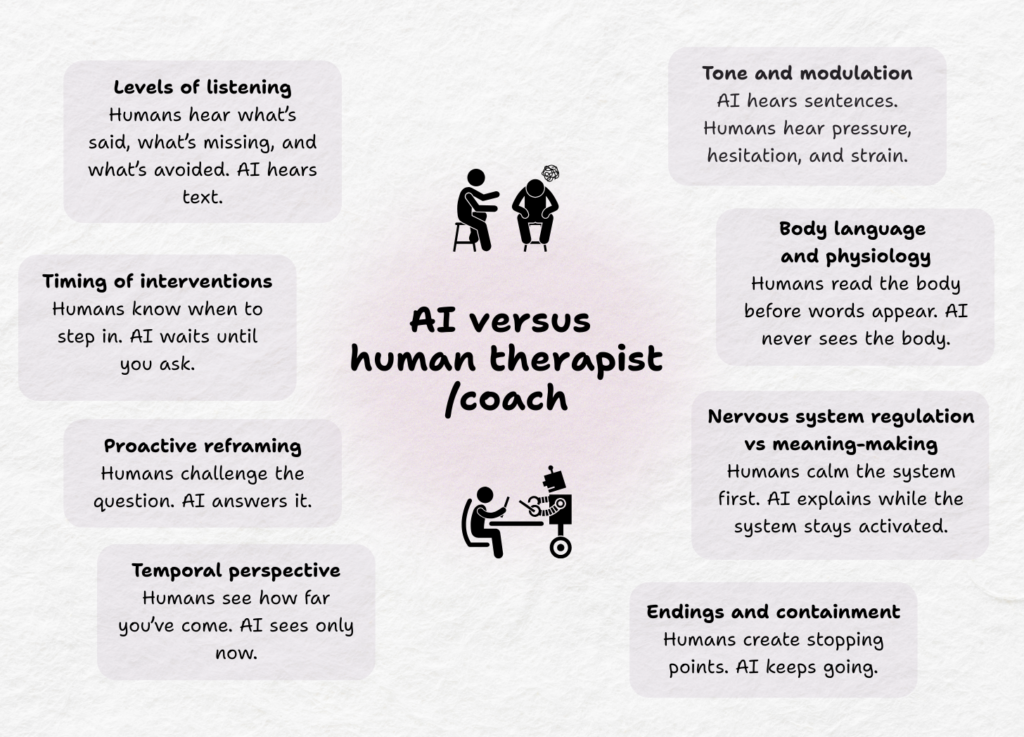
We’ll go step by step through several differences between AI as therapist and human care:
- Tone and modulation
- Body language and physiology ← today
- Nervous system regulation vs meaning-making
- Levels of listening
- Timing of interventions
- Proactive reframing
- Temporal perspective
- Endings and containment
Each episode focuses on one concrete difference. No theory overload. No moral panic.