He did the recovery exactly right. The leave approved, the calendar cleared, the phone in a drawer. Sleep, walks, no obligations — the full prescription, followed to the letter. By Wednesday the restlessness had a temperature. By Thursday the scrolling had a life of its own: two hours gone, nothing read. By Sunday he was more exhausted than the day the leave began, and he drew the only conclusion the evidence seemed to allow — rest doesn’t work on me. I must be past the point where rest works.
Nothing was wrong with him. The prescription was for a different nervous system.
Eight letters of this series taught recovery — gaps, quiet beats, closure, phases. All of it stands. But the last one ended on a warning: the map bends with the nervous system reading it. For the wiring that burns out off a cliff, the naive reading of this series’ own advice does not just miss. It backfires.
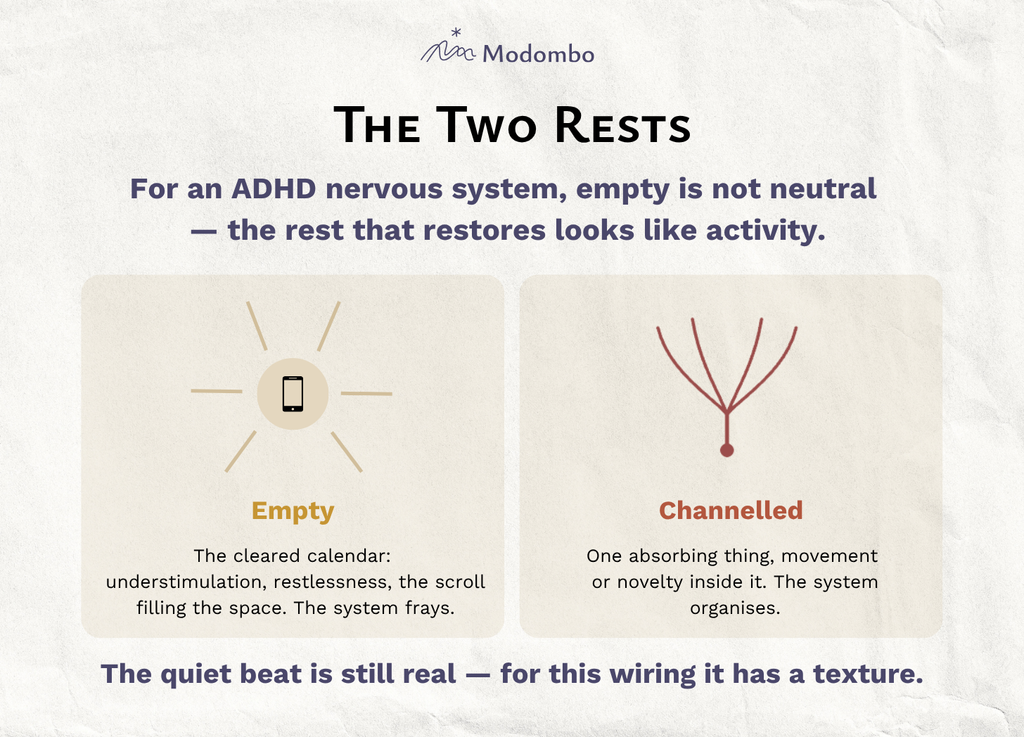
An empty calendar is not rest for this wiring. It is famine.
The wrong prescription
My episode on ADHD burnout said it in one paragraph. This letter is that paragraph given the room it deserves. An ADHD nervous system runs on a throttle closer to a switch than a dial — that was the burnout episode’s picture, and it holds on the recovery side too. This system does not idle. Cleared of everything, it does not settle the way the prescription promises — the void reads as famine, and the system goes hunting for stimulation wherever stimulation can be had. The thumb finds the feed. The kitchen gets visited hourly. A minor errand inflates into an urgent mission by mid-afternoon. Each hunt costs more than it brings back, which is how a man three days into prescribed nothing can be spending energy faster than he did at work.
So the recovery paradox, stated plainly: the advice most often prescribed to this wiring is the advice most likely to deepen the crash. Take time off. Do nothing. Slow down. For most nervous systems, that is where repair begins. For this one it strips away the last of the stimulation at the exact moment the system cannot generate its own — and then hands the person a second failure to blame themselves for. Whoever concludes, mid-way through the empty week, that they are beyond help is not reading their brokenness. They are reading the gap between the prescription and the patient.
And no earlier letter gets retired — that matters. The cycles still need to complete. The days still need to close. The flat middle is still where recovery lives or dies. What changes for this wiring is not the map. It is the texture of every stop on it.
The right kind of more
What restores this wiring is not the absence of demand. It is the right presence. The system needs a channel — something engaging enough to organise the restlessness. Water without a channel spreads everywhere and does damage; the same water given a riverbed flows, and drives things. One absorbing thing, ideally with movement or novelty inside it, does for this nervous system what silence does for others. From the outside it looks like activity. From the inside it reads as regulation.
Which is why the recovery that finally works tends to look, to everyone watching, like the opposite of recovery. Ten days on an unfamiliar coastline, a bike, a route to figure out each morning — obligations genuinely set down, not smuggled along as a working holiday — and he comes back regulated for the first time in a year. He has given up explaining to his family that the two-hundred-kilometre trip was, medically speaking, bed rest. His smartwatch logged the entire recovery as exercise. The mechanics: the channel organised the restlessness, the novelty held the attention, and nothing was asked of the executive function that burnout had emptied.
Rest that does not fit your wiring is just more demand.
The sixth letter closed on that line; this letter is that sentence at full depth. The channel is the quiet beat. Not a substitute for it, not a compromise — the thing itself, in the only texture this nervous system absorbs. The garage reorganised at eleven at night can be a deeper rest than the meditation app ever was before it got deleted on day two. The measure was never how restful it looks. The measure is what the system does inside it: organise, or fray.
I know this one from inside. My second burnout arrived the year we sold our startup and my first child was born. A former co-owner, suddenly in a senior management seat at the company that acquired us, a baby at home, regular trips to the US with the jet lag stacked on top — by the end of that year there was nothing left. And I remember precisely how nothing passive worked on me. I have quite strong ADHD. I did not need sleep, or rest, or a walk in the forest. What repaired me were weekends of hard physical work around the house. I kept a long paper list of options — dig the new vegetable bed, cut the dry trees, mow the lawn — no timelines, no due dates, no yesterday’s decisions to obey. I would scan it and take whatever pulled at me that morning. No screen, no people; alone and sweating in the garden. Two details mattered more than I understood at the time: the list did the remembering for me, because at depth I could never recall what I might do — and striking through the finished lines was pleasure, not reporting. It was never a project. It was a channel with a menu.
Arranged to arrive
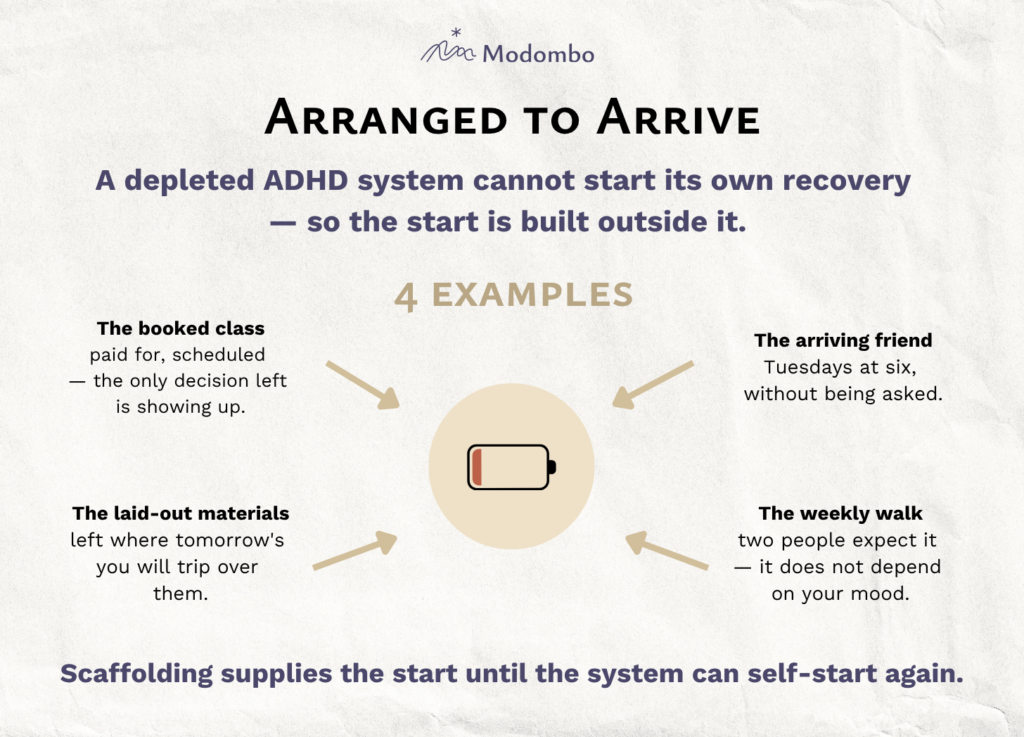
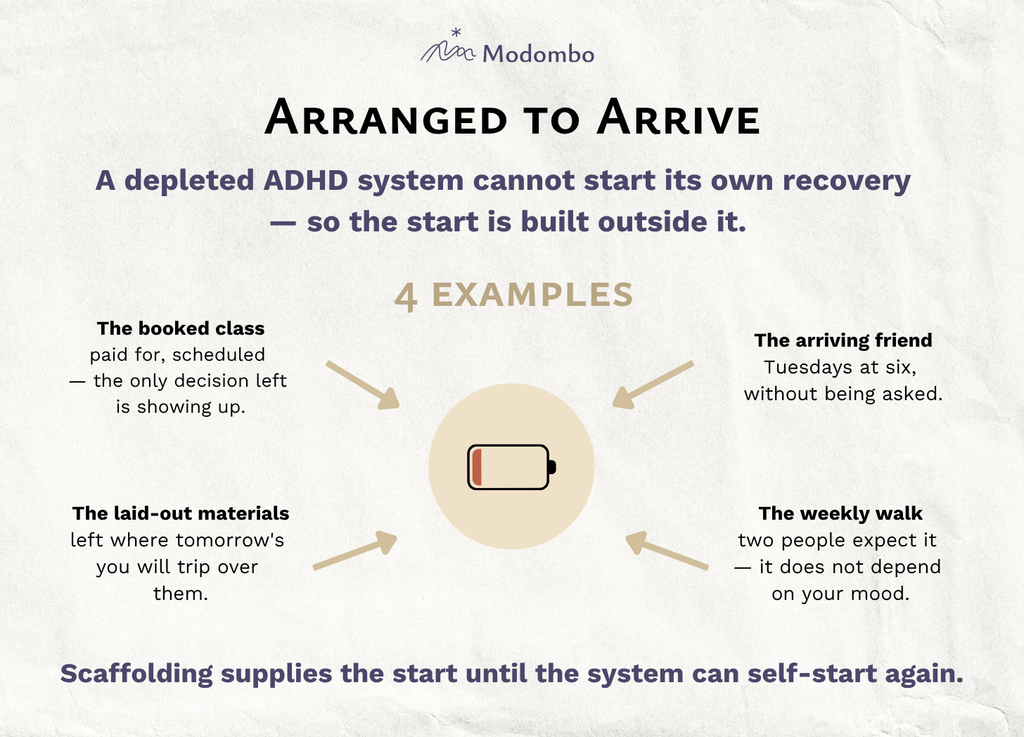
Here is the cruellest interaction in this whole series. A depleted ADHD system cannot generate its own activation — and nearly every recovery instruction ever written begins with a verb. Choose a hobby. Start moving. Build a routine. Each one runs on executive function, precisely the resource that is gone. The burnout episode named the trap — a depleted system told to repair itself using the function that is depleted. On the recovery side it cuts deeper: even the good advice, the channel from a section ago, arrives as one more thing you cannot start.
So ADHD recovery is architecture before willpower: it has to be arranged to arrive. The class already booked and paid for, so the only decision left is showing up. The weekly walk with a friend, which happens because two people expect it — not because you felt like starting it. The materials left out on the table overnight, where tomorrow’s version of you will trip over them. And the paper list of options — the garden list from a section ago — pinned where you cannot miss it: no order, no deadlines, just honest candidates waiting for whichever impulse shows up.
At her worst point, she could not have organised a walk, let alone a recovery. Her friend didn’t ask — just showed up Tuesdays at six, with the dog. Months later she calls those walks the thing that saved her, and the honest mechanics are the point: she never once had to start them. That is not a lesser recovery. For this wiring, at depth, it is the only kind that reaches.
The fifth letter’s order of operations holds — stabilise first — but the content changes. Stabilising, for this wiring, does not mean arranging stillness. It means arranging stimulation that arrives on its own. And if you love someone with this wiring, this is the most useful sentence in the letter: showing up without being asked is not intrusion. It is how recovery starts when starting is the thing that broke.
Scaffold, not project
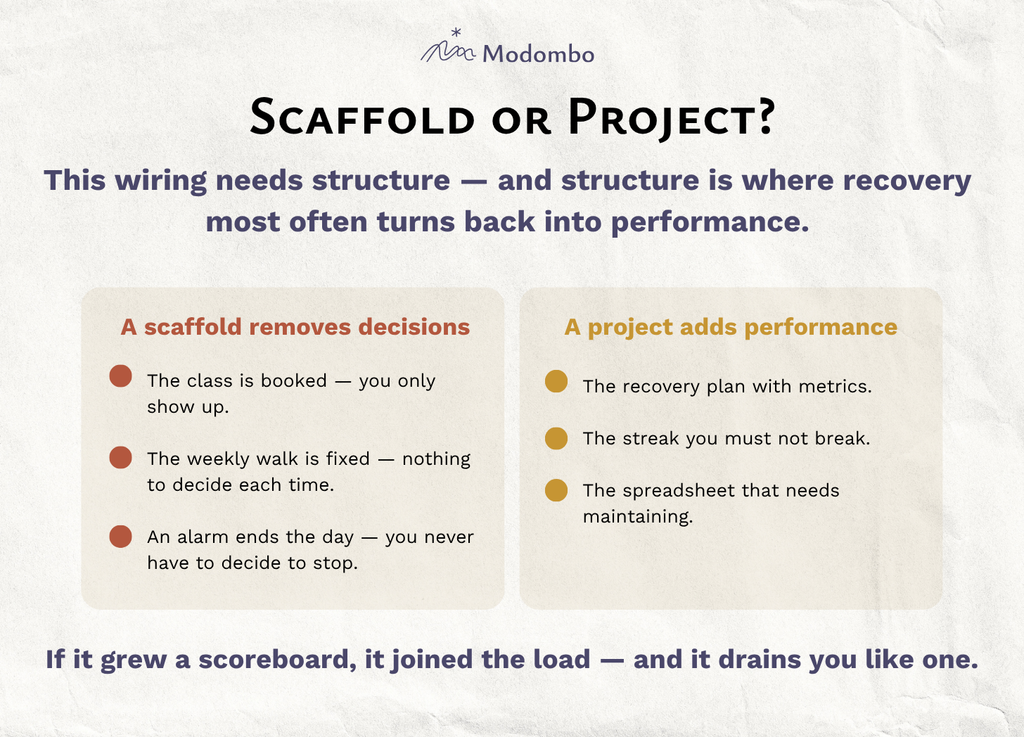
The sixth letter warned about recovery run as a project. This wiring genuinely needs external structure. Both are true, and the discriminator is one line: a scaffold removes decisions; a project adds performance. The booked class that happens to you is a scaffold. The colour-coded recovery plan you must maintain, track, and feel guilty about is a project — the performer performing rest, back for one more season. If the structure grew a scoreboard, it quietly joined the load. (The recovery spreadsheet with a column for spontaneity is not a hypothetical. Someone reading this has it open.)
The same scaffolding answers the day that will not close. The sixth letter taught closure — the day ends. For this wiring the open loop is not a habit problem; it is the wiring’s relationship to unfinished interest, and the transitions between intensities are where the invisible cost hides. So closure gets scaffolded too, not willed: an end-signal that lives outside your head, a buffer between the hyperfocus and the dinner table, a calendar that ends the day because the mind won’t. The paid section builds that tool. And one near-free practice on top: keep a list of your open mini-projects, and whenever you put one down — however chaotically — write a single line: the next step. The loop lets go the moment its next step exists somewhere outside your head.
Where you fall back
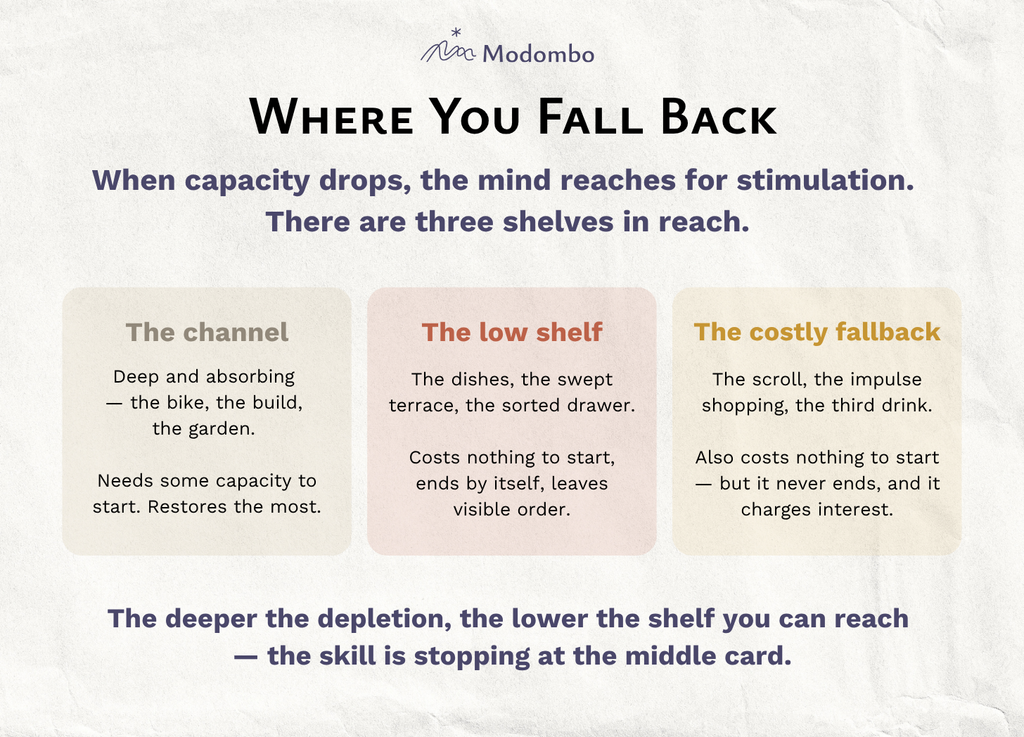
Clinicians who work with ADHD describe this mind as organising itself around stimulation — and when nothing worth organising around is in reach, it does not stop organising. It falls back. Everyone with this wiring has a fallback, and almost nobody chose theirs. There are good ones: the grounding walk, the conversation that sorts the thoughts, the reliable channel. And below these sits a whole shelf of small, honest ones that almost nobody counts as recovery: doing the dishes, clearing the desk, sweeping the terrace, sorting the screwdriver drawer, brushing shoes, a simple counting game that ends. Stimulation as cheap as the scroll — no starting energy, no plan, nothing at stake if you do it badly — except it ends by itself and leaves a small piece of visible order behind instead of charging interest.
And there are the others — the scroll, the impulse shopping, the joint, the third drink, the porn. Stimulation of last resort, reached for precisely when the system is too depleted to arrange anything better.
Look at the mechanism before judging it. At genuinely low capacity, the channel and the scaffold are out of reach — arranging them takes exactly the activation that is gone. So the system self-medicates with whatever stimulation is zero-effort and always within arm’s length. That is not weakness. That is the wiring buying stimulation at the only price it can currently pay. The problem is not the buying; it is that the cheap sources charge interest — they feed the restlessness for an hour and hand back a system more fragmented than they found it.
The move is not abstinence. It is noticing, then trading down. Noticing first, and rehearsed in advance, because the moment itself has no capacity for analysis — one sentence, prepared while capacity is high: this is depletion, not desire; it will cost more than it gives. Then substitution, never subtraction, because the fallback is doing a real job — it supplies stimulation, and a job can only be traded, not deleted. The show with a final episode instead of the scroll without one. The wishlist instead of the buy button: the hunt, minus the bill. The brisk walk with a podcast in your ears instead of the third drink. The game with a final whistle instead of the feed. One step down the cost curve, not a leap to zero. Willpower appears nowhere in this sequence, and that is by design — this wiring’s willpower is the resource that is already gone when the fallback fires.
Relapse looks like enthusiasm
The second letter’s flat grey middle is dangerous for everyone. For a boredom-intolerant system it is nearly unbearable. The long stretch where nothing improves and nothing reads — this wiring experiences it as understimulation, and every reflex it owns fires at once: quit the boring recovery, load something new, invent an urgency. Each reflex reads as relief, and each one resets the clock. And the grey stretch is when the harmful fallbacks from the last section call loudest: nothing is gripping you, so the scroll and its cousins offer themselves as the only stimulation in the room.
The counter-move is not patience — it is preparation, in two forms. The fixed slot: the channel scheduled into the flat weeks, so the understimulation meets arranged stimulation instead of a reflex. And the list of options, kept where the grey can find it: at low capacity the healthy fallbacks are exactly what the mind cannot recall, so the paper does the remembering — a menu of better moves for the moment the scroll offers itself.
Then energy returns, and the real trap springs — because returning energy wakes the yes-engine first.** The burnout episode named the engine: novelty pulls, and yes still proves your worth. So the reload does not arrive looking like relapse. It arrives dressed as health: the new project, the fresh commitment, the sudden burst of plans, greeted by everyone around you as proof of recovery. The third letter’s Monday reboot, with the engine now named.
The workable defence is a quarantine: when the burst of plans arrives, every new commitment waits two weeks. A real want survives the fortnight; a reload does not — and the burnout episode’s standing rule, no yes in the moment, was built for exactly this day. And if willpower has one legitimate job anywhere in this letter, it is here — not in starting things, but in not acting. The discipline to leave an idea unexecuted: the reorganisation, the resignation, the bold restructuring of something that basically works, conceived in depletion or in the first rush out of it. Ideas from those states get written down, not carried out. The quarantine holds them until a steadier version of you gets to vote.
For this wiring, relapse rarely looks like collapse. It looks like enthusiasm.
Prevention, recalibrated
The eighth letter ended on three conditions that make a heavy load survivable — a say, a fit, a rhythm. In one refresher sentence: you have a say in how you are spent, your effort lands on things you can stand behind, and your weeks keep a real alternation — loud stretches that truly end, quiet stretches that actually restore, so capacity keeps coming back. For this wiring, each condition needs a translation. The say cannot run on willpower here, because saying no is executive function, so it gets defended by structure: the standing rule that no yes happens in the moment, the trusted person with a veto over the next exciting project. The fit is not about liking your job more: for this wiring, interests are the restoration channel itself, so a life stripped down to obligations is not merely dull; it is structurally unrecoverable. And the rhythm means quiet beats go into the calendar as scheduled stimulation, not scheduled emptiness — a fixed hour for the channel, not a fixed hour of nothing. One nuance for the eighth letter’s four-week wanting log: when wanting returns to this wiring, it tends to arrive as a hyperfocus spike — five days of one want, not a spread of small ones. Count it. It counts.
The family question
“So the empty beach holiday my family needs is impossible for me?” No. But stop negotiating whether the shared holiday happens, and start negotiating what is inside it. The same two weeks can hold the family and your channel — if the days are designed for it on purpose. Ours work like this: on holiday, my wife and I each get one or two hours a day strictly for ourselves. One of us takes the kids; the other disappears — reading, walking, writing down ideas, whatever restores. Two rules keep it honest. Real work never enters — no email, no administration; the holiday hygiene on that is absolute. And reflecting, ideating, creating counts as rest, because for both of us (both with ADHD) it genuinely is. Two hours of channel each, every day — and the family gets the regulated versions of both parents for the other twenty-two.
And children change the arithmetic in this wiring’s favour, not against it. Shared time works when the activity feeds the parent too. The parent who picks the shared thing they genuinely enjoy — the bike, the build, the water, the laser tag — gives the child a regulated parent. Time together chosen only for the child’s sake, endured heroically, becomes suffering performed as love, and children read the difference precisely. What looks selfish is the opposite: your channel is the family’s gain. (She relaxes by learning Finnish, and the family has learned not to ask.)
If this letter is only half yours
Some readers have been doing uneasy arithmetic for eight paragraphs: the absorbing thing restores me — right up until people, noise, or emotion come attached, and then it drains me worse than the emptiness did. That is not a contradiction in you. A restless, novelty-hungry attention system and a deeply processing, easily saturated sensitivity are separate axes, and plenty of people live on both. The combination carries its own trap, and it belongs in this letter: depleted, the restless side reaches for the cheap kind of more — the scroll, the crowd, the loud plan — which feeds the hunger for activation while flooding the sensitive side with exactly the fragmented input it cannot metabolise. The combined profile is the one most likely to recover in the way that deepens the crash.
If this letter’s medicine sounds like more poison to half of you — if the engaging thing drains you the moment people and noise come attached — the next letter is yours. It carries the opposite wiring, and the place where the two letters meet is where you live.
Four questions to locate yourself:
- When did rest last feel like punishment?
- What was the last thing that left you both calm and awake — and how long since you scheduled it?
- If recovery had to start without you starting it, what would already be in place?
- Where do you fall back when nothing holds your attention — and what does it cost the next day?
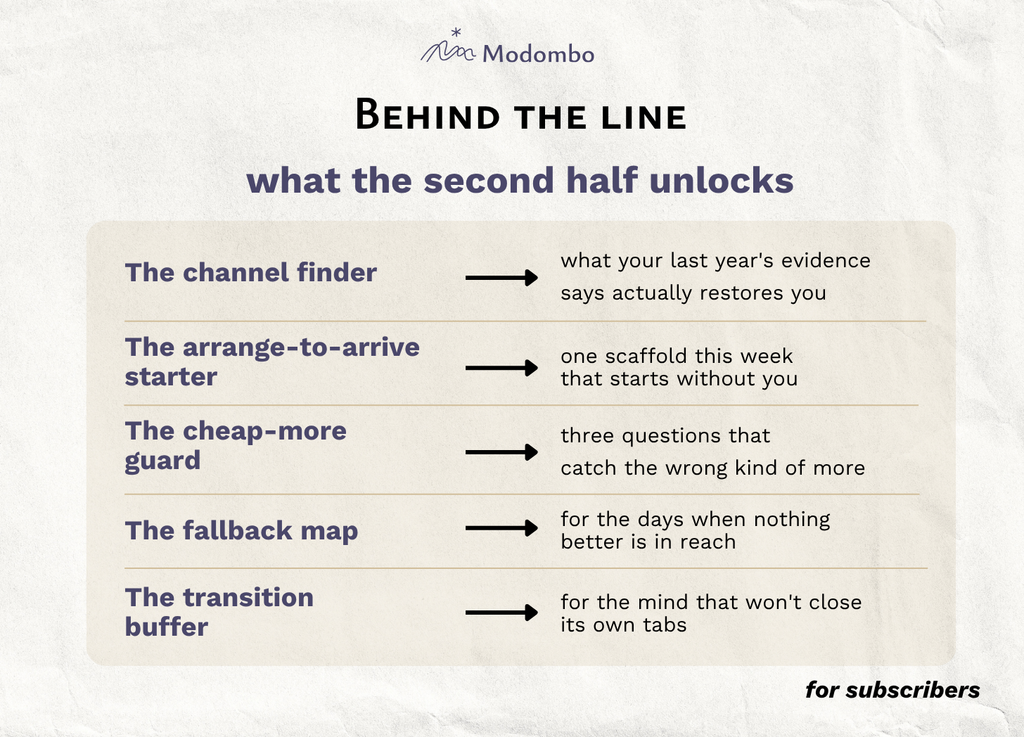
The rest of this letter is for subscribers, and it is the calibration in practice: the channel finder that reads your last year’s evidence, the arrange-to-arrive starter, the three-question guard against the cheap kind of more, the fallback map for the days when nothing better is in reach, and the transition buffer for a mind that won’t close its own tabs.
What is coming in the next episodes?
Next, the mirror: recovery with high sensitivity, where the restoring thing is the right kind of less — genuine low input, the long processing tail, and why even good things cost. Same map, opposite calibration. If you are both, that letter completes what this one started. And late October, the book — Recovery Is Not Rest, free to download for paid subscribers.
Related epizodes
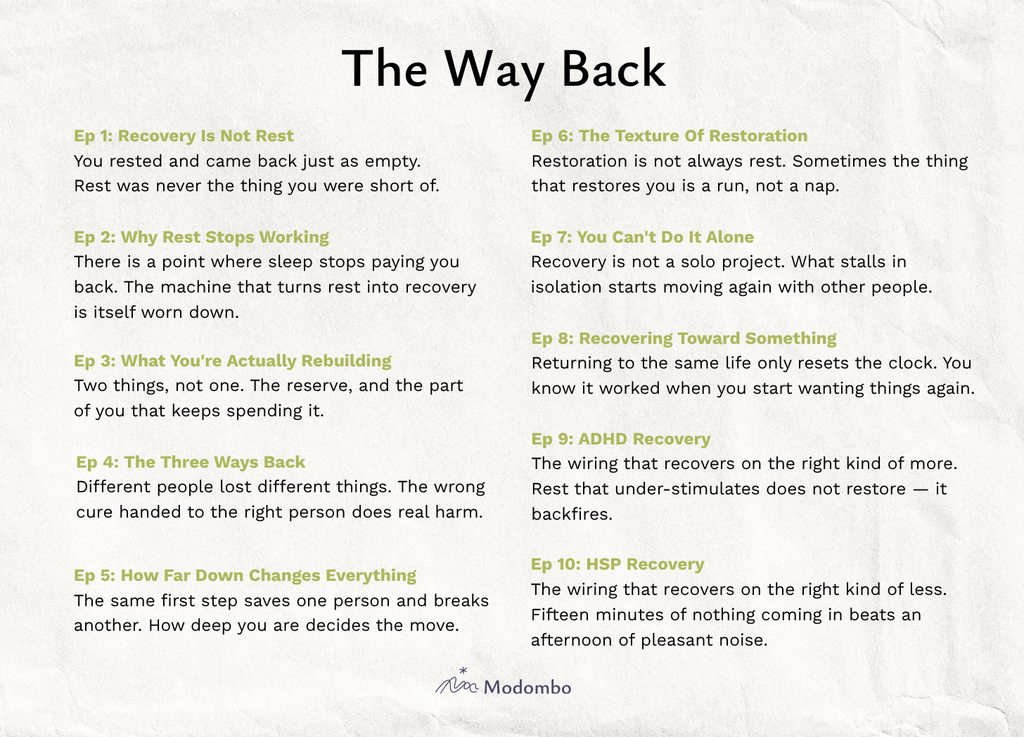
- NL38 B7 – ADHD Burnout — the mechanism this letter recovers from: the cliff, the yes-engine, the brake outside the brain
- NL R8 – Recovering Toward Something — the map this letter bends; the triad recalibrated here leg by leg
- NL47 R6 – The Texture Of Restoration — the promise this letter keeps; rest that doesn’t fit is more demand
- NL39 B8 – HSP Burnout — the mirror wiring’s burnout; the combined profile in one sidebar
- NL43 R2 – Why Rest Stops Working — the flat middle this wiring finds unbearable
- NL44 R3 – What You’re Actually Rebuilding — the Monday reboot the yes-engine powers
- NL48 R7 – You Can’t Do It Alone — the friend who shows up; support as structure