The bill that arrives around forty
This is the burnout of people who held it together for twenty years and cannot tell you what changed.
School was fine, or fine enough. The twenties were chaotic but survivable, because there was slack. Fewer obligations. More recovery. The freedom to work in bursts and crash afterwards with nobody depending on the crash not happening.
Built for sprints, asked to be steady. The load grew up. A career that wants steady output instead of brilliant sprints. A family that needs you regulated at six in the evening, not at midnight when the focus finally arrives. Somewhere in the late thirties or forties those two demands meet, and the slack that made everything survivable is gone. The same person who managed for two decades stops being able to, and no weekend puts it back.
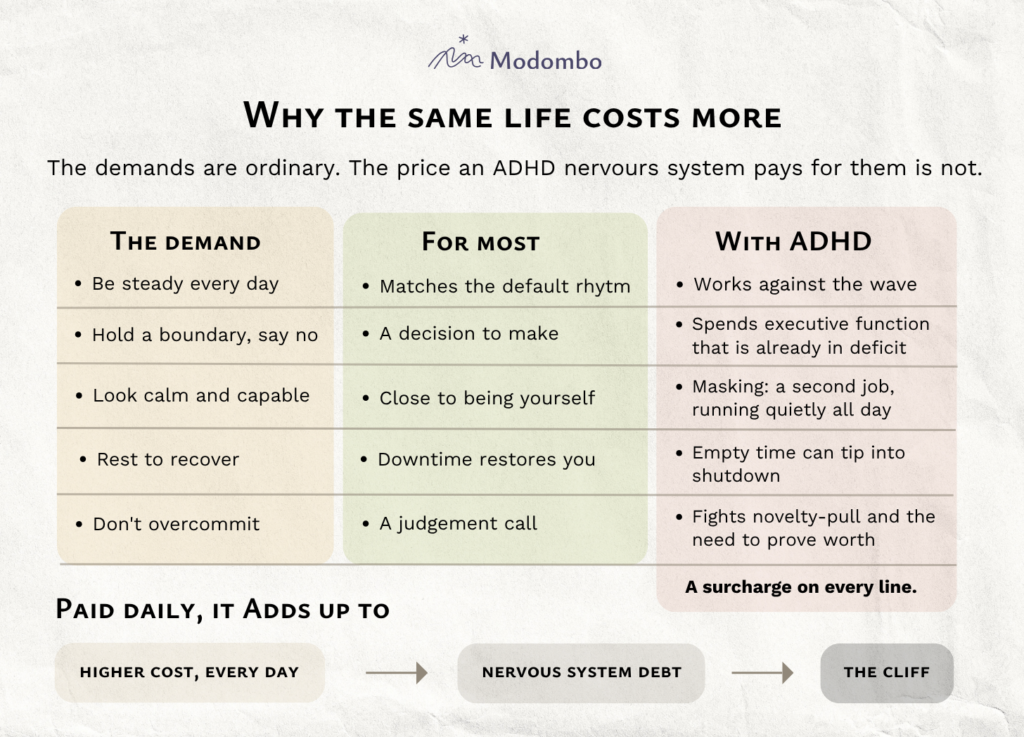
Nervous system debt. That is when the bill comes due. Every year of running the same output on more fuel, of compensating quietly, of borrowing tomorrow’s energy to get through today, has been accumulating somewhere. The body keeps the account even when the calendar does not. This is nervous system debt: the wear that builds when a system adapts for years without ever fully recovering. And once the reserve is gone, an ordinary week or a minor setback can produce a collapse far bigger than the trigger could ever explain. The small thing did not cause it. It only revealed that there was nothing left underneath. And the collapse, when it comes, rarely arrives as a slow fade. It is closer to a cliff. One week you are hyperfocusing and delivering, the next you cannot start anything, not even the things you enjoy. You have always run on intensity and last-minute pressure, so when that stops working there is no gentler gear to drop into. There is just nothing.
ADHD is a poor demand regulator. The ADHD version has a twist most burnout does not. The load was never simply handed to you. An ADHD brain moves toward novelty and says yes before the future gets a vote. The new project is genuinely exciting, so it gets a yes. The favour is easy to agree to in the moment. And for reasons that are hard to explain even from the inside, the future cost of all those yeses is underestimated every time, until the future shows up and the costs are all due at once. The load is partly built by the same wiring that then struggles to carry it.
Yes also proves your worth. Underneath the novelty there is a second engine. Years of being called lazy, careless or unreliable leave a dent in self-worth, and the easiest repair is to say yes and deliver. Yes becomes the evidence that you are not the disappointment you were once told you were. So the wiring reaches for new load, and the bruised self-worth reaches for it too. Different reasons, same direction.
Two different shapes of the same word
The word “burnout” hides two very different things. The standard picture is real, it just is not this one.

Most advice is written for the left column. If you live in the right one, you have been following the wrong instructions and blaming yourself for the result.
How it sounds in the room
- “I can do what they do. I just do it more tense, on far more fuel, and nobody around me can see the difference.”
- “I keep adding balls. Most days I catch them all. The day one drops, I file it as proof that I am failing.”
- “I always thought I was lazy. It turns out I was running the same output on twice the fuel.”
- “I can grip hard for a few weeks, while it still grips back. Then the interest goes, the grip goes with it, and I decide I just lack discipline.”
It was easier to believe I had bad willpower than bad wiring. Bad willpower was the working theory for twenty years.
The work nobody sees
Most of what exhausts an ADHD adult at work never appears on a task list. It is the second job running underneath the first one: the constant effort of performing a steadier, smoother version of yourself.
It is sitting still in a meeting while the body wants to move and the mind is already three topics ahead, holding a neutral face over both. It is reading the same paragraph four times because attention keeps sliding off, then hiding that it took four times. It is the scaffolding of lists, alarms and reminders built to do what colleagues seem to manage without thinking, and the daily upkeep of that scaffolding is itself a job. It is rehearsing a sentence so the impulsive version does not come out, holding a thought so it survives until your turn to speak, and checking your own work twice for the careless mistakes you know you are prone to, so that nobody else finds them first.
None of this is on the to-do list. So when burnout finally arrives and the advice is to reduce your load, the person cuts the visible things. The meetings, the projects, the commitments. The largest load of all, the masking, stays exactly where it was. They remove the part that was never the main cost.
Why standard advice misses
Two reasons the usual playbook fails here.
The first is that it asks for the one thing the condition removes. “Reduce your commitments” sounds simple. But reducing commitments, holding a boundary, declining the interesting request, abandoning a project you already started, all of that is executive function. Sustained, deliberate, effortful self-management. That is precisely the resource ADHD has less of, and precisely the resource that burnout has already drained. You are telling a depleted system to repair itself using the function that is depleted.
The second is the quiet assumption that rest returns everyone to the same baseline. Rest returns you to your baseline. Your baseline was already lower than the environment was built for. The friction comes back with the first full Monday.
And there is a trap hidden inside the word rest, which is where the next part starts.
What actually helps
Start with recognition. Naming the wiring changes what the exhaustion means. You were not failing to keep up. You were keeping up at twice the cost, for twenty years, with nobody charging you for it until now.
Recognition is harder than it should be. In much of Europe, and noticeably more than in the United States, adult ADHD is still treated by some clinicians as a contradiction in terms, a childhood disorder you were supposed to grow out of. Plenty of people sitting in exactly this pattern have raised it and been told, sometimes by a professional, that it does not apply to adults. That alone can cost years.
Recovery is not subtraction. Here the standard advice can do real harm. For an ADHD nervous system, rest is not the same as an empty calendar. Empty is understimulation, and understimulation is its own kind of drain. Slowing down does not produce a calm, sustainable pace. It produces shutdown. For this nervous system the throttle is closer to a switch than a dial: on, or off, with very little usable speed in between. Tell it to idle and it stalls. Take all the input away and the system does not settle. It gets restless, and the restlessness fills the space with scrolling, snacking and invented urgency that costs more than it restores. What actually regulates this nervous system is the right kind of engagement, not the absence of it. Something genuinely absorbing, ideally with movement or novelty in it. A focused creative project. A couple of weeks built around a sport. A trip with enough newness to hold your attention. Two conditions make it work: the draining obligations are genuinely set down for a real and bounded period, not carried along on a working holiday, and what replaces them is interest-aligned rather than blank. Recovery here is not less. It is the right kind of more.
Let recovery arrive, do not chase it. There is a catch in everything above. A depleted ADHD brain cannot easily generate its own activation, which is exactly what “go find an absorbing project” asks it to do. Asking an empty tank to drive itself to the petrol station. So when things are at their worst, the trick is to stop relying on yourself to start, and arrange for the stimulation to come to you instead. A friend who shows up without being summoned. A class already booked and paid for. A walking route that passes something worth looking at. Materials left out where you will trip over them. You are building a scaffold that supplies what your own drive cannot, for now, until enough recovers that you can self-start again.
Move the brake outside the brain. Saying no runs on executive function, the very resource that is depleted, so the most reliable fix is to put the brake somewhere outside your own head. A standing rule that no new commitment gets a yes in the moment, only “let me check and come back to you.” A trusted person with a veto over the next exciting project. Buffers built into the calendar by default, so the impulsive yes meets a structural no it does not have to generate on the spot.
Medication is capacity, not character. For some, medication is part of this. It is a capacity intervention, not a character verdict, and worth treating as plainly as that. But it carries a quiet trap worth naming. Stimulants hand back executive function, and that feels like capacity, so the natural move is to load up to match it: more projects, more commitments, longer hours, because now you can. The medication does not come with judgement about what is sustainable. It just supplies the fuel to push harder, which means you can medicate yourself straight into a crash and feel fine right up until it lands, harder than before, because you never stopped running. The honest test for any new yes is simple: would you still commit to this if you were not medicated? Therapy and coaching help most when they are built around how an ADHD brain actually works, rather than around a steadier baseline it was never going to have.
Where this is, and where it isn’t
The question that separates this from ordinary overload is not whether you are tired now. Anyone can be tired now. It is whether effort has always cost you more than it seemed to cost the people around you, for as long as you can remember. Whether you were brilliant when something gripped you and stalled flat when it did not, with very little of the steady middle that everyone else seems to live in. And whether, when you do crash, it is less a slow fade than a switch flipping off: full speed one week, unable to begin anything the next.
If the honest answer is that this is not new, that it has been the shape of things the whole time, then you are probably not looking at a load problem. You are looking at a calibration problem (a nervous system tuned to different settings than the environment assumes it should have) that the load finally made impossible to ignore.
If it is genuinely new, if there was a steady and reliable version of you that recent demands buried, that points somewhere else in this series, and the earlier types are worth a read.
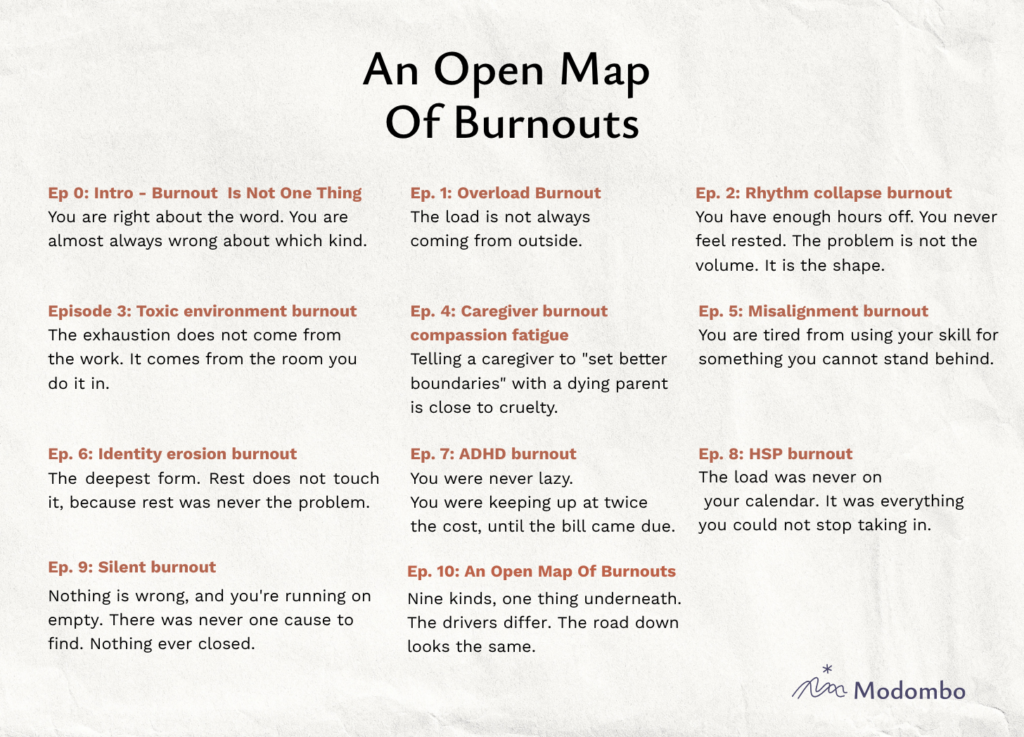
What is coming in the next episodes?
Next: the high-sensitivity version of this same late-arriving burnout. Different wiring, a different cost, the same pattern of paying invisibly for years until the bill arrives all at once.