
Last Thursday’s letter read your vacation: how the restoration faded told you what owns you. This one opens a series about the structure that takes restoration back fastest — the one that never closes. Not the office. The environment you think with.
You got faster this year. The days got heavier anyway. More shipped than in any year of your working life, and less of it registering as done. Teams are having the same year: more delivered, more frayed. The story on offer is a productivity story: learn the tools, ride the curve. It keeps not explaining the evenings.
More done than ever, more tired than ever — and no story for why.
What got easier
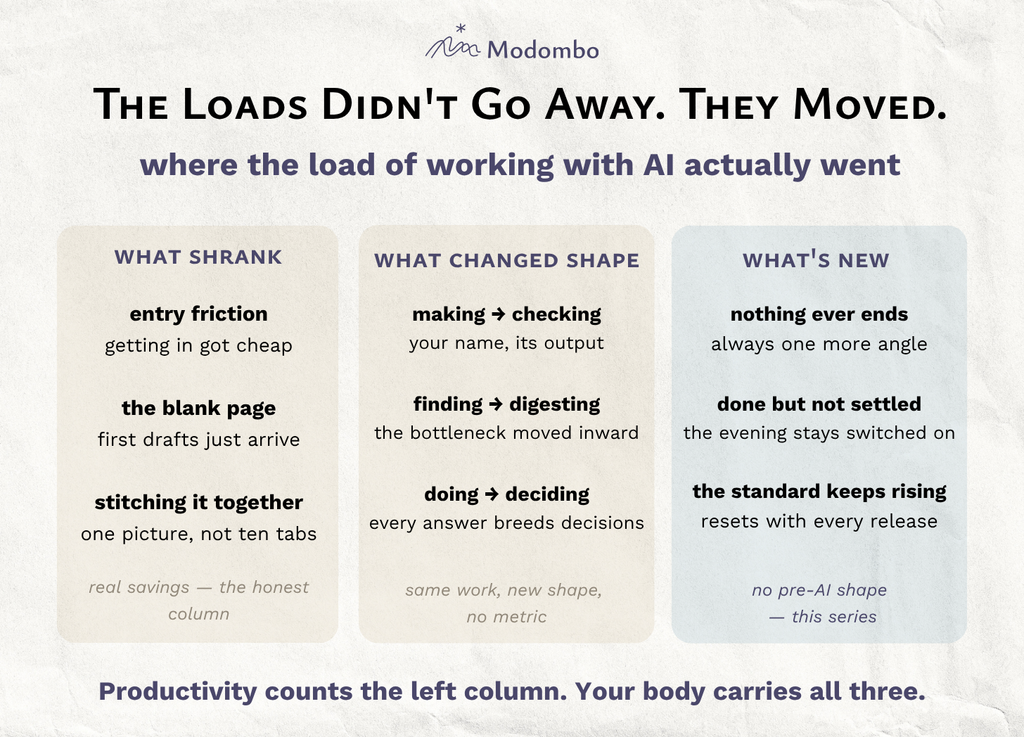
“AI saves time” is true. It just doesn’t tell you where the load went. The email that used to cost twenty careful minutes now costs two: dictate the idea to the AI, the whole thing arrives back elaborated, and you just send it before the coffee cools. Unfamiliar territory stopped costing an afternoon. The blank page stopped being a wall. These savings are real, and they deserve to be named without irony — they are why “AI is overloading people” sounds wrong to the very people it is happening to.
Where the load went
Plenty was removed from your work — the load was not. It was redistributed. Every hour the machine saved was spent the same week, on more. Some loads shrank — that column is genuine. Others changed shape. She used to write the analysis; now she reads what the machine wrote, closely, twice, because her name goes on it. On paper her day is lighter. She has never been less sure of anything she shipped. The work didn’t get smaller; it changed state — from making to checking.
And some loads are new, with no pre-AI shape. Ten at night, the question is answered — the work question, or the one about your own life — more thoroughly and more patiently than anyone you could have reached at that hour. The quiet pull comes anyway: go deeper, add nuance, one more angle. The answer was good. The body didn’t settle.
An environment, not a tool
A tool is something you put down. Somewhere in the last two years, AI stopped being one. It is becoming an environment — the way the open-plan office became an environment, the way the smartphone did. You no longer decide each morning whether to enter it. You work there, write there, and increasingly think there. And environments are never neutral: they set what counts as fast, what counts as finished, what silence feels like.
An environment is also not a villain. There is nothing to boycott here, and no plan to try. But every new environment reprices the nervous system that moves into it, and this one arrived faster than any nervous system adapts.
What this series is
An earlier series of these letters compared AI to a human therapist — eleven episodes mapping what AI lacks. That map is drawn; it will not be re-argued here. This series starts from the other side: your own load. What working and living inside AI does to a nervous system, and what to do about it: a user’s guide, not a takedown and not a tutorial.
One thing these letters will never say is “use AI less.” That sentence is this decade’s “rest more”: kind, mechanically wrong, and quietly shaming. The frame you use it inside can be redesigned. Walking out of the environment is not the design.
This week, just watch
Don’t redesign anything yet. This week, only watch. Note three things: what genuinely got easier this year; where you stopped making and started checking; and the last time finishing something actually felt like finishing. No fixing — the fixing is what this series is for, one load at a time, each Thursday below the line.
Everything got easier. Nothing got lighter. Now you know where to look.
What is coming in the next episodes?
Next Thursday, the series’ first mechanism: why nothing ever feels finished anymore — and, below the line, the first tool of the series.
By the end of November, this series becomes a book — the whole user’s guide, assembled and sequenced. The letters are the map; the book is the manual.
Related episodes
- NL52 – The Vacation Wore Off — last week’s hand-off: how restoration fades tells you what owns you
- NL20 – How AI Rewrites Our Stress and Anxiety — where the old arc began; effort per task down, tasks multiply
- NL21 – AI Supervision Trap — making → checking, first named
- NL30 – AI vs Human Therapist – Endings and Containment — the conversation that never closes
- NL22 – Friend, Therapist, AI — the third category, for the 10 p.m. readers