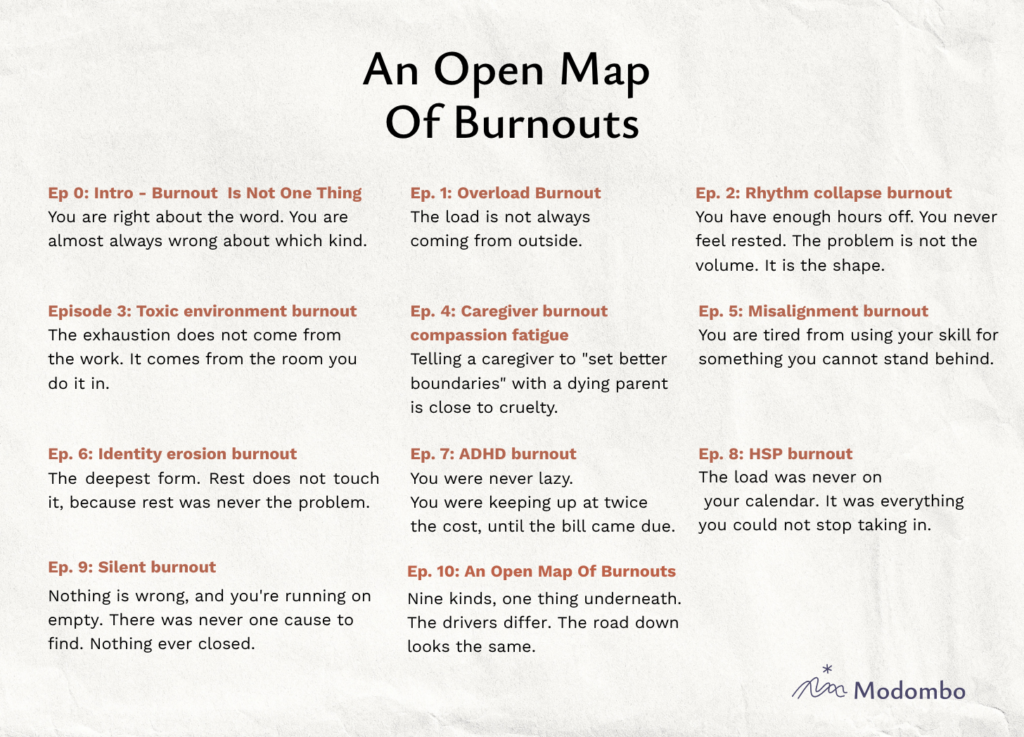
Nine doors into the same room
Over nine episodes I described nine different burnouts, and they needed different things. Some wanted rest. Some wanted a different rhythm, a different room, a different job, a different relationship to your own wiring. If you were paying attention, one question should have been quietly nagging you the whole time. If they all need opposite treatments, in what sense are they the same illness?
They aren’t nine illnesses. They are one thing, felt from nine sides. Nine doors into the same room. The room is called chronic overload, and before you roll your eyes at a word that sounds like “too busy,” let me take the obvious meaning away from you, because the obvious meaning is wrong.
The thing it isn’t: “too much work”
It was never just “too much.” Almost everyone carries the same working theory: burnout is too much work for too long. That theory is correct for exactly one of the nine. For the classic overload type, yes, the load is simply too big and the fix is genuinely to make it smaller. For the other eight, it quietly misses.
Sometimes the problem is not “too much.” It is “wrong.” A modest amount of work you cannot stand behind will still hollow you out, given enough years. You start out not minding it, drift into resenting it, and end somewhere close to hating it, and the hours never changed once. The wrong shape of the week. Values you cannot endorse. A self you keep folding away so you fit. A life with no gap left in it to breathe. None of those are about volume. They are about fit. The primitive there is not too much. It is wrong, held too long.
And “too much” was never a real number anyway. This is the part that changes everything, so I want to be slow about it. There is no objective amount of work that counts as too much. It is always too much for this person, in this context. Hand the same load a clear purpose and it becomes bearable. Strip the purpose out and the identical load crushes. I will give you my own version. I can sit with people and their hardest stories for hours, and come home tired but whole. Put me in the same number of hours of management meetings and I do not feel tired, I feel like something vital is draining out through the floor. Same clock. Completely different bill. The same backpack is nothing for the first mile and unbearable by the tenth, and whether you chose the trip changes the weight too.
So here is the actual thing sitting under all nine. Burnout is what happens when, for too long, your life asks more of you than you can take in and recover from. Not measured in hours. Measured in the only currency that counts, which is what it costs you.
Nobody burns out doing something they hated from day one. You have to love it first. That is the entry fee.
Nine faces of one mismatch
Once you see it that way, the nine types stop being a catalogue and become a single thing wearing different clothes. The mismatch can sit on the sheer volume of the load. On the shape of your day. On a room that keeps you braced for impact. On a load that happens to be a person you cannot put down. On skill spent in service of something you cannot endorse. On a self you have to suppress to belong. On a nervous system that is charged more than everyone else for the very same day. Or on a life where, reasonable as each piece looks, nothing ever actually closes.
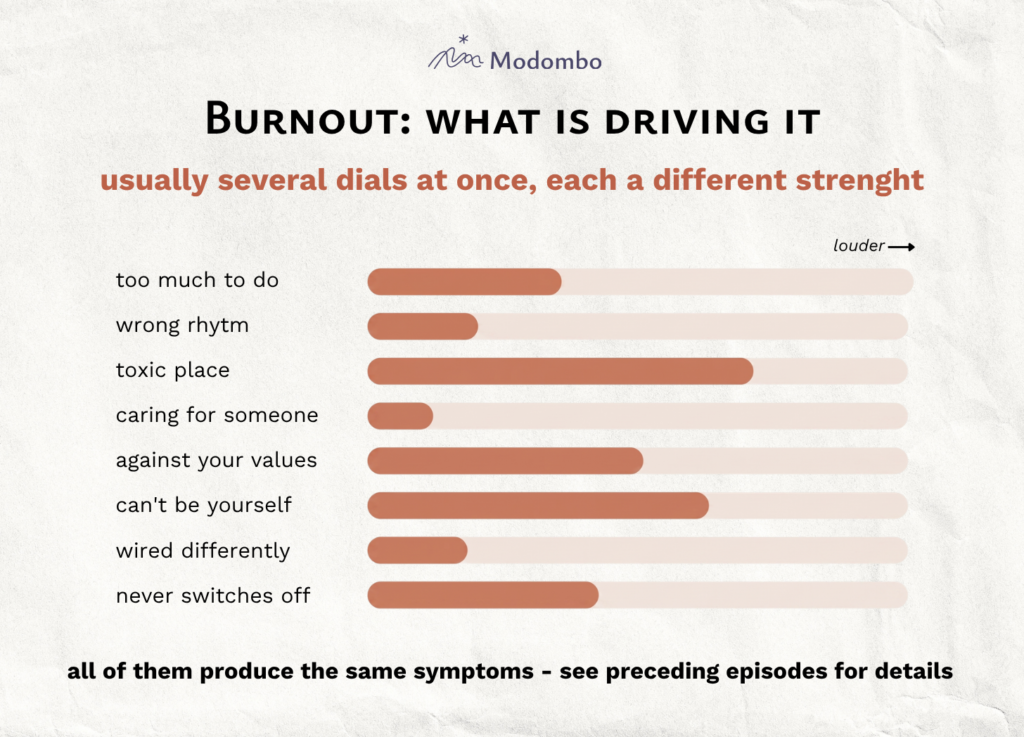
And here is the part that matters most. Almost nobody is just one of these. You are a mix. A lot of one, a bit of another, a trace of a third, and the blend shifts over the years. These are not nine boxes to sort yourself into. They are eight dials, and most people have several of them turned up at once.
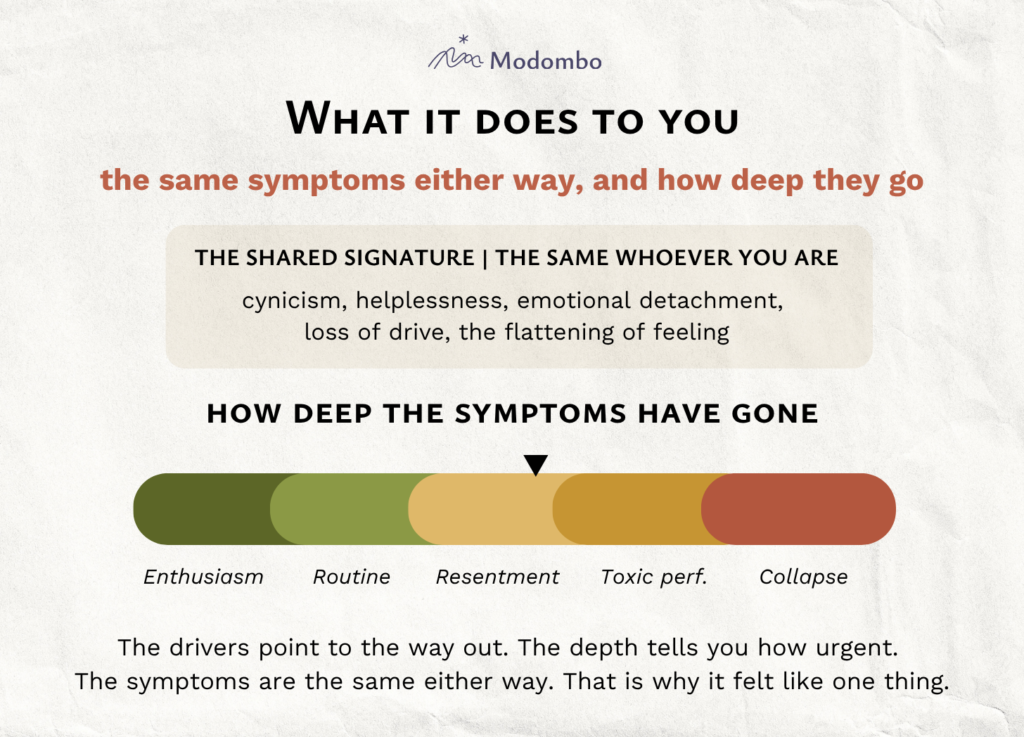
Eight dials, one machine. And here is the strange thing that fooled everyone for so long. Whichever dials are turned up, the machine breaks the same way. The cynicism, the helplessness, the flatness, the drive that quietly leaves and does not come back. That wreckage looks nearly identical whether the cause was a toxic room or a job you could not stand behind. Two people with completely different reasons arrive at the same symptoms. The symptoms converged. The causes never did. That is how one word ended up covering nine different problems. And it is also why which dials are up still decides the way out, even when the breakdown looks the same from the outside.
It doesn’t happen to you. You walk into it.
There is one more thing the nine portraits left out, and it is the most human part. Time. Burnout is not a state you wake up inside one morning. It is a road, and you walk the first stretch of it gladly.
It almost always starts as enthusiasm. This is who I am, you think, I was built for this. Nobody pushes you onto this road. You run onto it, because at the beginning it feels like the very best version of you. Then the enthusiasm quietly sets a pace, and one day the sprint is simply the speed you are now expected to hold. Enthusiasm cools into routine. You are still managing, just flatter, the colour gone slightly grey. Routine sours into resentment. I give more than I get. And then comes the strange stage, the one that fools everyone, including the person in it. Toxic performance. You cannot stop. You will prove it, whatever it takes. And from the outside, in this stage, you look like you are absolutely winning.
That is the cruel detail worth saying plainly. The person closest to the edge often looks the most impressive. The biggest output, the heroic stretch, the one everyone wants to clone, frequently arrives in the last chapter before the fall. We keep handing promotions to people who are about to break.
And there is a turn near the end. For a long time the trouble stays local. You are fine everywhere except the one context that does not fit you. But if the mismatch runs long enough, it stops being about that context at all. The tank is just empty now, so things that were never the problem stop working too. You cannot enjoy the weekend. You cannot be present with the people you love. You cannot find the thing you used to want. That is not a pile of new problems arriving. That is one old problem finally going system-wide. And there is a cruel twist in the timing of it. Early on you can still point at the cause. It is the room. It is the job. It is the rhythm. Late, you cannot. By the time you reach the bottom, the symptoms have grown so large and so self-sustaining that they come loose from whatever first set them off. You are simply exhausted by everything, and which kind it was becomes almost impossible to read, because the wreckage has buried the cause. And that stage, the empty one, is the stage that looks like depression, and often quietly becomes it. Which is the real reason this matters. Overload sits upstream. It comes before the burnout, before the flatness, before the version of you that does not want anything anymore.
Why “rest more” keeps failing people
This is why the standard advice is, frankly, a coin toss. “Do less, rest more” is exactly right for one of the nine types of burnout I mentioned and close to useless for the rest. Tell someone with the wrong rhythm to rest, and they will rest, return to the same misshapen week, and be flattened again by Wednesday. Tell someone in a toxic room to rest, and they will recover beautifully on Saturday and walk straight back into the alarm on Monday. Resting the wrong kind of burnout is bailing water out of a boat that has a hole in it. You will be very busy. You will still go down.
Where you actually are, and the way out
So the map comes down to two questions, in order.
First, which dials are up. Not which one, which ones, because there is almost always more than one, and the loudest two or three are your doors out. You do not have to fix all eight. You turn down the ones that are roaring. Each one leads somewhere different:
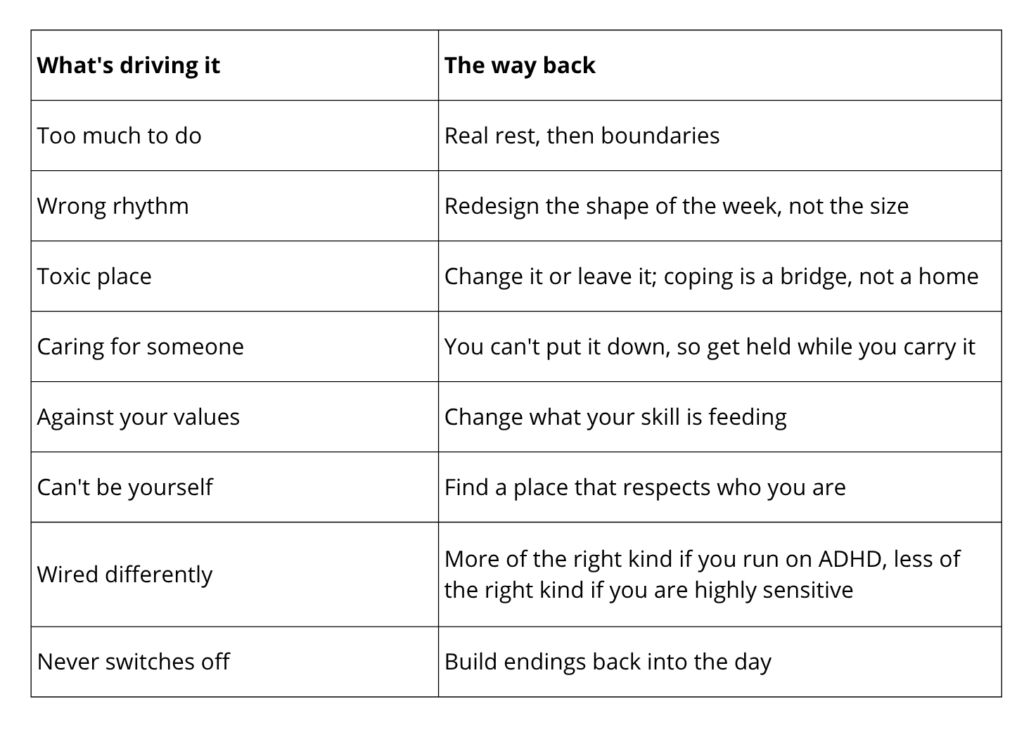
The table assumes you have spotted the loud dial. The deeper down you are, the more “steady the ground first” has to come before any of it.
Second, how far down. How deep the symptoms have gone does not change the door. It changes how fast you need to reach it, and what the first step can be. Early on, a small adjustment is enough. In the middle, you need real change, not tweaks. At collapse, the only honest first move is recovery and support, and everything else comes after that. At that depth the symptoms run on their own and the original cause is hard to even find, so you steady the ground first and sort out the dials later. A tip that would save you in the routine stage is almost an insult at collapse, and the hard conversation that rescues someone in toxic performance would uselessly frighten, or offend someone still happily in their enthusiasm.
You do not have a vague problem called “burnout.” You have a particular set of dials, turned up to particular levels, at a knowable depth. Name the loud ones, read the depth, and the way back stops being a mystery.
Closing the loop
Nine episodes ago I said you were right about the word and almost always wrong about which kind. Now you have the whole map in front of you. You can name which dials are loudest. You can see how deep it has gone. And naming it, as it turns out, was never just a labelling exercise to feel clever about. It was the first step out of the room. That was the point the entire time.
If one of the nine was unmistakably yours, go back to it. That is where your way out is written in detail. This map only tells you which door to walk toward.