The burnout that hides behind the workload
This person does not come in saying “I have too much to do.” They come in saying “I don’t know why I’m so tired.” The workload looks manageable. The hours are not extreme. By every external measure, this should be a job they can handle.
But they are exhausted in a way that does not match the tasks. And when you ask what the workplace feels like, the answer is rarely about the work itself.
How it sounds in the room
- “I spend half my day figuring out who is angry at whom and how to stay out of it.”
- “My manager never says anything directly. I find out I made a mistake when someone else gets the project.”
- “I check Slack before I get out of bed to see what mood the team is in today.”
- “The work itself is fine. The people make it unbearable.”
The person often feels confused about why they are so depleted. They may have had the same role in a different company and handled it with energy to spare. Nothing changed about their skills or capacity. The environment changed.
What is actually happening
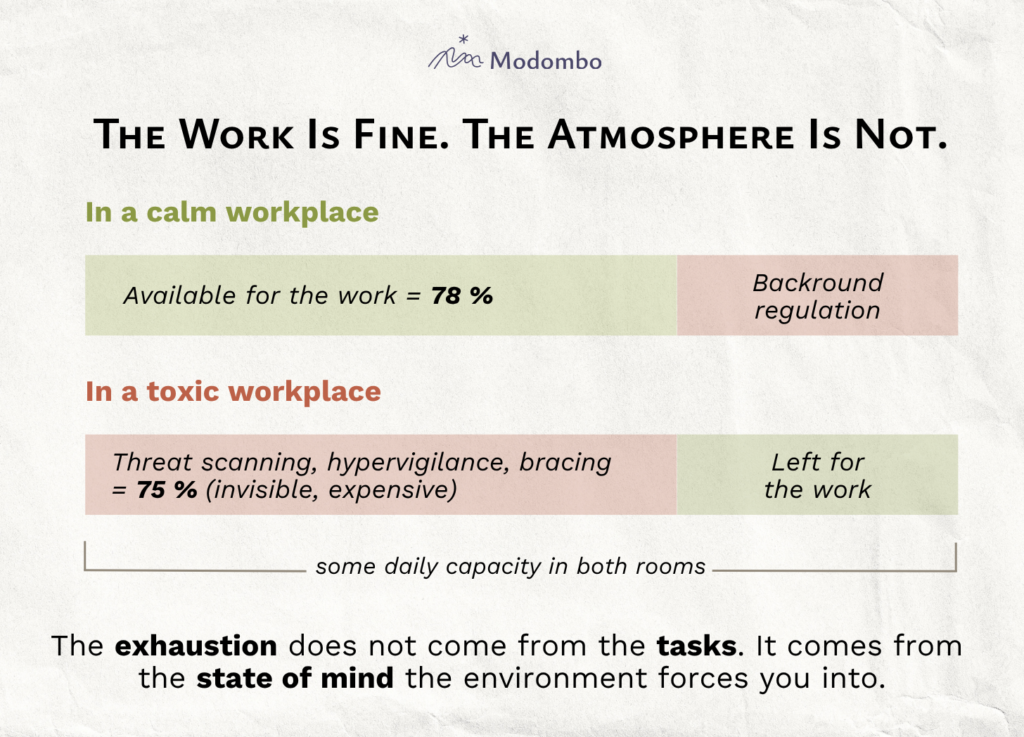
The nervous system is in a chronic alarm state. The person is not processing tasks. They are processing threat: scanning for conflict, anticipating the next unpredictable reaction, bracing for blame, tracking politics that shift without warning.
Hypervigilance is invisible and expensive. It runs in the background, consuming the same cognitive and emotional resources the person needs for actual work. By the time they sit down to do their job, much of their daily capacity has already been spent on survival.
The work is not the load. The atmosphere is the load. And reducing the workload does not reduce the atmosphere.
You can cut your hours in half and still come home depleted, because the thing that drained you was not the tasks.
Why coping is not the same as solving
This is where toxic environment burnout differs from every other type. In overload, rhythm collapse, even identity erosion — the interventions are about the person. Rest, restructure, reassess.
Here, the source is external and often outside the person’s control. You can build better boundaries, improve your stress response, protect your mornings. These help you cope. They do not fix the environment.
A person who builds excellent coping strategies inside a toxic workplace is a person who is managing their symptoms, not their problem. That distinction matters, because it changes what “recovery” means.
For sensitive nervous systems, this is louder
For people with sensitive nervous systems, toxic environments hit harder and faster. The sensitivity itself can come from several places. It can be inherited as a trait. It can be the residue of past trauma. It often sits alongside depression and similar conditions. The mechanism is the same in each case: the threat-scanning that an ordinary nervous system does occasionally is constant here, and the recovery from it is slower.
ADHD adds its own twist. A toxic workplace is, by design, high-stimulation. It runs on unpredictability and conflict. For an ADHD nervous system that runs short on dopamine, that stimulation can register as fuel. The same place that drains the person also organizes their day. The loop is then real and uncomfortable: hating the environment, being depleted by it, and quietly relying on it to stay activated. Naming that loop is often half the work of getting out of it.
What actually helps
Honest naming comes first. Many people in toxic environments spend months or years wondering what is wrong with them — why they cannot handle a job that looks manageable on paper. The first intervention is often just recognizing that the environment, not the person, is the primary driver.
After that, the question becomes practical: can the environment be changed, or does the person need to leave?
If the environment can be changed (different team, different manager, organizational intervention), that is the real solution. Coping skills are a bridge, not a destination.
If the environment cannot be changed, the honest conversation is about exit. Not “you should quit” as glib advice, but a grounded assessment: what is this costing you, and how long can you sustain it? For some people, the financial or personal constraints are real and leaving is not immediately possible. In that case, the work shifts to damage limitation: protecting capacity, building support systems, and keeping the exit option alive rather than adapting so well that the toxic environment becomes permanent.
Stockholm syndrome is, mechanically, an excellent coping strategy. It is also how you find yourself still there in five years.
Keeping the exit option alive, in a place you cannot leave today, is its own discipline. It means staying mentally one step out the door. You measure at each moment what this is costing you and what you are getting back, so the environment never quietly becomes normal. It usually requires a kind of detachment that borders on cynicism. People in toxic environments tend to show the worst versions of themselves, and taking it personally is the fastest way to lose ground. It takes hard, real mindfulness to notice when you are being pulled into the emotional weather of the place, and to pull back from it. And it leans on a small set of personal survival rules: protected mornings, hard stops after work, one or two people you can speak to honestly. Those rules hold the line, so that adapting to the environment never quite happens.
Where this is, and where it isn’t
A few questions:
- Is my exhaustion about how much I do, or about what the workplace feels like?
- Have I done similar work elsewhere and handled it with energy to spare?
- Do I spend significant mental energy on the politics, the mood, or the safety of my position — before I even start the actual work?
- When I imagine the same tasks in a calm, safe environment, does the exhaustion disappear?
- Do I check my messages with dread, not because of the workload, but because of who might have written?
If the answers point to the atmosphere rather than the tasks, you are likely in toxic environment burnout. The intervention is not about you. It is about the room.
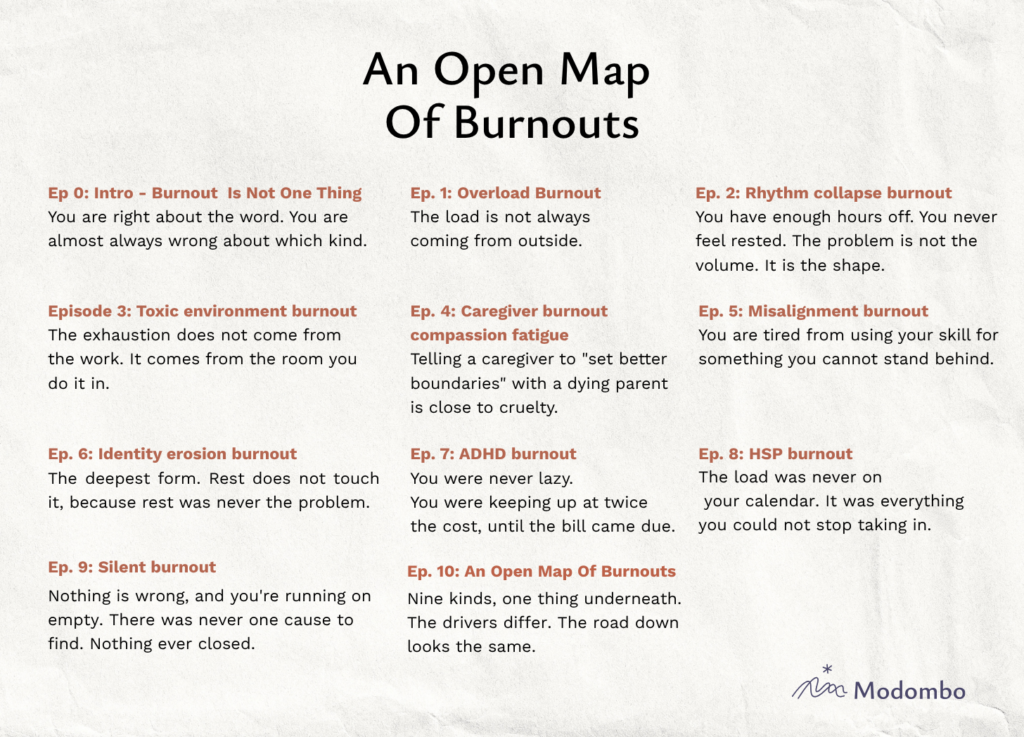
What is coming in the next episodes?
Next — NL B4: Caregiver burnout / compassion fatigue. When the load is someone else’s need, and you cannot put them on pause. Why this type has no “reduce the load” option, and what recovery looks like when the person you care for is not going to get better on your schedule.