AI doesn’t remember you
You tell a chatbot about your fear of confrontation on Monday. On Thursday, different chat, you mention it again. The chatbot responds as if hearing it for the first time. Because it is.
You tell it about your father. About the pattern with your boss. About the thing that happens every time someone raises their voice. Each time, you start from scratch. Each time, AI listens with the fresh curiosity of someone who has never met you. Which, in fairness, it hasn’t.
Chatbots are the most widely used form of AI for psychological topics: a brilliant stranger who forgets you the moment the conversation ends. It can be extraordinarily helpful within a single session. It just has no idea who you were last month.
The difference between a file and a witness
It’s tempting to frame this as a data problem. Give AI more memory, a structured file with your history, a project with timestamps — and it should close the gap. Right?
Partly. But think about what actually happens in long-term therapy.
Your therapist doesn’t just remember that you mentioned your father a few months into your work together. They remember the tension in your voice when you said it — how you rushed through the sentence as if saying it quickly would make it weigh less. They noticed that six months later, you brought up the same topic and your voice was steady. Your shoulders were down. You even paused before continuing. They carry not just the facts of your story, but the texture of how you’ve changed inside it.
A two-year therapeutic relationship is built on shared experience — the session where you broke down and they stayed with you, calm and unhurried, the weeks where nothing happened and that was exactly the point, the Tuesday you walked in and they could see something had shifted before you said a word. That is how trust gets built — not in a single moment, but across hundreds of small ones. And once it’s there, their voice reaches you even when everything else is noise.
You could write all of that into a briefing document. It would be accurate. It wouldn’t be the same thing.
Even a perfectly memory-equipped AI would hold the record. It would not hold the relationship. And the relationship is what makes everything else work. Without it, even the sharpest observation is just information — you can agree with it and move on. With it, the same words land differently. You don’t just hear them. You feel them. Because they come from someone who was there.
“You have no idea how far you’ve come”
Here’s something a therapist can do that almost no one talks about.
Many people — especially the driven, analytical, high-performing types who read newsletters like this one — have a persistent habit of viewing their current situation as insufficient. No matter how much has changed, the present feels like a problem. Progress is invisible from the inside when you’re still standing in it.
A therapist who has been with you for a year can interrupt this. Not with reassurance. *With evidence.
“You’re saying nothing has changed. But I was here a year ago when you couldn’t present to three people from your own team without your hands shaking. Last week you led a board meeting. Do you remember that, or has it already become the new baseline you’re failing to meet?”
That last part — the dry observation about how you’ve already turned progress into your newest source of disappointment — that’s something only a person who knows your pattern can say. And it works not because the observation is particularly clever — a chatbot could produce something just as sharp. It works because *you hear it and you take it seriously. You take it seriously because this person sat with you through the worst of it and chose to stay. They earned the right to name what you can’t see. That’s what trust does — it gives weight to words.
A chatbot could generate a similar sentence. But it would be guessing. When your therapist says it, you feel caught. In the good way.
What about AI that remembers?
Fair question. Some AI systems do have memory. ChatGPT can store facts about you. You can upload summaries to projects. Agentic systems exist that track your state over time.
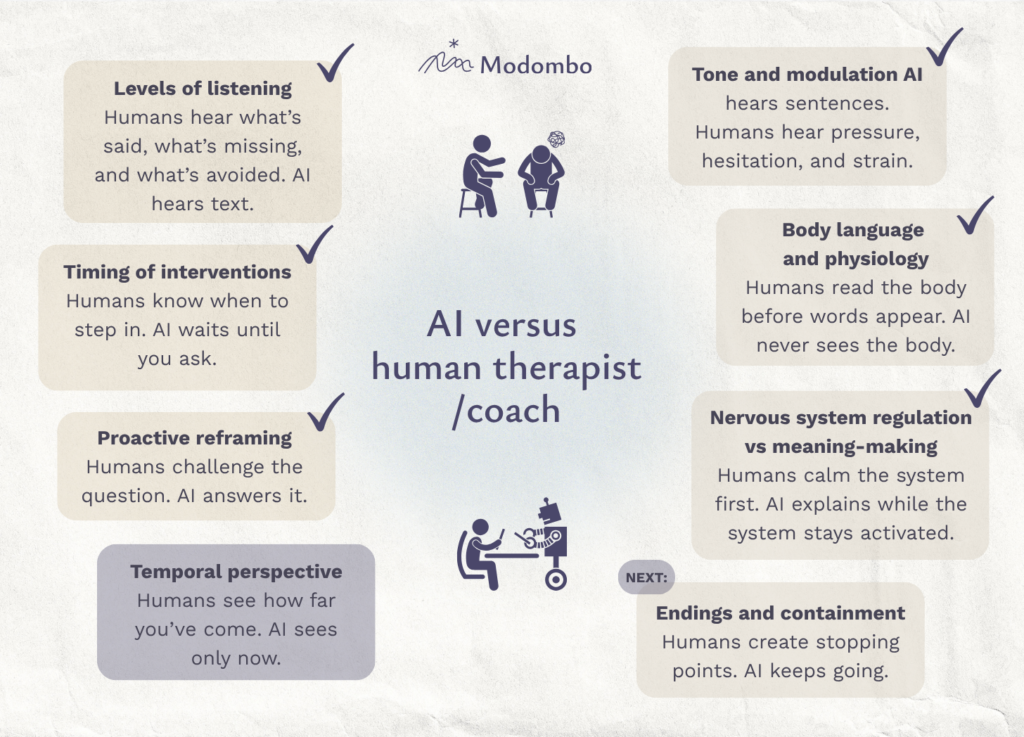
Helps more than nothing. Less than you’d expect. ChatGPT’s memory fills up quickly and starts dropping details — the psychological equivalent of a friend who remembers your name but not what you told them last summer. There’s no way to ask “how was I doing last October?” Everything in the history sits at roughly the same distance, whether it happened yesterday or eight months ago. The kind of temporal awareness a therapist has — “I’ve noticed that every autumn you go through this” — is not something current AI does. At all.
And even if it could track every detail perfectly, it would still be missing the thing that makes the temporal dimension therapeutic: someone was there. They cared about the outcome. When they say “you’ve come a long way,” it costs them something — because they remember what it cost you.
Making AI work better (despite all of this)
None of this means AI is useless for psychological topics. It means it’s a different instrument — and it works better when you stop expecting it to be a therapist and start treating it like what it is: a sharp, amnesiac collaborator.
Two things that actually help. After important conversations, ask AI to write a short summary — then *save it outside the chat, with a date. “March 2026. Realized the procrastination isn’t laziness — it’s about the project feeling meaningless.” Over time, you’re building the temporal record AI can’t build on its own. You become the memory.
And before you bring a problem, ask AI to interview you first. Let it ask about your life, your patterns, your history. You’ll be surprised how much more honest your answers are than the problem statement you would have started with.
A note on what this series is
This series isn’t an argument against using AI for psychological topics. It’s a map of what AI — specifically chatbots, the way most people use them today — can and can’t do. Knowing the limits doesn’t make the tool less useful. It makes you better at using it.
What is coming in the next episode?
Endings and Containment — what happens when a therapeutic conversation ends. How a therapist closes a session, holds the space between meetings, and manages the arc of an entire relationship. And what happens when a chatbot simply… stops.