People rarely lie when they talk about their problems. But they rarely say everything either.
Most of the time, what matters most is not hidden in the words themselves. It appears in tension around the words — in what contradicts the story, what is avoided, or what is carefully protected.
In the previous episodes of this mini-series we looked at voice, body language, and regulation of the nervous system.
Now we move to another layer of human listening. Not how something sounds. Not what the body shows. But what is actually being communicated through the story.
Stories are rarely the whole message
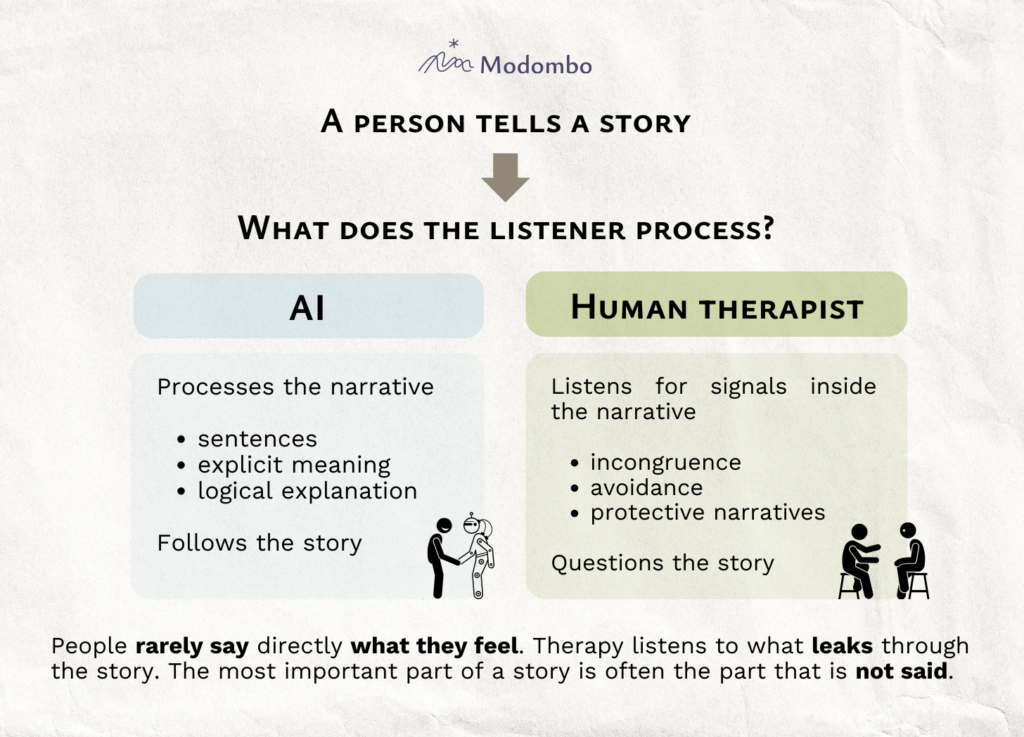
When people talk about their life, they usually present a story that makes sense. But the story often carries subtle signals that something else is happening underneath. A therapist or coach listens not only for the narrative — but for tension inside the narrative.
Three patterns appear again and again: incongruence, avoidance, and protective narratives.
Incongruence
Sometimes the words and the emotional signal simply do not match. A person says: “I’m totally over it.” But tears appear in their eyes.
Or someone says: “It really doesn’t bother me.” Yet their jaw tightens and their breathing becomes shallow.
The story says everything is fine. The way it is said suggests something else: this still hurts. AI processes the sentence. A therapist hears the contradiction.
When this contradiction is noticed in a careful and supportive way, something important happens. The person can finally acknowledge what they were trying to suppress or hide. That moment of recognition often brings relief — because the real emotion no longer needs to stay hidden.
Avoidance
Sometimes the real issue never appears directly.
A person keeps returning to external details — meeting schedules, project tasks, Slack messages. Again and again the conversation moves toward logistics and practicalities.
But underneath there may be something else: fear of disappointing the boss, or anxiety about being judged by colleagues.
Or someone describes a visit to their parents entirely through travel logistics, meals eaten, and the weather. What never appears is the emotional layer — perhaps the feeling of not being good enough for their father, or tension with a mother who openly dislikes their partner.
The story moves around the center without touching it.
AI tends to follow the narrative that is offered. A therapist listens for what the narrative avoids. When the avoided layer is gently opened, the conversation moves closer to what actually matters. Naming the avoided emotion often reduces confusion and tension — because the person can finally address what is really affecting them.
Protective narratives
Sometimes the story protects the person from a painful conclusion.
Someone says: “I just have very high standards.” A possible deeper layer might be: “If I make mistakes, I feel worthless.”
Or: “I prefer working alone. Teams slow me down.” A possible deeper layer: “Working with others makes me feel judged.”
Or: “I’m just a very rational person.” A possible deeper layer: “Emotions feel unsafe for me.”
But a therapist should never jump too quickly to these translations. The goal is not to impose an interpretation. The goal is to help the person discover what is really there.
A therapist might ask questions such as: “What happens for you when you don’t meet those high standards?” or “How was it for you the last time you worked in a team?” or “What is it like for you when someone expresses strong emotions?”
Questions like these slowly open the experience underneath the narrative. When the person can recognize and articulate that experience, the emotional charge around the situation often becomes more manageable.
Why this matters in conversation
AI is very good at working with stories. It can help clarify them, organize them, and expand them. But it usually follows the narrative that is presented.
Therapeutic listening works differently. When a therapist notices incongruence, avoidance, or a protective narrative, the conversation can shift. Instead of continuing the story, the therapist might ask: “You say you are over it — but I noticed your eyes filled with tears when you said that.” Or: “We’ve talked a lot about the logistics of your work. I’m curious what this situation actually feels like for you.”
These small moments redirect attention from the story about the problem to the experience underneath the story — where emotions, expectations, and personal patterns become visible.
The core difference
AI hears the story. A therapist listens for what is happening inside the story — contradictions, avoided topics, and emotions the person hesitates to name.
Working at this level matters because many psychological difficulties are connected to experiences people instinctively protect or avoid. When these experiences can be explored safely, they usually become less overwhelming and easier to work with.
Final note
This is not about AI being good or bad. AI can be extremely helpful for reflection and clarification.
But some layers of human experience appear only in relational listening — when another person notices what leaks through the narrative. Sometimes simply speaking about something difficult with a person you trust already brings significant relief.
The role of relationship in therapeutic work is a deeper topic in itself, and we will return to it in another episode of this series.
What’s coming next in the future episodes?
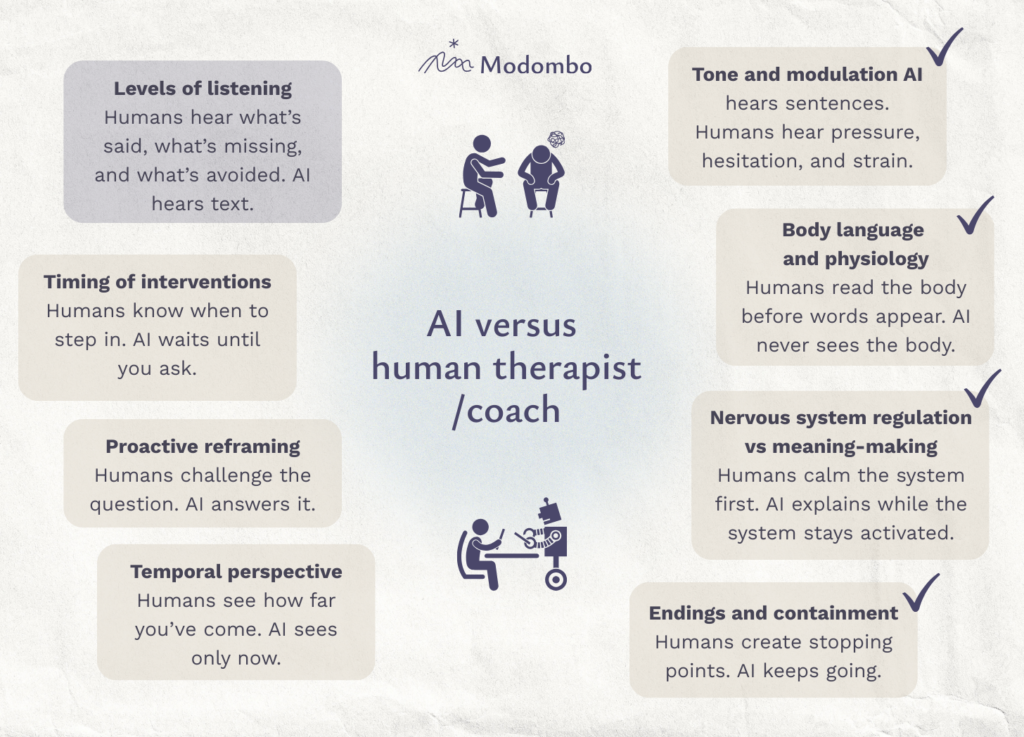
We’ll go step by step through several differences between AI as therapist and human care:
- Tone and modulation
- Body language and physiology
- Nervous system regulation vs meaning-making
- Levels of listening ← today
- Timing of interventions
- Proactive reframing
- Temporal perspective
- Endings and containment