Most overloaded people don’t burn out from pressure.
They burn out from being permanently available.
Overload isn’t created by what others ask of you —
it’s created by what you never say back.
That’s why boundaries matter far earlier than most people realise.
Not big, dramatic boundaries.
But small, soft, often invisible ones that protect your nervous system long before a crisis appears.
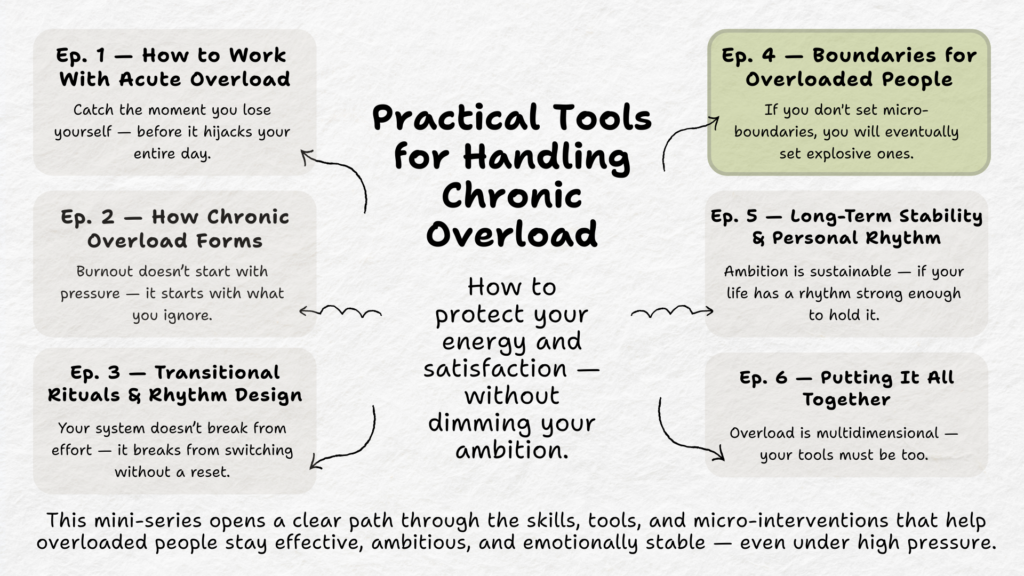
This LinkedIn version outlines the core ideas. The full Substack episode goes deeper — concrete examples, scripts, and how to apply them without conflict or guilt.
Why boundaries collapse under overload
When your nervous system is chronically activated, your ability to pause disappears.
You don’t choose to say yes. You react.
That’s why overloaded people don’t actually have a boundary problem — they have a permission problem.
They know what they need. They just don’t allow themselves to ask for it. Boundaries aren’t just communication. They’re physiology + permission + clarity working together.
Micro-boundaries: the tool most people miss
Most people think boundaries sound like confrontation. In reality, the most effective boundaries are micro-boundaries — short sentences that create just enough space for your system to stay regulated.
Examples:
- “Give me a moment.”
- “Let me finish this first.”
- “I’ll respond in a few minutes.”
- “I can’t shift to that right now.”
A small sentence can prevent a large collapse.
Why task switching drains you more than you think
Every interruption costs you twice:
- once when you stop
- once when you try to return
This is why “just one quick question” often destroys the next 20 minutes. Boundaries aren’t about being unavailable. They’re about protecting cognitive rhythm.
Emotional boundaries: the invisible load
Many overloaded people aren’t exhausted by tasks — they’re exhausted by emotional labor. Listening. Absorbing. Soothing. Mediating. Adapting.
Without clear emotional boundaries, your system never gets a transition. And without transitions, overload becomes inevitable.
The missing piece: permission
Almost everyone I work with knows what would help.
What they lack is permission:
- to pause
- to respond later
- to disappoint occasionally
- to protect their attention
You don’t build boundaries by learning better scripts. You build them by giving your nervous system priority. Once permission is there, language becomes simple.
Full version
The full episode on Substack breaks this down in detail — including real client stories, micro-boundary examples, and how to set boundaries without conflict, drama, or guilt.