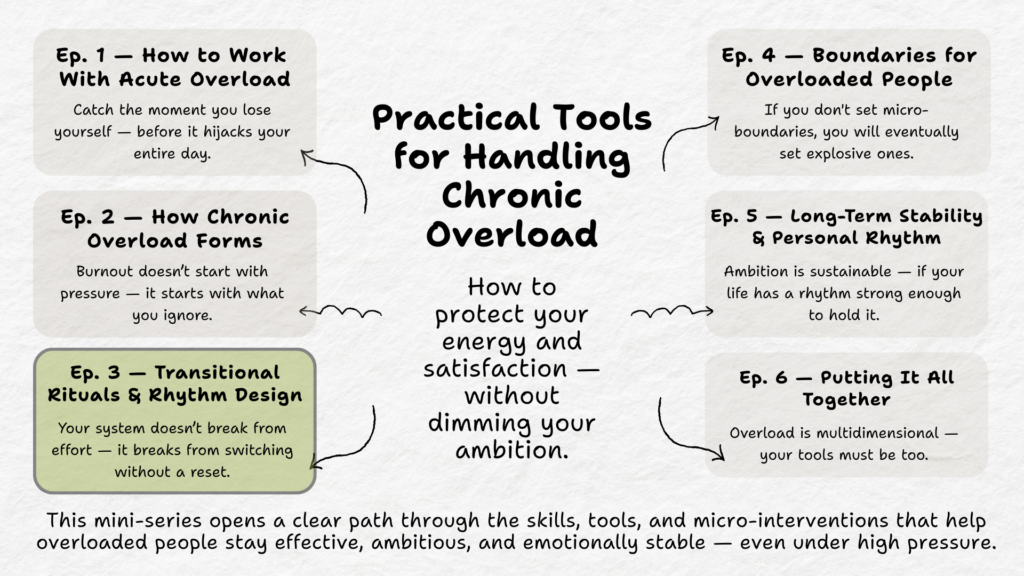
Overload doesn’t come from work intensity.
It comes from carrying the emotional residue of every task into the next one.
Most high performers aren’t defeated by what they do —
they’re defeated by how fast they force their nervous system to switch without recalibrating.
When you move from meeting → inbox → decision → colleague → family with no reset, your system stays in a single state: continuous activation.
That’s where chronic overload begins.
This LinkedIn version gives the core concepts. The full Substack episode includes the detailed protocols, client examples, and step-by-step rituals.
Why transitions matter
Overloaded clients often tell me:
“I didn’t even do anything that heavy today — so why am I exhausted?”
Because the fatigue comes from state changes, not tasks.
When we map their day, the pattern is always the same:
- emotional roles shift with no warning
- cognitive demands jump sharply
- sensory input spikes and never drops
- the system carries leftover tension forward
- no role is entered with a clean slate
Transitions are the blind spots of modern life.
They accumulate cognitive friction, emotional charge, and sensory noise — quietly pushing the nervous system past its natural thresholds.
Rituals are how you clear that residue.
The five key transitional rituals (compressed version)
1. Work → Home
Your home life collapses when you arrive in work mode.
A simple 3–5 minute ritual in the car or hallway — one sigh, one minute of stillness, one intentional shift — resets the emotional tone before you enter your next role.
2. Meeting → Deep Work
Deep work requires a different brain state.
A 90–120 second ritual (close laptop, slow exhale, one sentence defining the next goal) prevents the previous meeting from contaminating your focus.
3. Solitude → Social
Social spaces require a ramp.
Ground the feet, take one slow inhale, set a quiet intention:
“I choose how much energy I give.”
4. Emotional Role Changes
Advisor → negotiator → caretaker → fixer → partner → parent.
Each role has a different posture.
Name the shift, sigh once, let the system update:
“I’m switching roles now.”
5. Sensory Transitions
Fluorescent light → natural daylight → screen → noise → quiet.
A 60–90 second sensory reset (corridor, cold water, quiet corner) prevents irritability and emotional spikes later.
The principle behind rituals
Rituals are not aesthetics.
They are regulation through rhythm.
A ritual:
- marks the end of one role
- prepares the system for the next
- clears emotional residue (See the full version what exactly it is)
- creates predictable internal pacing
Your day is shaped less by tasks — and more by how you enter and exit those tasks.
Why rituals prevent chronic overload
Chronic overload forms when transitions pile up without resets, when your nervous system never drops below a certain activation line, when every role carries the emotional leftovers of the last.
Rituals break that chain.
Clients who implement even one ritual report:
- calmer evenings
- better focus
- fewer emotional spikes
- clearer boundaries
- more predictable energy
Transitions protect everything else.
Full version
The full Substack episode includes detailed instructions, specific client cases, and step-by-step rituals you can start using today.
Personal note
It took me years to apply transitional rituals consistently.
Once I did, I realised how much energy I had been wasting on avoidable tension, emotional residue, and the “mode confusion” that made even small tasks feel heavier than they were.
Even today I treat this as ongoing work — almost a craft.
During my entrepreneur and management years, these rituals saved me from unnecessary conflicts and bad moods that were actually symptoms of a system switching too fast.
My clients often find the same: once they start working with transitions, their nervous system responds far faster than expected.