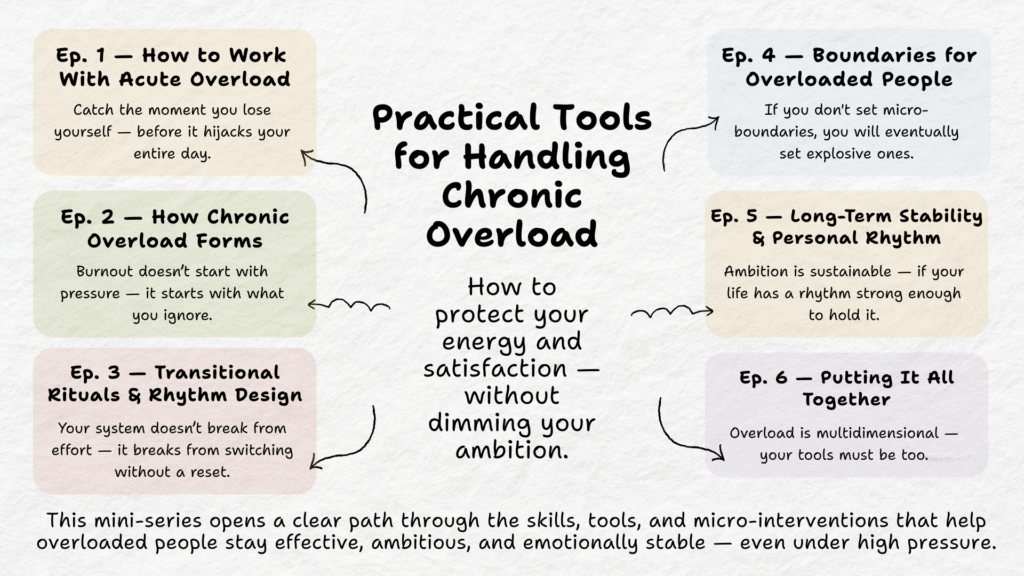
Over the past weeks several of my individual clients — completely independently of one another — told me the same thing:
“You explain the techniques for handling chronic stress and high overload at work so well in our sessions… why don’t you share them in your newsletter?”
What they meant was this: – that using these tools helps them stop acute overload before it explodes, – manage chronic stress without sacrificing ambition, – stay effective and genuinely satisfied, – and avoid drifting toward burnout even when life is demanding.
I work with people who are chronically overloaded — managers, founders, creatives, parents, experts, people who carry responsibility for teams, clients, or entire families. For many of them, these techniques became the difference between barely surviving pressure and functioning well under it, because the core pattern is always the same: too much intensity, too little recovery, and almost no guidance on how to protect the nervous system in everyday life.
All of this would be far too much for a single article — not just because of the volume, but because these techniques are skills, not just information. They need practice, repetition, and a way to actually learn them.
So on LinkedIn I’m sharing the outline — the essential ideas. And on Substack, in the longer version, I walk through the full method step by step. This is the beginning of a mini-series, each episode exploring one pillar you can immediately apply.
And we start where the whole overload cycle begins: with acute overload.
Episode 1 — How to Work With Acute Overload
(Free version — the full guide is on my Substack)
Most people think overload is something that develops over weeks or months. But for overloaded high performers, the real damage usually starts in the first seconds.
That’s the moment when clarity drops, emotions jump, and the nervous system flips into a mode where thinking becomes optional and reacting becomes automatic. And here’s the uncomfortable truth:
Your day usually doesn’t fall apart because of too much work. It falls apart because of one moment you didn’t catch in time.
Over the years, many clients told me the same thing:
“If I could just control those first seconds, everything else would be easier.”
They’re right. Acute overload is the beginning of the spiral. If you stop it early, the whole day changes.
The small tool that prevents big consequences
In my practice, we work with a technique called STOP–PAUSE–PROCEED. It’s quick, deceptively simple, and often prevents the exact reactions people later regret. Here is the very short version — the “free sample”:
STOP:
Notice the spike — tension, sharp breath, internal pressure.
PAUSE:
Interrupt the chain reaction. A slow exhale, closing your eyes for a few seconds, loosening your jaw, looking away, or stepping back.
PROCEED:
Respond from clarity rather than the emotional spike. Even 10 seconds can prevent a conflict, a sharp tone, or a comment you’ll ruminate about for hours.
Different clients use it differently:
- A senior manager reduced almost all of his reactive outbursts
- A creative freelance woman with panic spikes learned to delay her response by 15–20 seconds and stabilised her work relationships
- A chronically overstimulated mother found her evenings dramatically calmer when she inserted a pause before answering emotionally loaded requests
And yes — this is not “knowledge.” It is a skill, and it must be practiced until it becomes automatic. In the full version on Substack, I describe how to actually build this skill step by step.
One micro-regulation tool you can try today
Here is one fast technique from the full list:
Close your eyes for 10–20 seconds + take one slow inhale.
It drops amygdala activation, brings the prefrontal cortex back online, and stops the reactive cascade. It takes less time than opening your email. Try it once today. You’ll notice the difference.
More tools, and the method for turning them into habit, are in the full Substack version of this episode.
What’s inside the full version (see my Substack)
The premium version contains:
- the complete STOP–PAUSE–PROCEED training
- 7 micro-regulation tools
- simple explanations of the neuroscience
- real client stories
- tools for preventing guilt, reactivity, and evening exhaustion
- how to turn acute overload into clarity instead of collapse
If acute overload shows up in your daily life, these tools won’t just change one moment —
they will change the entire trajectory of your days.
Unlock the full guide below.