This is an archive version. For all new articles, extended editions, and full resources, visit my newsletter on Substack.
—
Seeing the problem only in yourself can be dangerous. Sometimes, the cure isn’t introspection — it’s context correction.
—
What it’s about
Successful, but not happy. Others would say you have everything — yet you don’t feel like that. Many people in this situation start believing it’s their fault. They assume something inside them is broken. But that’s not always true. Sometimes the problem isn’t internal — it’s environmental. It’s about relationships and settings that no longer fit who you are.
—
What’s happening
Many high performers succeed in environments or relationships that quietly drain them. They keep functioning — but the cost is rising.
Examples:
- A brilliant expert promoted to management, who misses the focus and depth of her previous analytical work.
- A devoted mother caring flawlessly for her children, but inwardly longing to build her own career.
- A dynamic extrovert trapped in a solitary, detail-heavy role that leaves no room for connection.
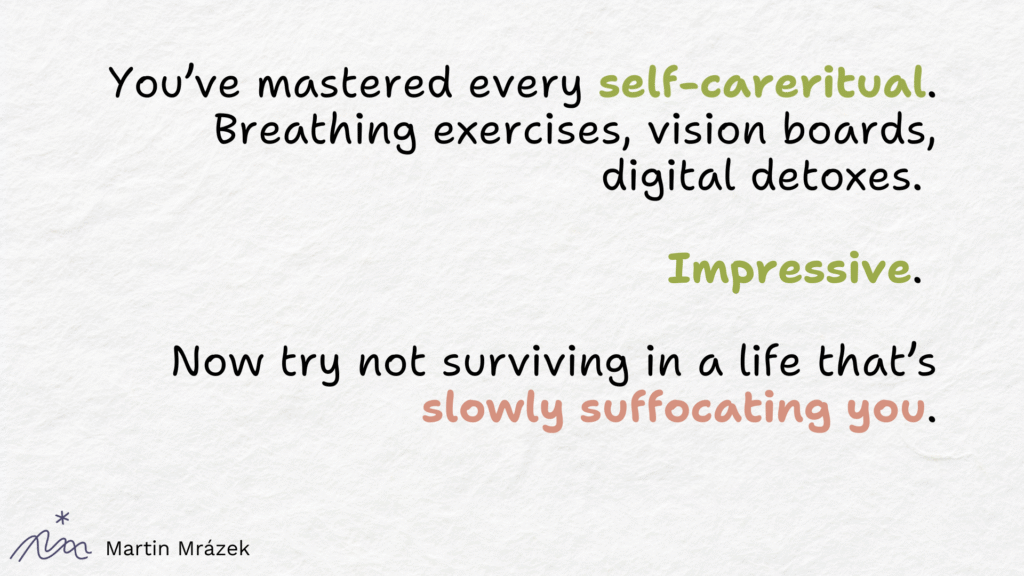
- A startup founder who sold his company and now reports to corporate hierarchy — and feels like he’s suffocating.
- An ADHD professional working under rigid deadlines and endless meetings, forced to maintain focus by sheer willpower.
- A highly sensitive person who becomes a public influencer, overwhelmed by constant exposure.
- A thoughtful introvert in a nonstop social environment, smiling while slowly burning out.
- A leader who thrives on vision but spends 90% of the day firefighting and managing Excel sheets.
These people try to live up to expectations instead of listening to their inner compass. It’s shocking how many never realize they’re simply operating in the wrong context. Instead, they ask: “What’s wrong with me? Why can’t I feel joy?”
They mistake misalignment with their values and character for mental disorder. They say, “I’m depressed,” “I’m anxious,” “I’ve burned out,” when in fact they’re just toxicly adapted to a life that doesn’t suit them. It’s easier — at least short-term — to say “I’m just not okay” than to change your environment.
—
The result
The body and psyche eventually protest: Anxiety. Sleep problems. Irritability. Emptiness. Sometimes even physical pain. You pass depression tests, start medication — but the real cause remains untouched.
It’s sad how many people take antidepressants or spend years in therapy, trying to tolerate situations they could actually change — if only they had the energy or courage to do so.
—
What now
Seeing the problem only in yourself can be dangerous. Sometimes, the cure isn’t introspection — it’s context correction.
Ask yourself honestly:
- I’ve achieved a lot — but do I still feel alive doing it?
- We’re not fighting — but is this relationship truly nourishing me?
- How often can I say no to external demands or others’ expectations?
- Does pressure motivate me — or does it only drain me?
- Do I automatically assume every mistake is my fault?
- Do I feel guilty when I take time for myself?
- Is my peace built on compliance — or authenticity?
You don’t always have to burn bridges. Sometimes, a few adjustments in rhythm, boundaries, or environment restore balance more effectively than years of self-blame.
—
Tip
Not every pain is pathology. Sometimes it’s valuable data — your system telling you what no longer fits. Listen before you label. Think of your context before you diagnose yourself. If these questions feel uncomfortable, or if they spark guilt or defensiveness, it may be a sign that you’ve stayed too long in an unhealthy context. Use journaling, honest conversations, or counseling to explore what would make your life more sustainable.
—
Personal note
I learned this lesson the hard way. During university, I worked as a radio journalist — a terrible idea for someone with ADHD. Later, as a corporate director, I discovered that I’m basically a solo operator trying to function inside a ten-person conference call. I didn’t feel well. Leaving management and returning to independent, therapeutic and creative work wasn’t a failure — it was context correction. And it turned out to be the healthiest decision of my life.
—
Want to go deeper?
This piece is part of a broader series on Substack, where I share full extended editions — including tools like these diagnostics, deeper explanations of each question, and practical ways to adjust your context without burning out or burning bridges.
The extended versions also include more examples from practice and additional guidance on alignment, boundaries, pressure, and sustainable life design.