This is an archive version. For all new articles, extended editions, and full resources, visit my newsletter on Substack.
—
What it’s about
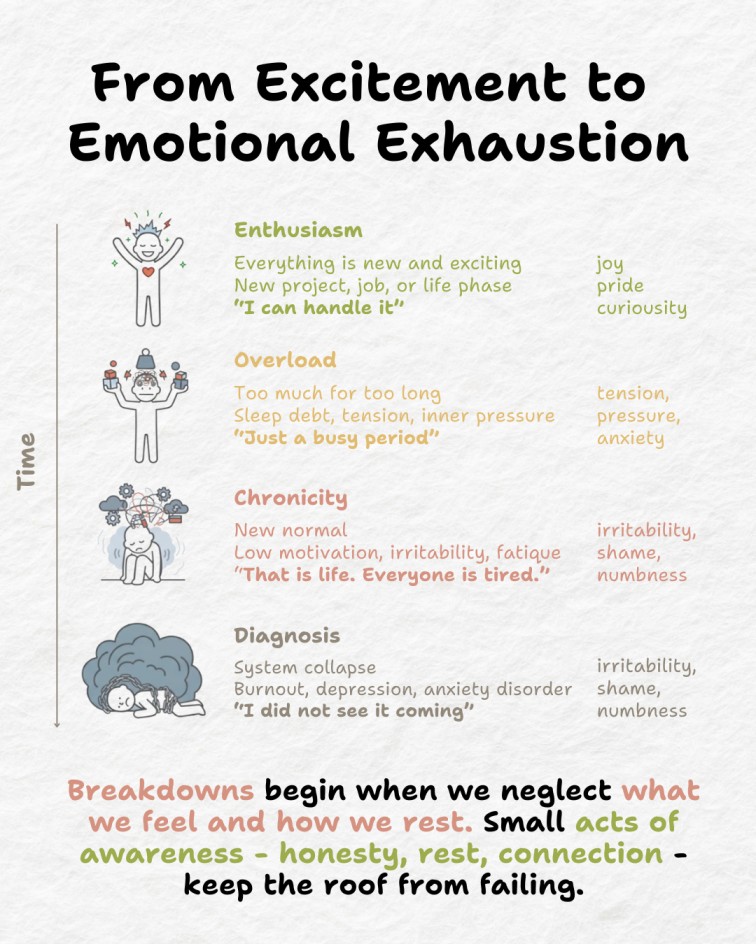
Chronic overload is not a diagnosis — but if you ignore it long enough, it often turns into a psychological or physical illness.
Example story: Marie managed everything for years — with ease and a smile:
- Her university program was exceptionally demanding, with high expectations for students.
- Alongside it, she competed in sports at a high level.
- She pushed herself to the limit but held it together.
- Then came her first job in a prestigious company. Excitement about getting in drove her performance to 150%. Then her first child — and the care that followed.
—
About a year after returning to work, frequent anxiety appeared:
- Her sleep never returned to normal, and during the day came unbearable fatigue.
- She started coping by starving herself, but her performance kept declining — and with it, her self-confidence.
- She completely stopped doing the sport she once excelled at — she simply had no energy left.
- Soon came the signs of depression and burnout.
—
What’s happening
You function for a long time in the mode of “I can handle it — but it’s too much.”
- Expectations are high.
- Acceptance of failure — low or zero.
- You operate in a culture where you go either up or out.
—
There’s too little space to feel even brief moments of comfort. You slowly start questioning meaning.
BUT – that’s the proverbial tip of the iceberg.
—
Beneath the surface, there’s usually:
- an identity built on success and performance,
- an inability to say “no” — or to say it in all the moments when it’s needed,
- a need to please others at your own expense,
- or the belief that you’re the one who must hold everything together — work, home, relationships.
—⠀
The result
Dissatisfaction. Fading sense of meaning. Emptiness. Chronic exhaustion. Or – You function like a machine. You perform — but you don’t feel.
The body keeps compensating — but each month, it gets harder. Fatigue fades more slowly. Mood swings become stronger.
—
What now
This is a crossroads:
- You can just keep going…
- But then words like depression, burnout, anxiety disorder, and others start appearing.
Don’t wait until it crosses the threshold into diagnosis.
- You get signals of overload long before it becomes a disorder.
- Overload often starts in the phase of enthusiasm — when things are new, motivation is high, and taking on too much begins to feel normal.
—
Tip: The best treatment starts before there’s a diagnosis.
- It’s like with a house: if you maintain it regularly, it’s a nuisance — but nothing serious happens.
- Ignore it for years, and one day the roof collapses on your head.
It’s the same with your mind. Just notice how you feel once in a while, and ask yourself: Is this fine? OK? Or am I just running on autopilot?Just surviving?
If your answers to those questions haven’t been good for some time, it’s time to act — and prevent the roof from falling on your head.
—
About me
I started out as a startup entrepreneur. After successfully selling my company, I became a corporate director. In the end, I left that career and turned my long-time passion into a profession: I became a full-time therapist and coach. I help high performers overcome overload and rediscover satisfaction in their lives.
—
Want more?
Subscribe to my newsletter on Substack or follow me here on LinkedIn.